Key Takeaway
- Stone-look surfaces replicate the visual character of marble, granite, slate, and concrete through engineered manufacturing, without the porosity or sealing requirements of natural stone.
- Sintered stone Singapore homeowners increasingly use covers the widest range of applications, from kitchen countertops to outdoor feature wall panels, because its resin-free composition handles heat, UV exposure, and humidity.
- Engineered stone finishes have advanced to the point where high-quality stone-look surfaces are visually indistinguishable from natural stone in a finished installation.
- The difference in maintenance between a stone-look engineered surface and actual marble or granite is significant: engineered surfaces need no sealing, no etching treatment, and no specialist cleaning products.
- Choosing the right stone-look finish for each room, whether marble-effect, concrete-effect, or slate-effect, determines how convincing and how practical the result is in a Singapore home.
Introduction
Walk through any well-designed Singapore condo renovation or HDB transformation in the past five years and you’ll likely find a marble-effect surface somewhere. On the kitchen countertop, behind the vanity, on the living room feature wall, or across the bathroom. What looks like marble usually isn’t. And in most cases, that’s the point.
Stone-look surfaces have become one of the defining material choices in modern Singapore interiors. Not as a budget substitute for the real thing, but as a considered material decision in their own right. The technology has improved to the point where a sintered stone panel in a marble finish, book-matched across a feature wall, produces an effect that a natural marble slab couldn’t guarantee, even at a higher cost.
This guide covers what stone-look surfaces actually are, how the main types differ, where they work best in a Singapore home, and what makes the difference between a stone finish that convinces and one that doesn’t.
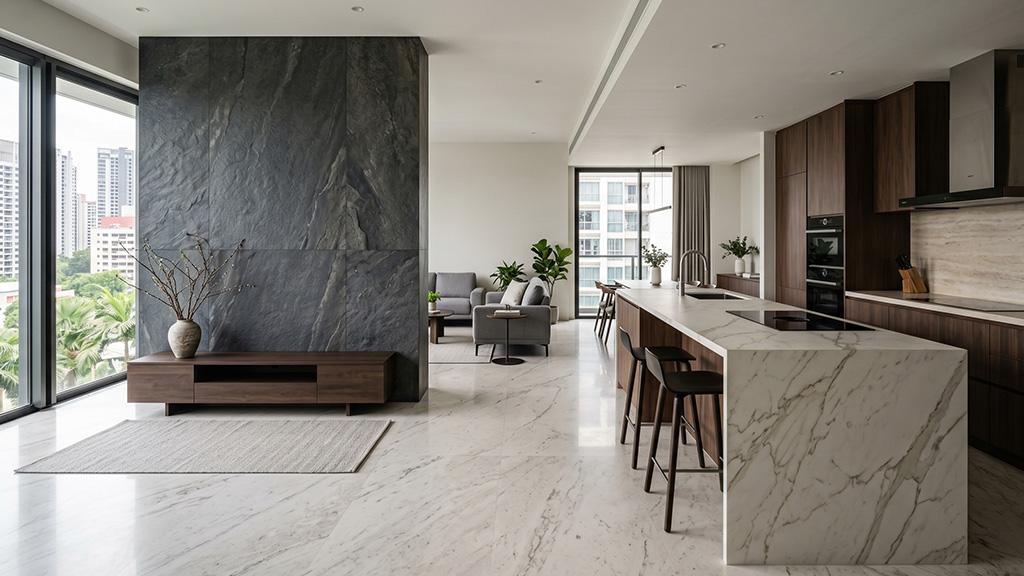
What Are Stone-Look Surfaces?
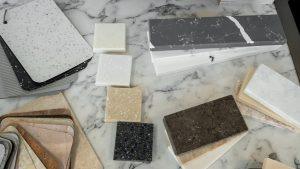
Stone-look surfaces are engineered surface materials manufactured to visually replicate the appearance of natural stone, including marble, granite, slate, travertine, and concrete, without using quarried rock as the primary substrate. They fall into two main categories. Engineered stone surfaces, including quartz, use crushed natural minerals bound with polymer resins to create a dense, non-porous slab. Sintered stone surfaces, including brands such as Dekton and Neolith, fuse natural minerals under extreme heat and pressure with no resin, producing a denser and more heat-tolerant slab. Both categories are available in a wide range of stone-look finishes, with digital printing and surface texturing techniques advanced enough to replicate the veining, depth, and mineral variation of natural stone at the manufacturing stage.
How Stone-Look Technology Has Changed the Material Landscape
Five years ago, a confident interior designer could tell the difference between a stone-look engineered panel and a real marble slab by the flatness of the pattern. The veining repeated. The depth wasn’t there. The texture felt uniform in a way that natural stone never is.
That gap has largely closed. Modern sintered stone in Singapore is produced using high-resolution digital printing layered with surface texturing that varies the finish across the slab. Book-matching, where two adjacent slabs are mirror-image cuts of the same pattern, creates the kind of continuous veining that makes a feature wall read as one unbroken piece of stone rather than two panels. The effect works because the eye processes the pattern as natural variation, not manufactured repetition.
Engineered stone has followed a parallel path. Quartz surfaces now come in designs that closely replicate the macro-veining of Calacatta marble, the grey tonal depth of Pietra Grigia, and the cream-and-gold layering of Botticino. The visual result, photographed in a finished kitchen, is genuinely difficult to distinguish from natural stone.
What doesn’t close the gap is tactile quality and uniqueness. A real marble slab has a coolness and weight underfoot or underhand that engineered surfaces can only approximate. And because each piece of natural stone is geologically unique, the visual variation of actual marble has a randomness that engineered patterns, however sophisticated, cannot produce to a repeating specification. For most Singapore interiors, that distinction doesn’t matter. For homeowners who specifically want the irreproducibility of natural stone, it does.
“Stone-look surfaces have moved past imitation. At their best, they’re a design material in their own right, chosen for what they offer, not for what they approximate.”
Where Stone-Look Surfaces Work Best in Singapore Homes
Kitchen Countertops and Islands
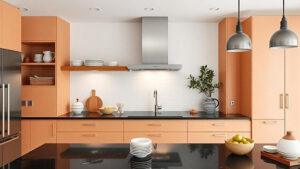
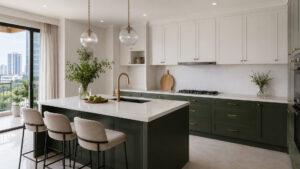
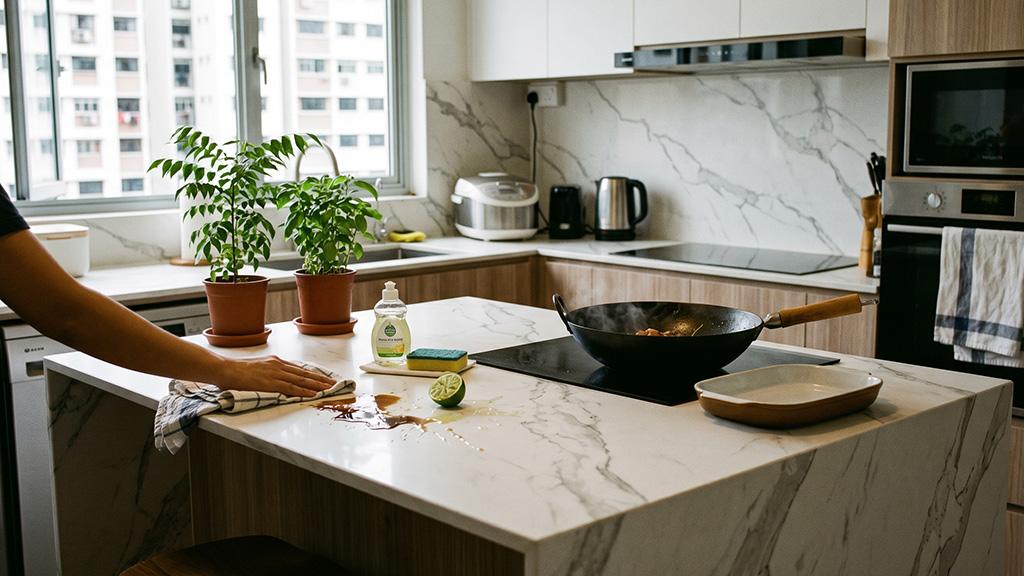
The kitchen is where the maintenance argument for stone-look surfaces is most decisive. A marble-effect engineered stone countertop delivers the visual richness of Calacatta marble in a cooking environment where actual marble would etch, stain, and absorb oils without regular sealing. Acidic substances common in Singapore cooking, including lime juice, vinegar, and soy sauce, sit on the surface of an engineered stone countertop and wipe off cleanly. On natural marble, they react with the calcite in the stone and leave permanent dull marks.
Sintered stone Singapore kitchen countertops extend this advantage further. The resin-free composition handles direct heat from a wok or a hot pot without any surface damage. A marble-effect sintered stone island can have serving dishes placed directly on it straight from the hob. For a household where entertaining and cooking happen in the same open-plan space, that freedom changes how the kitchen is used.
Caesarstone’s care and maintenance guide confirms that engineered quartz surfaces are non-porous and non-absorbent, requiring only warm soapy water for regular cleaning with no specialist products or sealing at any stage.
Feature Wall Panels
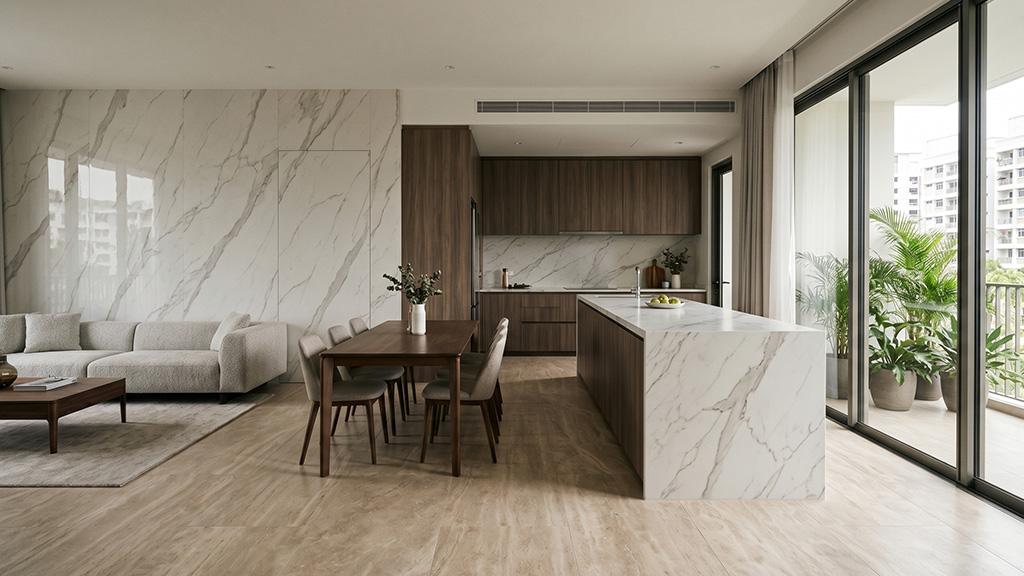
Feature wall panels in stone-look finishes have become one of the most requested applications in Singapore renovation briefs. A living room TV wall clad in large-format sintered stone with a marble or concrete effect transforms the visual weight of the room in a way that paint or wallpaper cannot produce.
The format matters as much as the pattern. Large-format sintered stone panels, some up to 3,200mm by 1,440mm, allow a full feature wall to be covered with minimal or no visible seams. When two panels are book-matched, the veining creates a symmetrical pattern that draws the eye and reads as intentional rather than incidental. The visual result depends entirely on the fabricator’s ability to match and place the panels correctly.
Concrete-effect sintered stone has also gained significant traction for feature wall panels in Singapore interiors with a Japandi or industrial-modern aesthetic. The texture replicates the tonal variation of polished concrete without the installation complexity that real microcement or concrete overlays require.
TSD’s overview of sintered stone wall panels covers the installation process, panel formats, and how to plan lighting to maximise the effect of a stone-look feature wall in Singapore homes.
Bathroom Vanities and Shower Walls
Bathrooms in Singapore are where natural stone most clearly reveals its limitations. Marble absorbs moisture, requires sealing, and can develop staining and discolouration in wet areas over time. A marble-effect sintered stone vanity top or shower wall panel delivers an identical aesthetic in an environment where natural marble would need continuous maintenance.
Full-height stone-look panels in a bathroom, running from floor to ceiling in a single slab behind the vanity, create the spa effect that Singapore homeowners consistently reference as a renovation goal. The non-porous surface sheds moisture and resists the cleaning products used in bathrooms without degrading. In a shower enclosure, a grout-free sintered stone panel is both more hygienic and more visually resolved than tiled alternatives.
TSD’s guide to sintered stone countertops and surfaces in Singapore covers the material’s moisture resistance in detail, relevant to bathroom and wet area applications.
Choosing the Right Stone-Look Finish
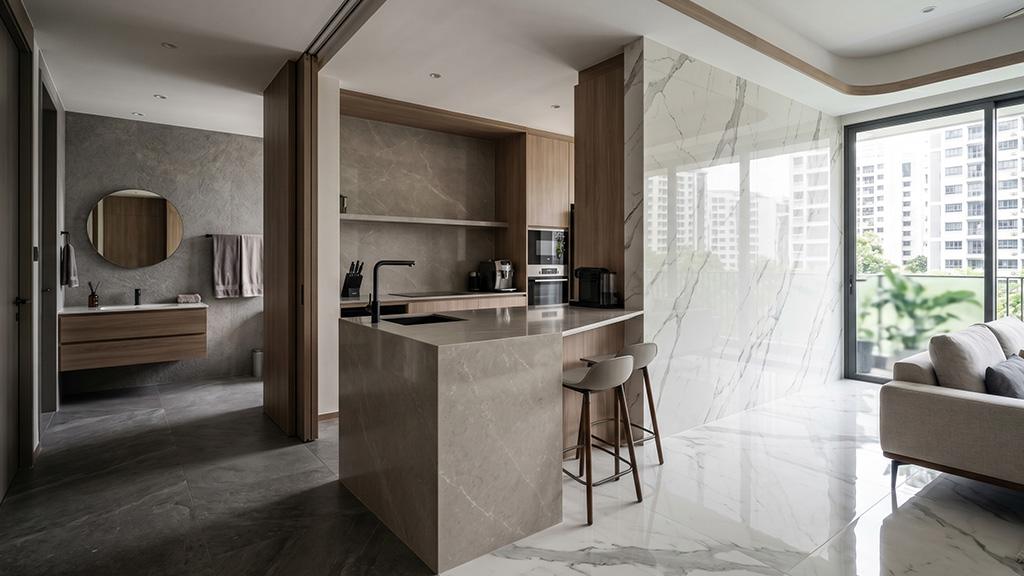
The finish on a stone-look surface, whether polished, matte, honed, or textured, determines how the pattern reads and how the surface performs in each application.
Polished finishes reflect light and make colour and veining appear most vivid. They suit living room feature wall panels and kitchen countertops in well-lit rooms. Polished surfaces are slippery when wet and should not be used on bathroom floors or wet room surfaces without anti-slip treatment.
Matte finishes absorb light and produce a softer, warmer visual effect. They suit bedrooms, Japandi-style interiors, and bathrooms where the goal is calm rather than drama. Concrete-effect and slate-effect patterns read best in matte finishes because the diffuse surface texture reinforces the organic quality of the pattern.
Honed finishes sit between polished and matte. The surface is smooth without sheen. They suit kitchens and contemporary bathrooms where a mid-range reflectivity is preferred. Honed surfaces need slightly more cleaning attention than polished surfaces because the open texture holds onto residue more readily.
Textured finishes include surfaces that replicate the physical dimensionality of rough stone. These suit outdoor applications, shower floors, and areas where grip matters. Textured sintered stone is UV-stable and handles exterior use in Singapore’s climate without fading or degrading.
As This Old House notes in their flooring guide, natural stone and stone-look porcelain perform differently in high-moisture environments: engineered surfaces with non-porous construction handle moisture without degrading, while natural stone requires sealing and regular maintenance to stay resistant.
“The finish on a stone-look surface does more than change how it looks. It changes how the pattern reads, how the room feels, and how the surface handles the conditions it’s placed in.”
Stone-Look Surfaces Across the Whole Home
One of the design advantages of stone-look surfaces is their ability to create visual continuity across rooms. A home where the kitchen countertop, the bathroom vanity, and the living room feature wall all use the same marble-effect pattern, or coordinated variations of the same stone family, creates a considered visual thread through the space. Natural stone makes this hard: matching slabs from the same quarry batch is difficult and expensive. Engineered stone makes it straightforward because the same pattern is produced consistently across multiple slabs.
For Singapore open-plan layouts where the kitchen, dining, and living areas exist as one connected space, this continuity is particularly relevant. A marble-effect sintered stone countertop that visually relates to the concrete-effect feature wall panels in the living zone creates a design dialogue between surfaces without requiring them to be identical.
For floor applications, stone-look surfaces in large-format formats reduce visible grout lines and create a cleaner, more continuous plane than smaller tiles. TSD’s floor tiles and surfaces guide for Singapore covers how stone-look flooring materials perform across different room types and design directions.
Are Stone-Look Surfaces the Right Choice for Your Singapore Interior?
Stone-look surfaces suit Singapore homeowners who want the visual character of natural stone across their home without the sealing requirements, etching risk, or ongoing maintenance that natural marble and granite demand. Engineered stone delivers this in countertop and indoor surface applications. Sintered stone Singapore extends it to feature wall panels, outdoor areas, and any surface that needs direct heat resistance or UV stability. The right finish choice for each room determines how convincing the result is and how well it holds up in daily use.

Frequently Asked Questions
1. What are stone-look surfaces made from?
Stone-look surfaces are engineered surface materials that replicate the appearance of natural stone through manufacturing rather than quarrying. The two main types are engineered quartz, made from crushed quartz and polymer resin, and sintered stone, made from natural minerals fused under extreme heat and pressure. Both are non-porous and require no sealing.
2. How convincing are stone-look surfaces compared to real marble or granite?
High-quality stone-look surfaces in sintered stone or engineered stone are visually very close to natural marble and granite in a finished installation. The main differences are tactile quality and uniqueness: natural stone has a physical coolness and geological variation that engineered surfaces approach but don’t fully replicate. For most Singapore interiors, the visual result of a good stone-look surface is indistinguishable from natural stone in photographs and in person at normal viewing distance.
3. Can stone-look surfaces be used as feature wall panels in Singapore?
Yes. Large-format sintered stone panels are one of the most popular feature wall panel applications in Singapore renovations. They’re available in marble-effect, concrete-effect, and slate-effect finishes, and can be book-matched for continuous veining across a wall. The non-porous surface requires no sealing and handles Singapore’s humidity without degrading.
4. Do stone-look engineered surfaces need to be sealed?
No. Both engineered quartz and sintered stone are non-porous by manufacture and never require sealing. This is one of the most significant practical differences from natural marble and granite, which need periodic sealing to resist moisture and staining. It’s particularly relevant in Singapore’s humid climate.
5. Which stone-look surface is best for a Singapore kitchen?
Sintered stone in a marble-effect or concrete-effect finish suits Singapore kitchens best because its resin-free composition handles direct heat from a gas hob without risk of surface damage. Engineered quartz in a stone-look finish is also practical and lower in cost, but requires trivets near the hob. Both are non-porous and resist staining from the acidic ingredients common in Singapore cooking.
Stone-look surfaces have earned their place in Singapore interiors not as a substitute for natural stone but as a material category that solves the specific challenges of a working home in a tropical climate. The visual quality is there. The maintenance argument is clear. And the range of available finishes, from Calacatta marble to rough concrete to veined slate, covers most design directions a Singapore homeowner might pursue.
If you’d like to see stone-look surfaces across formats, finishes, and material types in person, TSD’s full range of sintered stone and engineered stone surfaces is available at their Singapore showroom, with in-house fabrication and installation handled end to end.