Key Takeaways
Edge profiles are a design decision and a practical one, both carry equal weight. The profile you choose affects the visual weight of your counter, how the edge interacts with light, and how the surface feels to stand at and lean against.
Material compatibility determines which profiles are available to you. Thin engineered stone, for instance, cannot support the same deep sculpted profiles that a thick granite slab can carry. Surface fabrication expertise is what bridges the gap between what you want and what your chosen material can actually deliver.
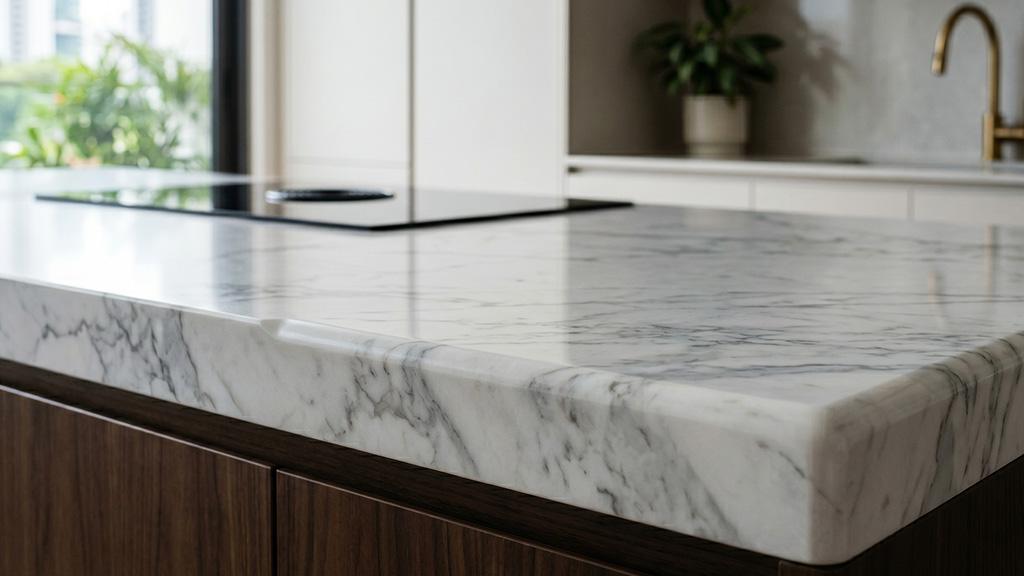
Edge thickness changes the perceived weight of the whole counter. A standard 20mm slab with a waterfall mitre looks substantial and contemporary. The same slab with a pencil edge looks light and minimal.
Safety and cleaning should inform profile choice before aesthetics do. Households with young children, plus the elderly family members, or heavy cooking use have different edge requirements than a show kitchen.
The fabrication quality of the edge matters as much as the profile design. A bullnose edge cut and polished by an experienced fabricator on the right equipment will outlast the same profile produced in a hurry on dull tooling.
Introduction
Most homeowners spend considerable time choosing the right surface material, colour, thickness for their kitchen counter, and then select the edge profile in the final five minutes of a fabrication consultation. That is a mistake worth correcting.
Countertop edge profiles as we do more than finish a raw slab edge. Grand View Research estimates the global countertops market will exceed USD 267.38 billion by 2033, driven largely by demand for longer-lasting, lower-maintenance kitchen surfaces. This choice determines whether your slab stays pristine or develops unsightly chips within the first two years. We shape how your entire kitchen reads from across the room.
It’s our job to make comfortable the counter is to work at, how easily it cleans, and how the surface wears over years of daily use. This guide works through the profile options available, the practical considerations that narrow the right choice for your kitchen.
Why Edge Profiles Deserve More Attention Than They Usually Get
Walk into most kitchen showrooms and the edge profile conversation happens at the end, almost as a formality. The material has been chosen, the layout finalised, and the profile is presented as a minor finishing option, a brief visual choice between a few samples on a board.
In reality, the edge profile is one of the most visible elements of a finished kitchen counter.
It’s the little details that catch light differently as the day goes by, and visitors suddenly notice when they lean against the counter. Your hands feel every single time you work there.
Also, it is the section of the counter most exposed to impact, chipping, and everyday wear, because it sits at the outermost edge of a surface that gets regularly slid past, bumped into, and knocked with cookware.
A countertop edge profile is shaped at the meeting point of aesthetics, material science, and fabrication craftsmanship. Picking one good option really means you think through all three sides of it, not only which profile seems right in a photo.
The Main Countertop Edge Profile Types
Edge profiles fall into four broad families based on their shape character: straight profiles, rounded profiles, bevelled profiles, and decorative profiles. Within each family, there are variations in depth, radius, and detail that produce meaningfully different visual outcomes.
How Edge Thickness Shapes the Whole Kitchen?
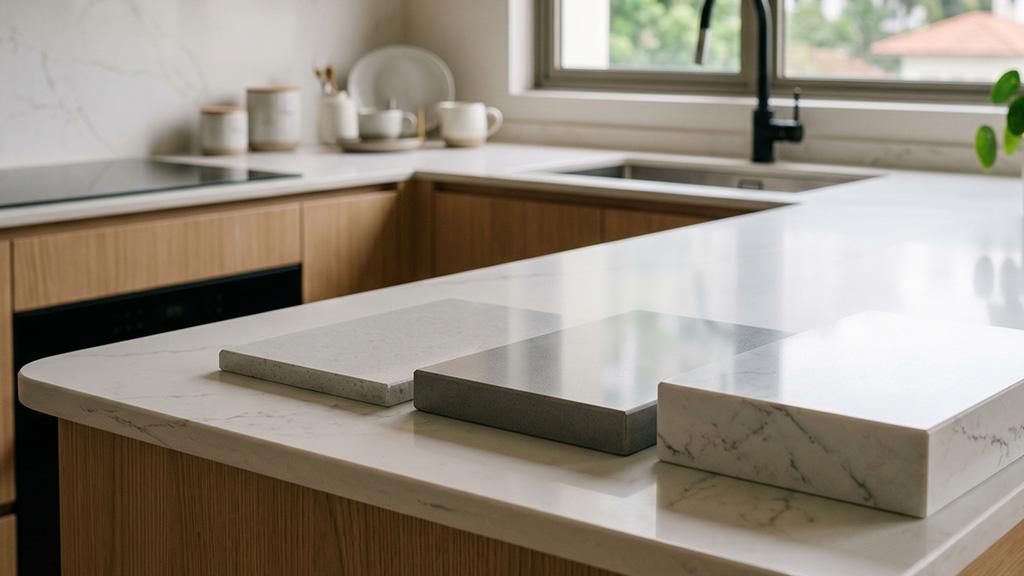
Before choosing a profile shape, the thickness of the counter edge needs to be settled, because thickness determines which profiles are even achievable, and it fundamentally changes the visual character of the finished surface.
Countertop edge profiles are executed on slabs that typically come in three standard thicknesses: 12mm (thin format), 20mm (standard), and 30mm (premium/thick). Each creates a different edge presence, and each carries different fabrication implications.
The laminated edge option is worth understanding in detail. By bonding a strip of matching material to the underside of the slab edge, fabricators can create an edge that reads at 40mm or even 60mm thickness from the front, while the actual slab remains at 20mm.
This approach delivers much of the visual impact of a thick slab at a meaningfully lower cost, provided the mitre joint is cut and bonded with precision. A visible gap or colour mismatch in that joint will be noticed every time someone looks at the counter.
Which Profiles Work With Which Surfaces?
One of the most common misunderstandings in kitchen countertop design consultations is the assumption that any profile can be applied to any material. Surface fabrication does not work that way.
Some materials are too brittle to hold certain profiles; others are too thin; others require specialist tooling to achieve a finish that does not show grinding marks or rough patches.
An experienced surface fabrication specialist will advise on the specific product you have chosen, not just the material category.
Safety and Household Considerations That Get Missed
Aesthetics and material compatibility are the most discussed aspects of countertop edge profiles, but for many households, the dimensions of safety, cleaning ease, and daily durability matter just as much.
Sharp edge profiles: Particularly the arris/eased edge at standard or thin slab thickness, present a genuine impact risk for young children at counter height, and for adults in kitchens where space is tight.
Rounded profiles: Bullnose, half bullnose, pencil edge, are significantly more forgiving on impact and are the preferred choice for family kitchens, galley-style layouts with limited movement space, and any kitchen where elderly family members spend regular time.
Bevelled profiles sit in the middle: The angled face reduces the sharpest right-angle contact but still presents a relatively hard edge on impact compared to a radius profile.
These considerations tend to surface after installation rather than before it, which is why covering them at the selection stage saves a good deal of frustration later.
The Fabrication Process: Why Execution Quality Defines the Final Result?
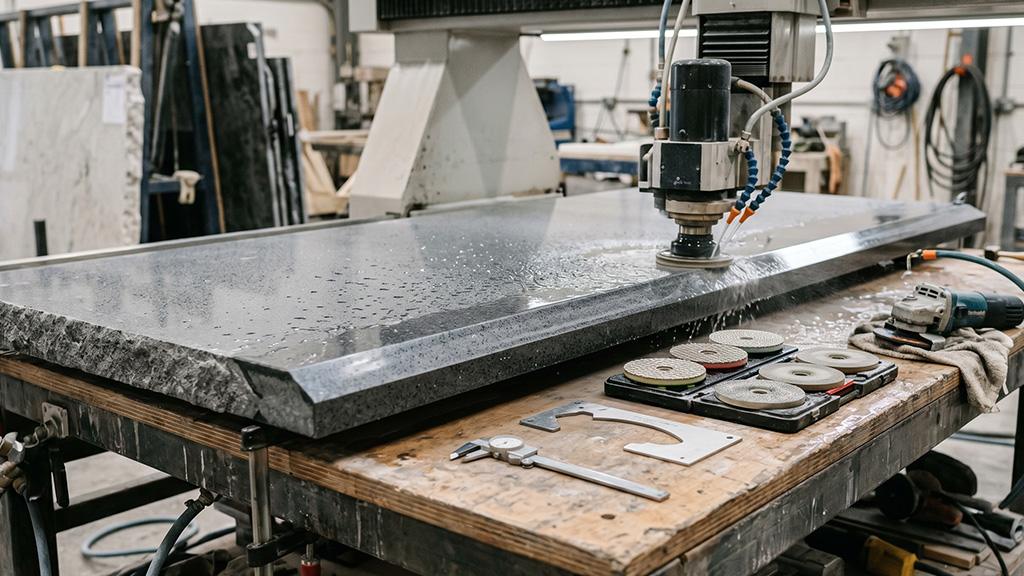
Surface fabrication for kitchen counters involves cutting the edge profile using CNC (computer numerical control) machinery or manual grinding and polishing, depending on the profile complexity and the fabricator’s setup. Several factors in this process have direct bearing on the quality of the finished edge:
Tooling condition and specification: Worn or mismatched diamond tooling produces profiles with grinding marks, inconsistent radii, and dull finish sections.
Polishing sequence and stages: The number of polishing grits used to take the profile from cut to finished surface affects both the gloss level and the durability of the edge finish.
Seam placement and bonding on laminated edges: For laminated boost edges and waterfall mitres, the precision of the mitre cut and the quality of the adhesive bond determine whether the seam is invisible or visible. A 0.5mm gap in a mitre joint collects debris and is immediately noticeable on a continuous-grain slab.
Material-specific finishing requirements: Porcelain and ultra-compact surfaces require diamond tooling rated for their specific hardness. Using general-purpose stone tooling on these materials risks chipping, cracking along the edge, or a finish that is inconsistent in sheen.
Template accuracy: The template that the fabricator takes from the installed cabinets determines how precisely the finished slab fits the space.
These are not abstract concerns. They are the specific fabrication variables that experienced homeowners, and interior designers who commission kitchen projects regularly, learn to ask about before awarding a fabrication job.
Which Questions You Should Ask Before Confirming Your Edge Profile?
Armed with the profile types, material compatibility, safety considerations, and fabrication quality dimensions covered above, the final step before confirming a profile choice is a direct conversation with your fabricator. The questions below are the ones that separate from one made on assumption.
1. Can you show me a polished sample of this profile in my specific material?
Not a catalogue image, a physical sample cut from the same material or a closely equivalent one.
2. Does this profile work at the thickness I have specified, or do I need to adjust the slab thickness or use a boost edge?
This question surfaces material compatibility issues before the slab has been cut.
3. How does the profile handle across an inside corner, and is there a different approach at the sink cutout?
Inside corners and sink edges are where profile execution is most technically demanding, and where shortcuts are most likely to show.
4. What is the finish level on this profile, polished, honed, or leathered, and does it match the top surface finish?
A polished edge on a honed surface creates an inconsistency that is rarely intentional and usually unwelcome.
5. What is your approach if the profile chips during fabrication?
An honest fabricator will have a clear answer about repair options, replacement protocols, and how they handle material damage during the process.
6. How do you recommend I maintain this profile once it is installed?
This question tests both the fabricator’s knowledge of the material and gives you the cleaning information you need before installation, not after.
Conclusion
The edge profile on a kitchen counter is a small-scale detail with a disproportionate effect on the finished space. It shapes how the surface reads visually, how it performs practically, and how it wears over years of daily use.
Most of the decisions that determine a good outcome, material compatibility, slab thickness, fabrication quality, household practicality, are made before a single cut, which is exactly why this detail deserves more than five minutes at the end of a showroom visit.
TSD gives you custom stone fabrication, backed by decades of residential and commercial experience, so it’s easier for homeowners to pick the right materials, slab thicknesses, and countertop edge profiles that fit both aesthetics and durability.
From clean pencil edges, bevel profiles, waterfall mitres, and detailed custom finishes, everything is made in‑house with dedicated cutting and profiling stations.
We carry a range of premium options like quartz, granite, ML sintered stone, terrazzo, and Cosentino surfaces, in finishes such as River Blanc, Calacatta Aurum, Black Marquina, Mystic Black, Ivory White, and Golden Calacatta. TSD also provides custom edge profiling for vanity tops, kitchen islands, countertops, splashbacks, and feature surfaces, giving you flexibility during the design stage.
For project discussions, edge profile options, or material recommendations, contact us, or call at +65 6908 5147 or tsd.enquiry@gmail.com. You can also visit us at our workshop located at 16 Joo Koon Circle, Singapore to see the latest stone collections, completed projects, and fabrication capabilities.
FAQs

1. What countertop edge profiles are most popular for modern kitchens?
For contemporary and modern kitchens, the most frequently specified profiles are the eased/arris edge, the pencil radius, the bevel, and the mitre laminated edge. These profiles share a clean geometric character that works with flat-front cabinetry and minimal detailing.
2. Can I use an ogee profile on engineered stone countertops for kitchens?
An ogee profile is achievable on engineered stone, but it requires a slab of at least 30mm thickness, or a 20mm slab with a laminated boost edge, to provide sufficient material for the full S-curve profile to be cut without risk of the edge becoming structurally fragile.
3. How do I choose between a sharp edge and a rounded profile for a family kitchen?
For a kitchen used daily by a household that includes young children or elderly family members, a rounded profile, full bullnose, half bullnose, or pencil radius, is the more considered choice.
4. Does the edge profile affect how the countertop is fabricated and priced?
Yes, meaningfully. More complex profiles, ogee, dupont, waterfall mitre, laminated boost edges, require additional fabrication time, specialist tooling, and in some cases more material (for boost edges or mitre cuts). A standard eased or pencil radius edge is the most economical profile to fabricate.
5. How do I find a surface fabrication specialist who can advise on edge profiles for my kitchen?
Look for a fabricator who can show you physical polished samples of the profiles you are considering in your chosen material. Ask whether they use CNC machinery or hand-profiling, what tooling they specify for the material you have chosen, and how they handle quality control on polished edges before delivery.