Key Takeaways
- The choice between matte and glossy countertop finishes shapes how your kitchen looks and how much upkeep it requires every week.
- Glossy finishes reflect light, create depth, and suit kitchens with a clean, contemporary aesthetic.
- Matte finishes absorb light for a softer look and hide everyday smudges and minor scratches better than glossy surfaces.
- For quartz countertops in Singapore, both finishes are widely available and perform well in humid climates with proper care.
- Your lighting setup, cabinet colour, and daily habits all play a role in deciding which finish works best for your home.
Introduction
You’ve picked the layout. You’ve shortlisted the materials. Then you get to the finish selector and pause. Matte or glossy? Both look great in showroom photos. Both come in the same materials. So how do you actually decide?
The finish on a countertop isn’t just cosmetic. It affects how a surface handles grease, how it photographs in a bright kitchen, and how forgiving it is after a long day of cooking. In a Singapore kitchen, where humidity and heat are constant, the finish choice matters even more.
Many homeowners make this decision based on a single image they saw online, or by picking whatever their neighbour chose. That’s not necessarily wrong, but it does mean the finish sometimes works against the rest of the kitchen rather than with it. A glossy finish in a kitchen full of warm timber tones can feel cold and clinical. A matte finish in a small dark kitchen can make the space feel flat.
This guide walks you through how matte and glossy countertop finishes compare across five practical dimensions: light, maintenance, style, durability, and material compatibility. By the end, you’ll know which finish suits your kitchen and your lifestyle, not just your mood board.
What Are Countertop Finishes?
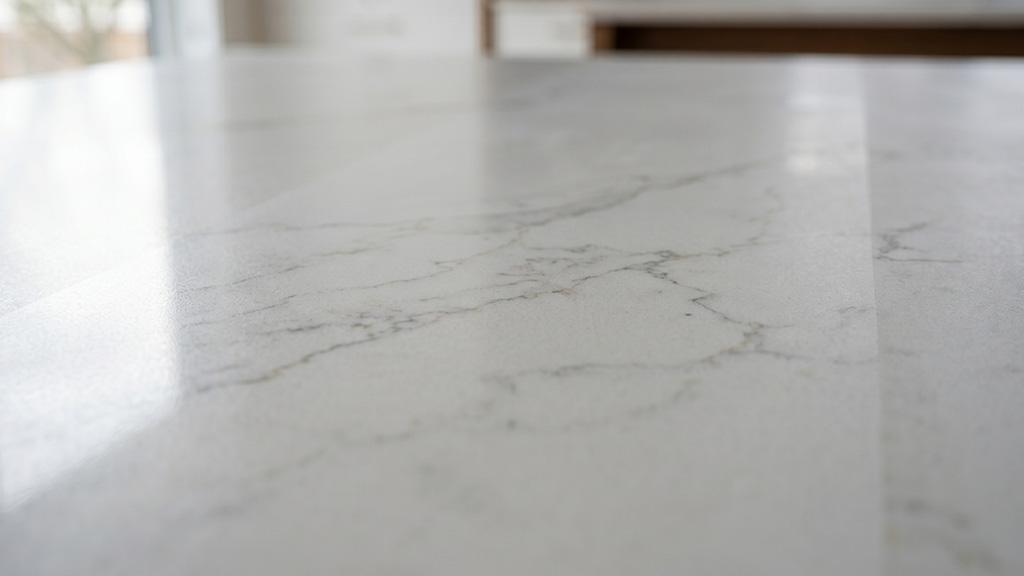
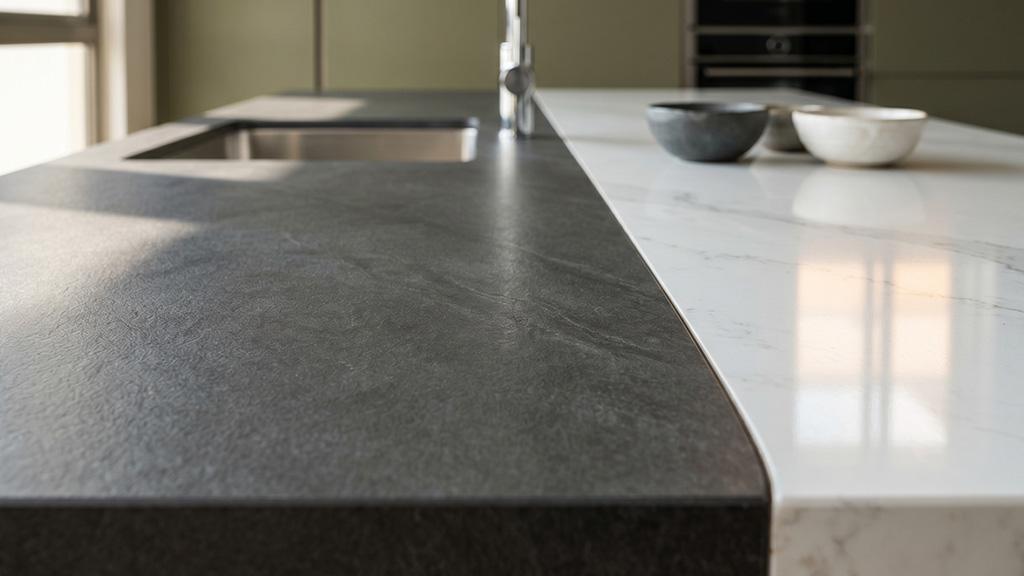
Countertop finishes refer to the surface treatment applied to a stone or engineered material during manufacturing. The finish determines how light interacts with the surface: high-gloss finishes reflect light directly, creating a mirror-like sheen, while matte finishes scatter light diffusely, producing a flat, low-reflectance appearance. A third option, honed, sits between the two with a soft, smooth texture and minimal sheen. The finish doesn’t change the underlying material. It changes how that material reads in a space.
How Light Behaves on Each Finish
Glossy finishes bounce light around a room. In a smaller HDB kitchen or a galley layout, this can make the space feel larger and brighter. The reflectivity amplifies both natural light from windows and artificial light from pendant fixtures above an island.
Matte finishes absorb light instead of reflecting it. That creates a calmer visual effect. In kitchens with a lot going on, such as open shelving, patterned tiles, or bold cabinet hardware, a matte countertop keeps the surface from competing with other design elements.
If your kitchen design in Singapore leans toward minimal and open, glossy often wins. If your kitchen has texture and layering, matte tends to hold the space together.
One practical note: glossy surfaces show water marks and fingerprints clearly, especially under downlights. If your kitchen lighting is bright and positioned overhead, you’ll see every splash. Matte surfaces are far more forgiving under the same conditions.
There’s also a third option worth knowing: the honed finish. Honed sits between matte and glossy. The surface is smooth to the touch but carries no sheen. It doesn’t scatter light the way a true matte finish does, and it doesn’t reflect the way gloss does. For homeowners who like the look of polished stone but want something less demanding to maintain, honed is worth considering. Many quartz suppliers in Singapore now offer honed as a standard option alongside the two traditional choices.
Maintenance: What Each Finish Demands
This is where real differences emerge. Glossy countertops need more frequent wiping. Any residue, oil, or water sits visibly on the surface. After cooking, you’ll want to wipe down immediately to keep the reflective finish looking clean.
Matte countertops are more resistant to showing daily marks. Oil smudges blend into the texture rather than pooling on a shiny surface. That said, matte finishes can be harder to clean when something genuinely stains because there’s no slick surface for a cloth to glide across. Acidic liquids, particularly citrus and vinegar, should be wiped off quickly regardless of finish type.
For quartz countertops in Singapore, maintenance is similar across finishes since the engineered surface is non-porous. Spills don’t penetrate. For daily care, Caesarstone’s care and maintenance guide recommends warm soapy water and a soft cloth, with no special products or sealing required. For granite or natural stone, finish choice affects sealing frequency: glossy polished granite holds its seal well, while honed or matte granite is more porous and may need re-sealing annually.
A quick rule: if you cook daily and have children in the kitchen, matte is more forgiving. If aesthetics take priority and you’re disciplined about wiping down, glossy delivers a consistently sharp result.
It’s also worth considering whether you do a lot of wet cooking. Singaporean home cooking often involves high-heat wok work, soups, and sauces, all of which create steam, splatter, and grease. Glossy surfaces near a hob show this very quickly. If you’re placing the countertop directly adjacent to your cooker, matte is almost always the more practical call. For a preparation island further from the heat, glossy is easier to justify.
Style Compatibility: Which Kitchens Suit Which Finish?
Glossy finishes work well in:
- Contemporary and minimalist kitchens with flat-front cabinetry and strong lines.
- Monochrome kitchens where the surface reflectivity creates visual depth.
- Darker kitchens where light bounce helps prevent the space from feeling closed in.
- Kitchens where the countertop is meant to be a focal point.
Matte finishes work well in:
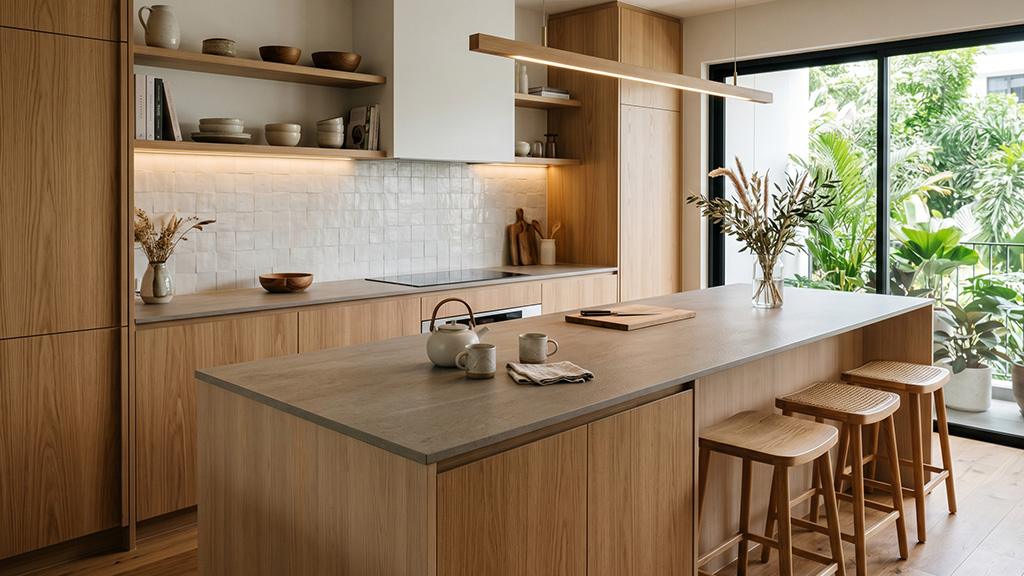
- Japandi, Scandi, or organic-modern kitchens that favour texture over gloss.
- Warm-toned kitchens with timber accents, where a shiny surface would feel jarring.
- Busy, family-oriented kitchens where practicality takes precedence over polish.
- Kitchens where the countertop should read as a neutral backdrop.
For sintered stone countertops in Singapore, the matte option has become particularly popular in recent years. Brands like Dekton and Neolith offer ultra-matte surfaces with stone-like textures that photograph beautifully in residential projects. The finish on sintered stone is UV-stable and holds up well outdoors, too, which makes it a common choice for alfresco or balcony kitchen extensions.
“A glossy countertop in a minimal kitchen creates polish. A matte countertop in a layered kitchen creates calm. The finish doesn’t just describe the surface, it describes the feeling of the room.”
Durability: Does Finish Affect How Long the Surface Lasts?
The finish itself doesn’t change how strong the underlying material is. A glossy quartz slab and a matte quartz slab made from the same stock have the same hardness. What the finish affects is how visible wear becomes over time.
Glossy surfaces show scratches more clearly. Even minor abrasion from cutting boards or ceramic mugs dragged across a surface will leave micro-marks that catch the light. This doesn’t mean the surface is damaged structurally. It means it no longer looks pristine.
Matte surfaces hide light scratches well. The diffuse texture masks minor scuffing so the finish stays looking consistent longer. For high-traffic kitchens, this is a meaningful advantage.
For sintered stone countertop Singapore applications, both finishes are extremely scratch-resistant due to the material’s density. Sintered stone scores between 7 and 8 on the Mohs hardness scale, placing it above both granite and engineered quartz in scratch resistance. That advantage holds regardless of whether you choose a matte or glossy finish.
Over a ten-year span in a working kitchen, a matte surface is more likely to look consistent. A glossy surface will look sharper in year one but may require more maintenance to retain that appearance.
“Finish durability isn’t about which surface lasts longer. It’s about which surface continues to look intentional after years of daily use. For most kitchens, that question has a clear answer.”
One thing that surprises some homeowners: the finish can be refreshed on natural stone. A granite countertop that’s been in use for five years can be re-polished or re-honed by a stone professional. This isn’t possible with engineered materials like quartz or sintered stone, where the finish is set at the factory. If future flexibility matters to you, that’s worth factoring into the material decision alongside the finish choice.
Is Matte or Glossy Better for Your Kitchen?
The better finish depends on two things: your kitchen’s design direction and your daily routine. Glossy finishes deliver a brighter, more reflective look suited to contemporary or minimal kitchens and require consistent upkeep. Matte finishes are quieter, more forgiving with daily marks, and suit warmer or textured kitchen styles. Neither is universally superior. The right choice comes down to how you use and maintain your kitchen.
Frequently Asked Questions

1. Which countertop finish is easier to maintain in a Singapore kitchen?
Matte finishes are generally easier to live with day to day. They hide fingerprints and minor splashes better than glossy surfaces. That said, if something genuinely stains, a smooth glossy surface is easier to wipe fully clean. For most working kitchens, matte requires less frequent attention.
2. Can I get both matte and glossy finishes in quartz countertops in Singapore?
Yes. Most quartz brands, including Silestone and Caesarstone, offer the same stone patterns in multiple finish options. Your supplier can show you the same slab in glossy, honed, and matte so you can compare directly before deciding.
3. Do matte countertop finishes scratch more easily than glossy?
Matte surfaces don’t scratch more easily, but they show scratches less. The textured surface diffuses light in a way that hides minor abrasion. Glossy surfaces, by contrast, let scratches catch the light, making them more visible even when the underlying damage is minor.
4. Is sintered stone available in matte finishes in Singapore?
Yes. Sintered stone brands like Dekton and Neolith are available in Singapore through certified suppliers. Both brands offer extensive matte and ultra-matte finishes across their ranges. Sintered stone is particularly well-suited to matte applications because its density makes the surface resistant to staining even without the protective effect of a glossy seal.
5. Does the countertop finish affect the resale value of my home?
Not significantly on its own. What affects resale value is the overall quality of the renovation and the material used. A high-grade matte quartz countertop holds its value as well as a glossy one. Buyers respond to quality and condition, not finish type.
Choosing between matte and glossy comes down to matching the finish to how you actually live in your kitchen. A glossy surface rewards discipline and suits a kitchen where aesthetics come first. A matte surface rewards practicality and blends into everyday life without demanding constant attention. Both options are available across quartz, granite, and sintered stone, giving you room to find what works for your space. If you’re still undecided, visiting a showroom to see the finishes on full slabs, under real lighting, is the most useful step you can take. No screen renders finish the way a physical surface does.
If you’re working through a renovation in Singapore and want to compare finishes side by side on actual slabs, TSD’s showroom carries a full range across materials and finishes. You can also explore quartz countertop options and sintered stone surfaces to see how each finish reads in real conditions, not just on a screen.
For homeowners renovating an HDB kitchen, HDB’s official Renovation Guidelines for Building Works covers what is and isn’t permitted, including kitchen-specific works, permit requirements, and contractor rules.