Key Takeaways
- Choosing the right kitchen backsplash materials is not just a design decision. It directly affects how easy your kitchen is to clean and maintain over time.
- Stone and sintered stone panels perform strongly behind the hob, where heat, grease, and steam are constant.
- Ceramic and porcelain tiles are reliable and affordable, but grout lines add a maintenance burden that slab surfaces eliminate.
- Sintered stone wall panels offer large-format, grout-free coverage that suits both HDB and condo kitchens in Singapore.
- The right backsplash depends on your cooking habits, layout, and how much upkeep you’re prepared to do long term.
Introduction
The backsplash rarely gets as much attention as the countertop during a kitchen renovation. Most homeowners pick it quickly, choose whatever the contractor recommends, or default to the same subway tile they’ve seen in every showroom. Then six months later, they’re scrubbing grout at 10pm wondering why they didn’t think harder about this.
The wall behind your hob handles more abuse than almost any surface in the home. Grease hits it at cooking temperature. Steam from boiling pots condenses on it daily. In a Singapore kitchen, where high-heat wok cooking is common, the backsplash takes more punishment than it does in kitchens elsewhere.
Choosing the right kitchen backsplash material means understanding how each option holds up to that specific environment. Different zones of the kitchen also create different demands: the area behind a gas hob needs different properties from the wall behind a prep sink. This guide covers the main options, where each performs well, and when stone surfaces make a stronger case than tiles or laminates.
What Are Kitchen Backsplash Materials?
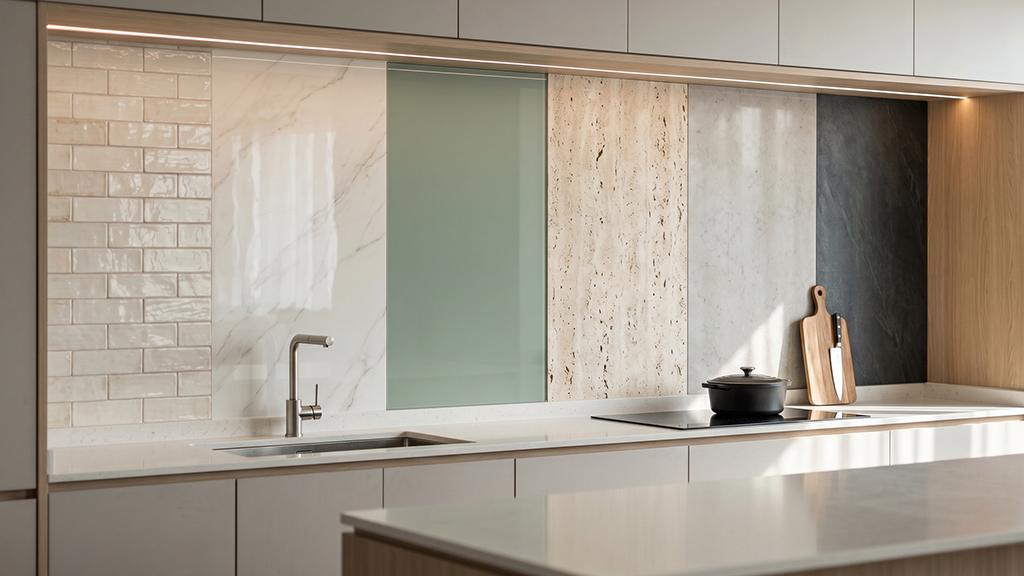
Kitchen backsplash materials are the surface finishes applied to the wall between a countertop and the upper cabinets, typically behind the hob, sink, and preparation areas. Their primary function is to protect the wall from moisture, grease, heat, and food splatter. Secondarily, they define much of the kitchen’s visual character. Common options include ceramic tiles, porcelain tiles, glass, laminates, natural stone slabs, quartz panels, and sintered stone. Each differs in porosity, heat tolerance, ease of cleaning, and installation format.
The Case for Tiles: Reliable but Not Without Trade-offs
Ceramic and porcelain tiles remain the most widely installed kitchen backsplash material in Singapore. They’re affordable, widely available, and come in an enormous range of colours, sizes, and patterns. Porcelain is dense and resists staining well. It handles humidity reliably, which matters in a tropical climate.
The functional limitation isn’t the tile itself. It’s the grout. Grout lines are porous, and behind a hob, they collect grease, steam residue, and cooking oils with every meal. Standard grout discolours within months in an active kitchen. Epoxy grout performs better and resists staining, but it costs significantly more and is harder to install correctly.
According to Singapore home renovation platform Qanvast, grout sealing and caulking are essential steps to prevent water seeping into hairline cracks and causing mould growth behind the backsplash. That maintenance cycle of sealing, re-grouting, and cleaning is manageable, but ongoing. For a homeowner who cooks daily, it adds up.
Glass tiles sidestep the grout issue somewhat because the tile surface itself is non-porous. But grout between individual tiles still requires care. Glass also shows every fingerprint and water streak under kitchen downlights, which looks tired quickly behind a wok station.
Laminate and Solid Surface: Budget Options with Limitations
Laminates offer a low-cost, quick-install backsplash option. High-pressure laminate panels are moisture-resistant and come in stone-look finishes, which makes them a common budget alternative to real stone. They’re easy to cut and install, and the initial result can look clean and considered.
The limitation is heat. Laminate surfaces can blister, warp, or discolour when exposed to sustained high temperatures close to a gas hob. In a kitchen where wok cooking happens at 300 degrees Celsius and above, laminate is a risk. It suits preparation zones further from the flame better than the area directly behind the cooker.
Solid surface panels, such as acrylic-based materials like Corian, provide a grout-free finish that wipes down easily. They resist moisture well. The weakness is also heat: solid surface can be damaged by direct heat exposure, which limits their use directly behind high-output gas burners. If your kitchen has separate cooking and prep zones, a solid surface panel on the prep side and a more heat-resistant material behind the hob is a practical split. Many Singapore kitchens with wet and dry zone layouts already work this way.
When Stone Surfaces Make Sense
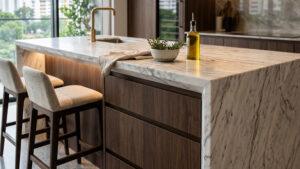
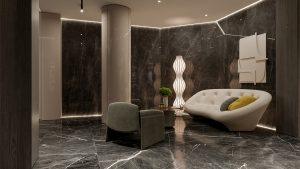
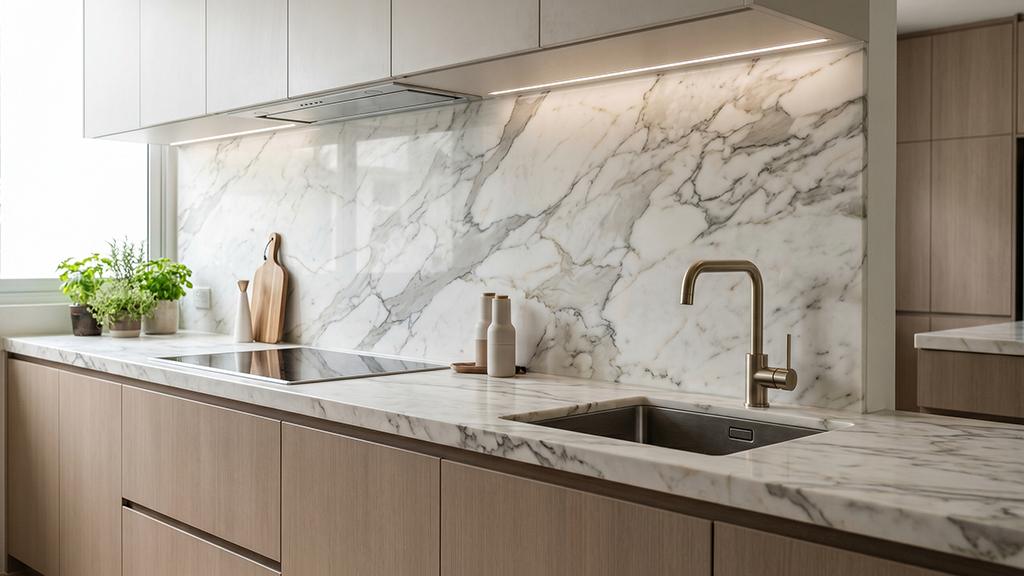
Natural stone slabs, including marble, granite, and quartzite, bring visual depth and uniqueness to a backsplash. No two slabs are identical. A matched marble slab running from countertop to ceiling creates a genuinely striking kitchen, and for homeowners in landed properties or larger condos with open-plan kitchens, the investment can transform the space.
The practical consideration with natural stone is porosity. Marble absorbs acidic liquids and oils if unsealed and requires periodic resealing to maintain its resistance. This doesn’t disqualify it for a backsplash, but a marble backsplash in a high-use kitchen needs more care than a sintered or engineered alternative. Wiping down promptly after cooking is not optional with marble. It’s the basic maintenance requirement.
Granite is the more forgiving natural stone option. Dense and hard, it resists scratching, handles heat well, and seals reliably. For homeowners who want a genuine stone aesthetic without the sensitivity of marble, granite performs strongly as both a countertop and backsplash material. You can read about how granite and other natural stones pair with kitchen countertops Singapore homeowners commonly choose for a more complete picture of material pairing.
“A stone backsplash earns its place not because of how it looks in a showroom, but because of how it performs in a kitchen that cooks every day. The material has to handle heat, grease, and repeated cleaning without losing its appearance.”
Why Sintered Stone Wall Panels Work Well in Singapore Kitchens
Sintered stone wall panels have become one of the more practical backsplash choices for Singapore homeowners, particularly in open-concept kitchens where the backsplash is visible from the living area and expected to carry aesthetic weight.
The technical properties suit the local cooking environment well. Sintered stone is non-porous, meaning grease and steam have no surface to penetrate. It tolerates temperatures up to around 1,200 degrees Celsius without cracking, discolouring, or warping. Behind a high-output gas wok burner, that heat resistance is a genuine functional advantage.
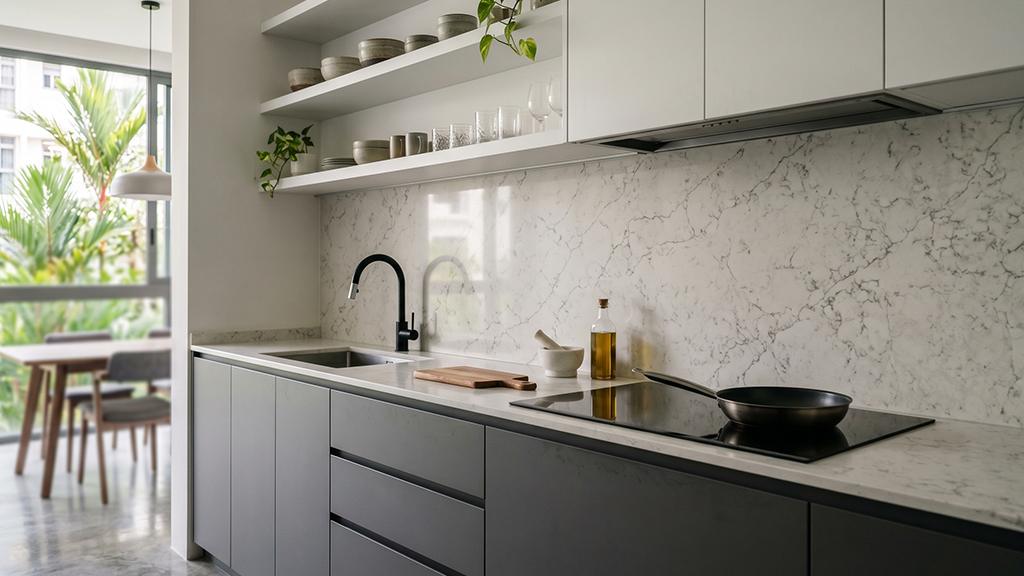
The format is a practical benefit too. Sintered stone wall panels come in large slabs, some up to 3,200mm by 1,440mm, which means installation with minimal or no grout lines. A single panel can run the full height of the wall from countertop to cabinet underside without a visible joint. For homeowners who’ve spent time scrubbing tiled grout, that difference is felt immediately.
Stone-look surfaces in sintered stone, including finishes that replicate marble, concrete, or slate, are now detailed enough to be genuinely convincing. The visual result of a book-matched sintered stone backsplash panel often reads as natural stone. The maintenance reality is closer to a wipe-down with a damp cloth.
TSD’s guide to sintered stone wall panels covers how these panels are used across residential and commercial spaces in Singapore, including installation considerations specific to HDB and condo kitchens.
Pairing Your Backsplash with Your Countertop
A backsplash doesn’t exist independently of the rest of the kitchen. The most considered kitchens treat the backsplash and countertop as a connected surface decision.
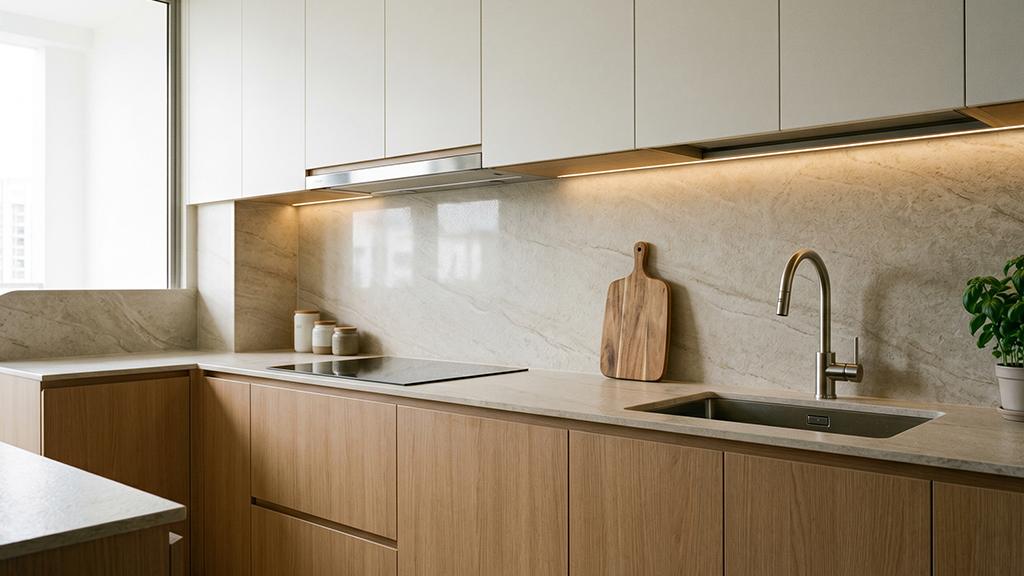
One approach is continuity: running the same sintered stone from the countertop up the wall creates a unified surface that makes the kitchen feel larger and cleaner. This works particularly well in smaller HDB kitchens where visual simplicity helps the space read better. The material reads as one continuous plane rather than two distinct surfaces.
A contrasting approach, using a different material or colour on the backsplash, creates definition. A darker stone backsplash against a light quartz countertop adds depth without adding visual noise. The key is that both materials need to handle the same kitchen environment, so matching their performance properties matters as much as matching their aesthetics.
For homeowners working through this decision, TSD’s overview of sintered stone countertops in Singapore explains how the material performs across different kitchen zones and installation formats.
“The backsplash and countertop share the same environment. Choosing them together, for performance first and aesthetics second, usually produces better results than treating them as separate decisions.”
Which Kitchen Backsplash Material Is Right for You?
The right kitchen backsplash material depends on three things: how intensively you cook, how much maintenance you’re prepared to do, and how visible the backsplash is in your overall kitchen design. For light-use kitchens or budget renovations, porcelain tile with epoxy grout is a reliable and cost-effective choice. For active cooking kitchens in Singapore, particularly those using high-heat gas hobs, sintered stone panels offer the best combination of heat resistance, easy cleaning, and grout-free longevity.
Frequently Asked Questions
1. What kitchen backsplash material is easiest to clean in a Singapore kitchen?
Sintered stone and glass are the easiest to clean because both surfaces are non-porous and grout-free in large-format installations. Grease and steam wipe off with a damp cloth. Porcelain tiles are also easy to clean on the tile surface, but the grout lines require more attention in a high-use kitchen.
2. Can I use sintered stone wall panels as a backsplash in an HDB kitchen?
Yes. Sintered stone wall panels are suitable for HDB kitchens. For any renovation involving wall finishes, homeowners should check HDB’s renovation guidelines for building works to confirm what requires a permit and which works must be carried out by a registered contractor.
3. Are stone-look surfaces as durable as actual stone for a backsplash?
Stone-look surfaces in sintered stone are generally more durable than natural stone for backsplash applications. Sintered stone is non-porous and requires no sealing, unlike marble or unsealed granite. Its heat and scratch resistance also exceed most natural stone options. The visual difference between a quality sintered stone finish and natural marble is minimal in a finished installation.
4. How thick should a backsplash panel be for a kitchen?
For backsplash applications, sintered stone panels are typically supplied at 6mm to 12mm thickness. A 6mm panel is standard for wall cladding and backsplash use. It’s light enough for vertical installation while providing the same surface performance as thicker slabs. Your fabricator will advise on the right thickness based on the substrate and installation method.
5. What is the difference between a tiled backsplash and a slab backsplash?
A tiled backsplash uses individual tiles installed with adhesive and grout, creating a grid of joints across the wall. A slab backsplash uses one or more large-format panels with minimal or no visible grout lines. Slab backsplashes are easier to clean, more visually continuous, and better suited to high-heat zones. Tiled backsplashes offer more pattern flexibility and are typically lower in cost.
Choosing a backsplash well means thinking past the showroom and into the kitchen as it actually functions, with daily cooking, regular cleaning, and years of wear. Tiles work. Laminates have their place. But for a Singapore kitchen where cooking is genuinely intensive, stone and sintered stone surfaces consistently outperform on the metrics that matter most: heat resistance, non-porosity, and no grout lines to maintain.
If you’re planning a kitchen renovation and want to see how sintered stone panels and countertops work together in practice, TSD’s showroom in Singapore carries a full range of surfaces across materials, formats, and finishes.