Key Takeaway
- Quartz countertops Singapore homeowners choose are engineered stone surfaces made from around 90% crushed natural quartz bound with polymer resins.
- The non-porous surface resists staining and never requires sealing, which suits Singapore’s humid climate and daily cooking habits.
- Quartz handles moderate heat well but can scorch under sustained direct heat, so trivets near the hob remain important.
- Colour and pattern consistency across slabs makes quartz a reliable choice for matched kitchen designs and island extensions.
- Choosing the right thickness, edge profile, and supplier matters as much as the material itself.
Introduction
Walk into almost any renovated HDB kitchen or condo in Singapore and you’ll likely find a quartz countertop. Not because it’s the most expensive option, or the most talked-about. Because it works. Day after day, meal after meal, wipe-down after wipe-down, quartz holds up in a way that makes it the default choice for homeowners who want a surface that disappears into the background and just performs.
But knowing that quartz is popular doesn’t tell you why it suits Singapore kitchens specifically, or what to watch for when choosing it. Not all quartz is identical. Thickness, composition, resin content, and fabrication quality all affect how a slab performs over years of use. And there are limits to what quartz handles well that matter more in a Singapore kitchen than they might elsewhere.
This guide covers the composition of quartz countertops Singapore homeowners actually buy, how the material performs under local kitchen conditions, what the honest limitations are, and what to confirm before you finalise your purchase.
What Are Quartz Countertops?
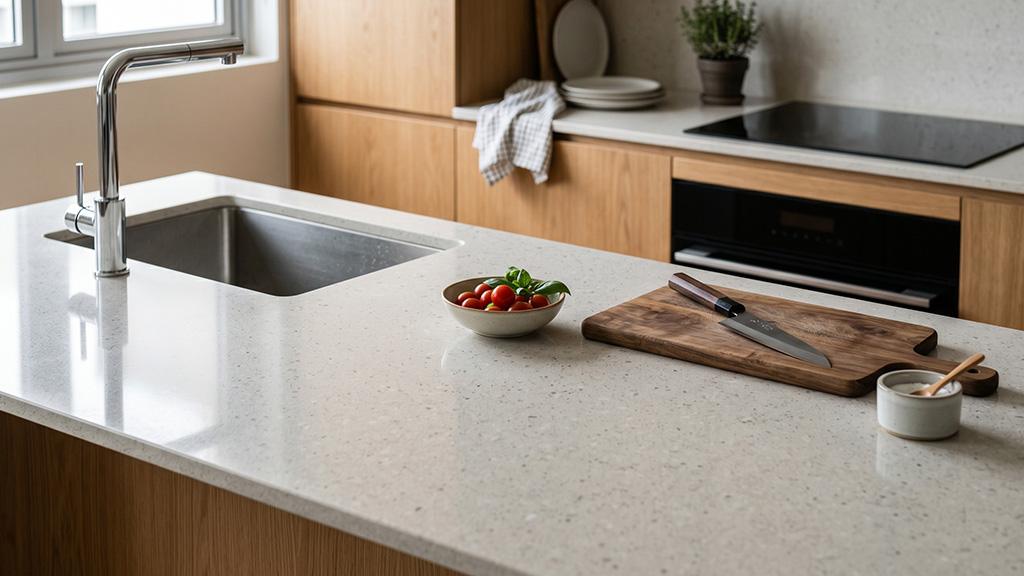
Quartz countertops are engineered stone surfaces made from approximately 90 to 95% crushed natural quartz crystals bound with 5 to 10% polymer resins and pigments. The manufacturing process compresses the mixture under heat and pressure, producing a dense, non-porous slab that requires no sealing. According to This Old House, this engineered composition results in a surface with exceptional hardness and stain resistance, and a wide range of colour options that natural stone cannot replicate with consistency. Unlike granite or marble, which are cut from natural rock, engineered stone is manufactured to consistent standards, which means every slab from the same batch looks nearly identical.
Why Quartz Works So Well in Singapore Kitchens
Singapore kitchens face a specific set of conditions. High ambient humidity means any porous surface absorbs moisture over time, creating conditions for mould and staining. Daily cooking, often involving sauces, oils, and acidic ingredients like lime and vinegar, means the surface gets tested regularly. And compact kitchen layouts, particularly in HDB flats, mean the countertop also serves as preparation space, dining surface, and occasionally a work-from-home desk.
Quartz handles all of these well. The non-porous surface resists moisture absorption, which directly addresses Singapore’s humidity. Acidic spills from cooking sit on the surface rather than seeping in, and they wipe off cleanly. For a homeowner cooking daily, this means the countertop stays looking consistent without special products or periodic treatments.
The engineered stone composition also means no two jobs are noticeably different. If you extend your kitchen island six months after the original countertop was laid, or replace a section after damage, the new slab can match the original closely. That consistency is harder to achieve with natural stone, where every piece of granite or marble differs from the last.
Singapore’s renovation platform Qanvast notes that engineered quartz is non-porous, meaning homeowners almost never need to worry about tough-to-remove stains or bacterial growth from moisture exposure. For families with young children, that hygienic property matters as much as the visual appeal.
The Heat Limitation Worth Understanding
Most quartz countertops Singapore suppliers sell can handle moderate heat without issue. Setting a warm mug or a pan that has been off the hob for a few minutes is not a problem. The surface won’t react to ambient kitchen temperatures.
The issue arises with sustained direct heat. Quartz contains polymer resin as a binder, and that resin has a threshold. Placing a pan directly from a high-heat gas burner onto the surface can cause discolouration, scorch marks, or in some cases micro-fractures around the contact area. The damage isn’t always visible immediately; it can show up over months as a dulling or yellowing of the resin layer beneath the surface.
This doesn’t make quartz unsuitable for a kitchen. It means using a trivet or a heat pad as standard practice. Most homeowners who treat this as a basic kitchen habit have no issues over a ten-year lifespan. The problem appears most often when someone moves from a different material, particularly sintered stone or stainless steel, where direct heat contact is not a concern at all.
If your kitchen layout puts the countertop directly adjacent to a high-output gas hob, or if you cook frequently with a wok at maximum heat, this is worth discussing with your supplier before choosing quartz. The TSD comparison of sintered stone vs quartz breaks down exactly where each material wins under different kitchen conditions.
“Quartz handles nearly everything a Singapore kitchen throws at it. The one exception is sustained direct heat. That single limitation is manageable with habit, but it’s worth knowing before you install.”
Maintenance in Practice
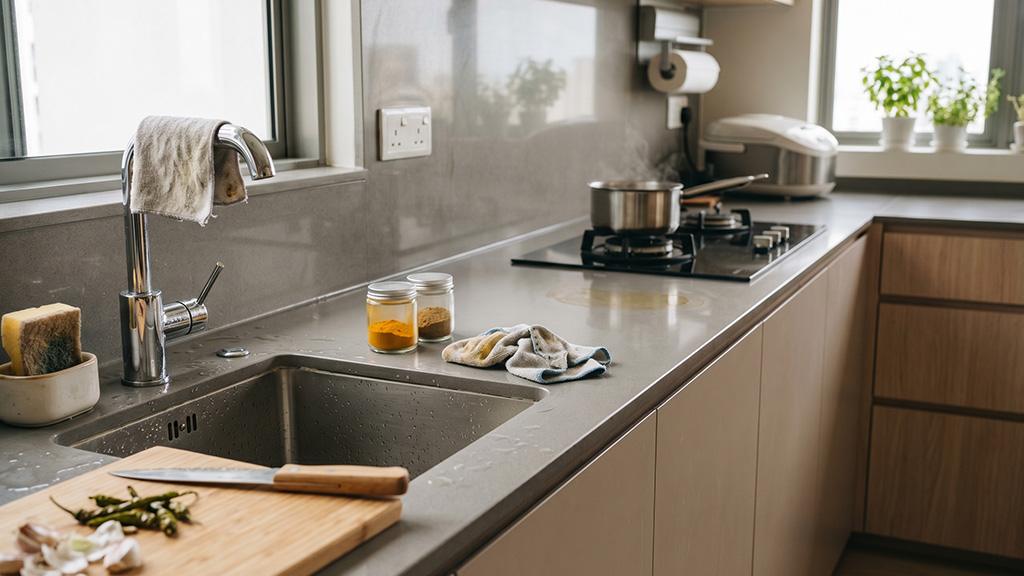
The maintenance case for quartz is simple: wipe it down with a damp cloth and mild detergent after cooking. No sealant, no special cleaners, no annual treatments. For most households, that’s the entire maintenance routine.
A few specific things to avoid will keep the surface looking good for longer. Strong bleach-based cleaners and highly alkaline products can dull the resin layer over time. Leaving oil or acidic liquids on the surface overnight rather than wiping them promptly can lead to surface discolouration, even though the liquid hasn’t penetrated the slab. Abrasive scrubbing pads scratch the polished finish of a glossy quartz surface and are unnecessary since most residue wipes off easily.
In Singapore’s cooking environment, where curry, soy-based marinades, and cooking oil are daily kitchen staples, the non-porous nature of quartz genuinely earns its place. These substances do not penetrate. A prompt wipe-down is all that is needed.
One thing many homeowners notice after a few years: the grout lines or silicone edges around the countertop can show more wear than the quartz surface itself. The junction between the countertop and the wall, or between the countertop and the sink, is where staining and mould growth typically appear first. This isn’t a quartz issue. It’s a maintenance issue with the seal around it, and it can be addressed with periodic re-caulking rather than countertop replacement.
Thickness, Edge Profiles, and What to Confirm Before Buying
Most quartz countertops Singapore fabricators offer come in 20mm and 30mm thickness. For a standard kitchen countertop, 20mm is the most common. It provides sufficient depth for most layouts, including overhangs for breakfast bars and single-basin sink cutouts. For double-basin sinks or larger overhangs, 30mm provides additional structural depth.
Edge profiles affect both the look and the safety of the finished countertop. A square edge gives a sharp, modern appearance but can chip more easily at corners under impact. A pencil-round or eased edge creates a slight curve that is more forgiving. Waterfall edges, where the countertop continues vertically down the side of a cabinet or island, create a striking visual but require precise fabrication and sufficient slab size.
Slab format is worth considering alongside thickness. Standard quartz slabs typically run around 3,050mm by 1,440mm. For a long kitchen run or a large island, this may mean one or more seams in the finished countertop. Seam placement matters: a seam positioned over a sink cutout or at a high-stress corner introduces a potential weak point. A good fabricator will plan seam locations during the templating stage and place them where structural stress is lowest. Ask to see the seam layout on your template before fabrication begins.
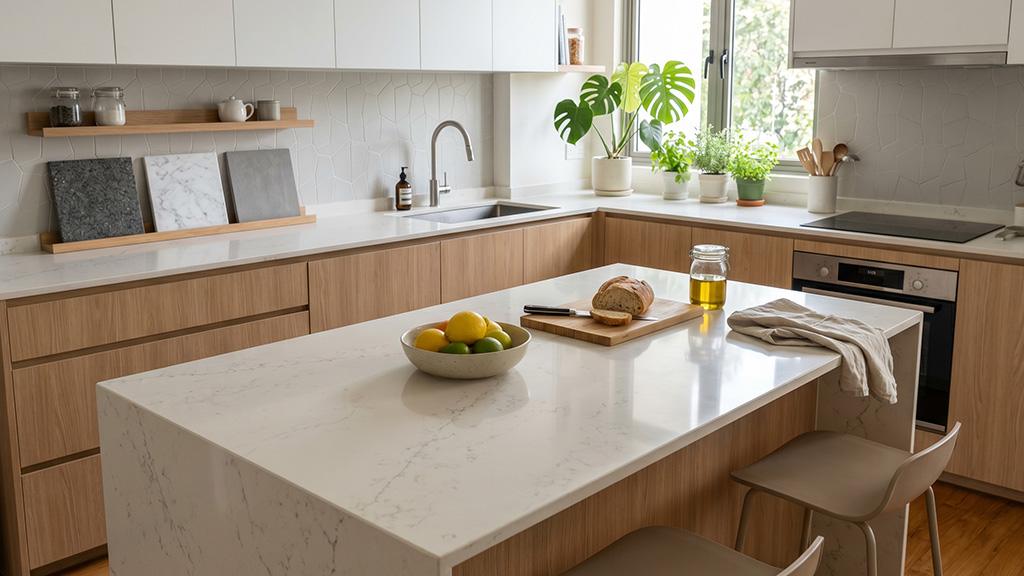
For kitchen countertops Singapore homeowners are matching across multiple zones (a main run, an island, and a breakfast counter), consistent batching from the same slab production run helps achieve colour uniformity. Ask your supplier whether this is possible for your order quantity.
TSD’s guide to quartz countertops in Singapore covers selection criteria in detail, including layout considerations, edge options, and what to check during the fabrication process.
Quartz vs Other Materials: Where It Sits in the Market
Quartz sits in the mid-to-upper range of kitchen countertops Singapore homeowners typically consider. It costs more than high-pressure laminate or solid surface, roughly comparable to mid-grade granite, and generally less than sintered stone or premium imported marble.
What positions quartz well is the combination of consistent appearance, zero-maintenance sealing, and broad design availability. Against granite, it wins on consistency and maintenance. Against sintered stone, it yields on heat tolerance but often wins on cost and impact resistance. Against marble, it wins clearly on durability and maintenance, while offering similar aesthetics in engineered stone veined designs.
For homeowners who want a surface that looks considered and premium without requiring premium-level upkeep or budget, quartz occupies a practical middle ground. The TSD overview of kitchen countertops Singapore materials covers how quartz sits alongside granite, sintered stone, and marble for different renovation priorities.
“Quartz isn’t the hardest material available, or the most heat-tolerant. What it is: consistent, low-maintenance, and well-matched to how most Singapore kitchens are actually used.”
Are Quartz Countertops Right for Your Singapore Kitchen?
Quartz countertops Singapore homeowners should consider when they want a non-porous, low-maintenance surface with consistent colour and pattern across their kitchen. The material suits daily cooking environments well, handles Singapore’s humidity without degrading, and requires no specialist upkeep. The key conditions to watch are proximity to a high-heat gas hob and the choice of fabricator, since slab quality and edge finishing vary between suppliers.
Frequently Asked Questions
1. Do quartz countertops in Singapore need to be sealed?
No. The non-porous composition of engineered quartz means it does not absorb moisture or liquids. Unlike granite or marble, quartz countertops Singapore homeowners install require no sealing on installation or at any point during use.
2. Can quartz handle Singapore’s humidity?
Yes. The non-porous surface does not absorb moisture, which means humidity does not cause swelling, staining, or degradation over time. Quartz is a practical choice for Singapore’s tropical climate precisely because of this property.
3. Why does quartz get damaged by heat if it contains natural quartz?
The natural quartz mineral itself is heat-resistant. The issue is the polymer resin binder that holds the quartz particles together, which makes up 5 to 10% of the slab composition. Sustained direct heat above approximately 150 degrees Celsius can soften or discolour this resin layer. Using trivets near the hob prevents the problem entirely.
4. How long do quartz countertops last in a Singapore kitchen?
With standard daily care, quartz countertops typically last 15 to 20 years or longer without visible degradation of the surface. The main causes of premature wear are heat damage from direct contact with hot cookware, impact chipping at edges, and chemical damage from strong cleaning products.
5. What thickness of quartz should I choose for my kitchen countertop?
For most HDB and condo kitchens, 20mm quartz is the standard and practical choice. It suits overhangs up to 300mm and standard sink cutouts without structural issues. If you’re planning a large kitchen island with a longer overhang, or a double-basin integrated sink, 30mm provides greater depth and reduces flex at the span.
Quartz has earned its place as the most widely installed kitchen countertop in Singapore for straightforward reasons: it performs consistently, it doesn’t require ongoing maintenance, and it suits the cooking habits and spatial constraints of most local homes. Understanding the one genuine limitation around direct heat and choosing a fabricator who works to a high standard are the two things that determine whether a quartz countertop still looks good after ten years.
If you’re planning a kitchen renovation and want to compare quartz options across colours, thicknesses, and finishes, TSD’s full range of quartz surfaces is available at their Singapore showroom, with in-house fabrication and installation handled end-to-end.