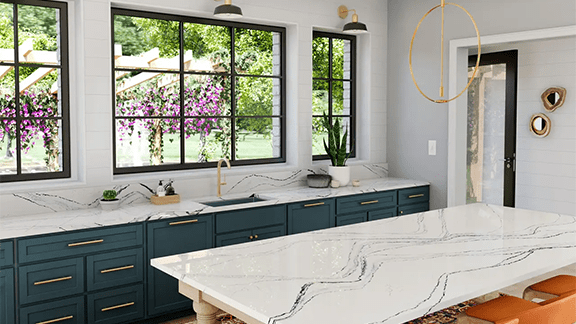
The choice between sintered stone and quartz countertops results in difficulty because both materials guarantee long-lasting performance together with contemporary design and high-quality appearance.
The kitchen countertop market experiences fast expansion because Asia-Pacific kitchen countertops contribute 37.05% of global revenue of worldwide revenue in 2025 while showing the highest regional compound annual growth rate of 6.02% because of ongoing urban development and middle-class population increase.
The kitchen design decision becomes more critical in Singapore because kitchens must maintain their attractive appearance while handling intensive daily operations. This blog provides a complete examination of sintered stone and quartz through its discussion of their makeup, their ability to withstand damage, and their upkeep requirements, along with their price differences.
The blog provides a comparison table together with solutions to frequently asked questions. The material you need for your home renovation plans and your personal habits will become clear to you after reading this section.
What Sets Sintered Stone and Quartz Apart?
The evaluation of performance and pricing requires an initial examination of surface construction methods.
- Engineered stone surfaces used in quartz countertops consist of crushed natural quartz crystals which bind together through resin and pigment materials. The result is a non-porous slab with consistent colour and pattern.
- Sintered stone, on the other hand, is created by subjecting natural minerals to extreme heat and pressure. This process mimics how stone forms in nature, but accelerates it into a matter of hours. The absence of resins in the material creates physical properties which differ from those of quartz.
The fundamental distinction between sintered stone and quartz exists in their material composition because one product uses resin binders while the other product obtains its structure through high-temperature mineral fusion.
Material composition is only part of the picture, how these surfaces perform in real Singapore kitchens matters just as much.
Why You Should Choose Between Sintered Stone and Quartz?
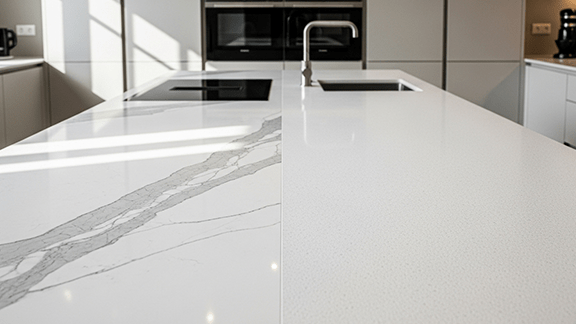
The current kitchen design trends in Singapore show a preference for open-concept layouts together with slim-profile countertops and seamless surfaces. Many customers also cook frequently which causes their countertops to experience damage from high heat and moisture and strong cleaning products.
The climate serves as an additional element that impacts the situation. The tropical climate of Singapore causes materials to deteriorate through extended exposure to high humidity conditions. The conditions require non-porous surfaces which refuse to absorb moisture to achieve superior performance.
The local property owners and homeowners participating in the discussion about sintered stone vs quartz select their main focus on:
- Heat resistance for heavy cooking
- Low maintenance in humid environments
- Scratch resistance for compact kitchen workspaces
- Modern finishes that complement minimalist interiors
The final decision about materials is more affected by practical needs than it is by aesthetic considerations.
Now we need to examine which surface materials handle heat and physical damage and routine cleaning based on our understanding of lifestyle requirements.
Discover More : White Quartz Countertops: Benefits, Design Ideas, and Buying Guide
Durability, Heat, and Maintenance
We will present this information in a simple way.
1. Heat Resistance
Frequent cooks who use high heat need to understand how sintered stone compares to quartz because it will impact their cooking experience.
- Sintered stone can handle very high temperatures. You can usually place a hot pan directly on the surface without damage.
- Quartz functions well in standard kitchen environments but its resin material causes it to develop discolouration and cracks when it comes into contact with excessive direct heat.
2. Scratch and Impact Resistance
Both materials resist scratches better than many natural stones.
- Quartz is hard and durable but can chip at edges with heavy impact.
- Sintered stone is also highly resistant to scratches and abrasion, particularly in matte finishes.
3. Stain Resistance and Porosity
Both surfaces are non-porous, which means:
- No sealing required
- Resistance to common kitchen stains
- Easy cleaning with mild soap and water
The two materials quartz and sintered stone provide maintenance workers with practical benefits for their daily tasks. The best method to maintain surface quality is to clean up spills immediately while avoiding the use of strong chemical cleansers.
The table below shows the main differences between the two options which you can use to make a quick comparison.
Quartz vs. Sintered Stone
This simplified table highlights the practical differences in quartz vs sintered stone for quick reference.
| Feature | Quartz | Sintered Stone |
| Composition | Quartz crystals + resin | Natural minerals, heat-fused |
| Heat Resistance | Moderate to high | Very high |
| UV Resistance | May fade outdoors | UV stable |
| Maintenance | Low | Low |
| Thickness Options | Standard slabs | Ultra-thin to thick slabs |
| Price Range (Singapore) | Mid to high | High |
The aesthetic aspect of kitchen renovations has become important for contemporary kitchen design which requires additional visual elements to achieve its goals.
Design Flexibility and Visual Appeal
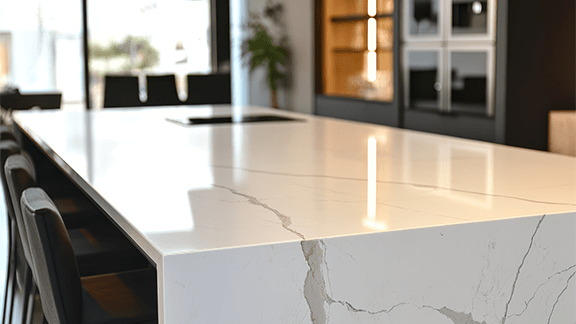
Singapore property owners who lead design trends require aesthetically pleasing kitchens which maintain their status as distinctive spaces. The advantages of quartz design create strong points which make it a superior material choice for design purposes.
1. Quartz Design Strengths
Quartz is well-established in local showrooms, giving buyers more predictable results.
- Wide range of colours and patterns
- Consistent veining
- Popular marble-look options
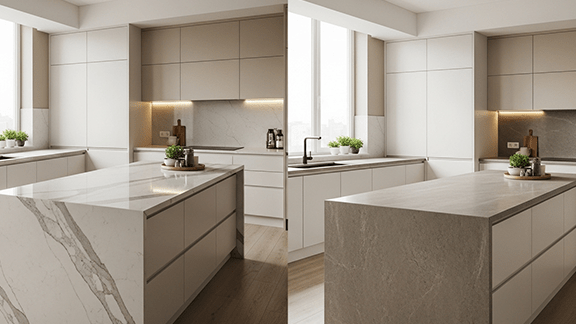
- Uniform slabs ideal for large islands
2. Sintered Stone Design Strengths
People who prefer modern design will find sintered stone to be their most advanced material choice.
- The design features slim profiles which enable polished installation procedures.
- The collection provides slabs which customers can obtain in book-matched design.
- The product offers authentic stone and concrete appearance for its surface finishes.
- The material functions as a suitable option which designers can use for countertops and backsplashes and cabinetry work.
In many renovation projects, the sintered stone vs quartz debate comes down to desired visual impact. Quartz offers reliability and variety. Sintered stone materials show a preference for minimalistic architectural design.
The final decision depends on three factors which include performance, design elements, and budget constraints.
Cost Considerations in Singapore
The different brands, material thicknesses, and installation difficulties determine the pricing which varies across various options.
In Singapore:
- The price of quartz products falls within a range between mid and high price points.
- The production methods and handling procedures make sintered stone materials more expensive than other materials.
The installation process requires specialised skills because fabricators need to handle heavier and more difficult-to-cut sintered stone slabs.
While comparing sintered stone vs quartz, budget-sensitive customers lean toward quartz. Those prioritising heat resistance and ultra-slim designs may justify the higher investment in sintered stone.
The comparison between these two things will show its results through its evaluation of a real residential kitchen installation.
Dekton Sintered Stone in a High-Use Family Kitchen
The residential kitchen project by Surrey Marble & Granite, featuring Dekton by Cosentino showcases its practical use of sintered stone through their work.
The homeowners wanted a kitchen island design that maintained its modern appearance while enduring daily cooking and hot pan use and the regular cleaning process. The fabricator installed Dekton sintered stone for both the island countertop and splashback. The case study describes that the material was chosen because of its exceptional protection against heat and scratches and stains which made it perfect for use in a busy family kitchen.
The finished result delivered:
- The design presents a modern look which maintains uninterrupted visual flow.
- The material provides exceptional protection against both stains and scratches.
- The product delivers extended service while requiring only basic upkeep.
Homeowners selected Dekton because its heat resistance functioned as their primary decision factor. Sintered stone products maintain their ability to endure direct heat contact because their manufacturing process uses extremely high temperatures and pressure, which makes them more durable than quartz surfaces that use resin binders.
The product gave homeowners cooking confidence for their daily kitchen activities. The process of practical tests allows users to evaluate their surface options before making a final decision.
Tips Before You Decide
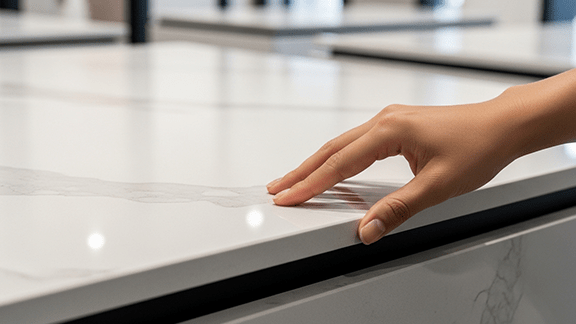
Before finalising your countertop choice:
- You can go to Singapore showrooms to see complete slabs which demonstrate all material qualities.
- You need to find out which slab thicknesses they offer together with their available edge profile designs.
- You need to check the warranty information together with their manufacturing experience.
- Your cooking practices will determine how much damage your surfaces will sustain.
- You need to obtain a detailed quotation which shows all installation costs.
Choose quartz if you want:
- Reliable performance
- Broad design choices
- Slightly lower cost
- Proven popularity in Singapore properties
Choose sintered stone if you value:
- Superior heat resistance
- UV stability for outdoor use
- Ultra-thin modern profiles
- Architectural-style finishes
These steps help you evaluate sintered stone vs quartz in a realistic way, beyond online photos.
Common Myths About Sintered Stone and Quartz – and the Real Truth
Many Singapore homeowners base their countertop decisions on what they hear from friends or quickly read online. But some of those ideas aren’t entirely true. Knowing the real truth before making a choice can help you avoid making a decision you may regret later.
Myth 1: “Quartz is completely maintenance-free forever.”
This is not entirely true. Quartz is very easy to care for, but when you use strong chemical cleaners or place hot cookware directly on the surface, the resin inside it can slowly break down. Over months and years, this can make the surface dull or show faint marks. The proper way to care for quartz is to clean it daily with mild soap and warm water, and always place a trivet or wooden board under anything hot.
Myth 2: “Sintered stone cannot be damaged.”
Sintered stone is the toughest countertop material you can buy. It handles heat, scratches, and stains better than almost anything else. But if something very heavy falls on it from a height, it can still chip or crack. Strong does not mean unbreakable.
Myth 3: “Choose the countertop that looks best in the photos.”
This is the most common mistake. Your countertop isn’t just for looks – it has to perform under real cooking and cleaning conditions every day. The surface that looks perfect in a showroom photo may not be the same as the surface you’ll use in your kitchen. At TSD, we help each customer make a choice based on their lifestyle and their design goals – because a countertop that works well is always more beautiful in the long run.
Explore More : Caesarstone vs Quartz: Choosing the Perfect Surface for Your Modern Kitchen
Conclusion
The sintered stone versus quartz comparison does not have a single winner because it depends on individual needs. Both materials provide three key benefits which include their ability to withstand damage and their need for minimal upkeep and their attractive visual characteristics. The ideal choice for you depends on your cooking patterns and your financial restrictions and your design objectives.
If you’re planning a quartz or sintered stone upgrade in Singapore, explore more insights at TSD. The kitchen’s appearance and functionality will remain unchanged for many years because you selected the right surface material.
TSD offers end-to-end service, from selection and consultation to fabrication and installation, all handled in-house. With decades of residential and commercial experience, we acquire a fully equipped workshop, and custom edge profiling capabilities.
Our team delivers precise workmanship from our fully equipped workshop at 16 Joo Koon Circle which operates on an appointment basis.
Explore our wide range of quartz, granite, and ML sintered stone collections, or speak to their specialists at +65 6908 5147 or tsd.enquiry@gmail.com to start your project.
FAQs
Q1. Is sintered stone vs quartz better for heavy cooking in Singapore?
If you frequently cook with high heat or use woks and large pots, sintered stone has the advantage in heat resistance. Quartz performs well for standard cooking but should not be exposed to prolonged direct heat.
Q2. Does quartz stain more easily than sintered stone?
Both materials resist stains because they are non-porous. However, quartz contains resin, so certain harsh chemicals can dull the surface. Sintered stone tolerates stronger cleaners better.
Q3. Which lasts longer in a humid climate like Singapore?
Both materials handle humidity well. Since neither absorbs moisture, long-term performance depends more on installation quality than climate.
Q4. Is quartz or sintered stone better for outdoor kitchens?
Sintered stone performs better outdoors due to UV resistance. Quartz may fade with prolonged sun exposure.