Key Takeaway
- A sintered stone kitchen top is one of the most heat-resistant and low-maintenance countertop options available for Singapore homes.
- Sintered stone is manufactured under extreme heat and pressure, producing a non-porous surface that needs no sealing.
- The material suits both HDB kitchens and large condo layouts, with slab sizes that reduce visible joints across the surface.
- Fabrication precision matters as much as material quality. Poor cuts or unsupported spans can cause cracking at stress points.
- Before committing, homeowners should check slab thickness, edge profile options, and whether the supplier handles both fabrication and countertop installation.
Introduction
Most homeowners doing a kitchen renovation start with the cabinet design and finish the countertop decision last. That order often leads to rushed material choices. Sintered stone is one option that deserves more careful consideration early in the planning process. It has specific requirements around fabrication, support, and installation that affect the final result.
A sintered stone kitchen top performs differently from quartz or granite in several key ways. It handles direct heat without risk of scorching. Its surface never needs sealing. It can be fabricated in very thin profiles, which changes what’s possible with edge details and wall cladding. Understanding those differences before you finalise the renovation brief saves time and avoids surprises on site.
This guide covers what sintered stone actually is, how it performs in a working Singapore kitchen, what the installation process involves, and the questions worth asking your supplier before sign-off.
What Is a Sintered Stone Kitchen Top?
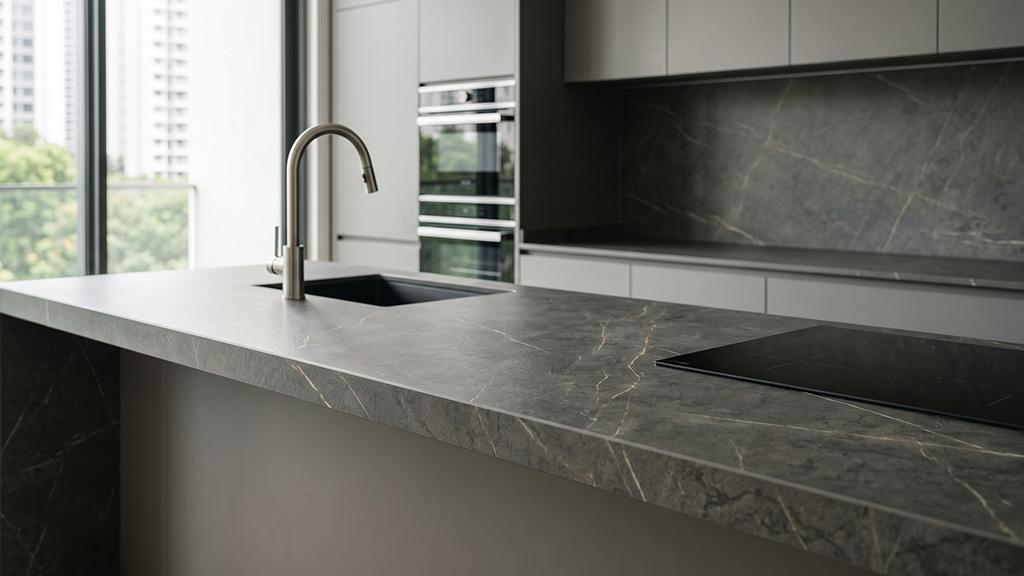
A sintered stone kitchen top is a countertop surface made from natural minerals, including silica, feldspar, and mineral oxides, that are compressed under approximately 25,000 psi and fired at temperatures exceeding 1,200 degrees Celsius. The sintering process bonds the raw materials into a dense, homogeneous slab with virtually zero porosity. No resins or synthetic binders are used in the manufacturing process. The result is a surface that is non-porous, highly scratch-resistant, UV-stable, and capable of handling direct heat without surface damage. Sintered stone is available under brand names including Dekton and Neolith, both of which are stocked and installed by suppliers across sintered stone Singapore.
How Sintered Stone Performs in a Singapore Kitchen
Singapore kitchens put surfaces under sustained stress. High-heat gas burners, wok cooking, daily exposure to cooking oils and acidic sauces, high ambient humidity, and frequent cleaning with strong products. A countertop needs to handle all of these without degrading.
Sintered stone performs well across each of these conditions. Its non-porous structure means cooking oils and acidic liquids cannot penetrate the surface, even without a sealant layer. Unlike natural granite, which is porous and requires annual resealing, or quartz, which contains polymer resins that can scorch at high heat, a sintered stone kitchen top resists direct heat without discolouring or warping. This is a practical advantage in any kitchen that uses a gas hob regularly.
The surface also cleans easily. A damp cloth and mild detergent remove grease and food residue without the need for specialist cleaning products. For Singapore homeowners managing a busy household, that low-maintenance profile is a meaningful consideration over a ten- or fifteen-year lifespan.
According to Countertop Authority, sintered stone bonds glass, porcelain, and quartz components under extreme pressure and temperature, producing a homogeneous slab classified separately from standard porcelain by its density, Mohs hardness rating, and UV stability. Unlike porcelain tiles used as kitchen tops, large-format sintered stone slabs are non-porous at the manufacturing stage and require no sealing.
One honest limitation: sintered stone can be more brittle than quartz under sharp impact. Dropping a heavy object onto the edge or cutting directly above an unsupported span, such as a sink cutout, can cause cracking. This is a characteristic of its density, not a defect in the material. Proper countertop installation addresses it through correct cabinet support, edge profile selection, and seam placement.
Thickness, Format, and Design Options
Part of what makes sintered stone a versatile choice for kitchen countertops Singapore homeowners consider is the range of available thicknesses and formats. Slabs are typically supplied in 6mm, 12mm, and 20mm profiles. Each suits different applications.
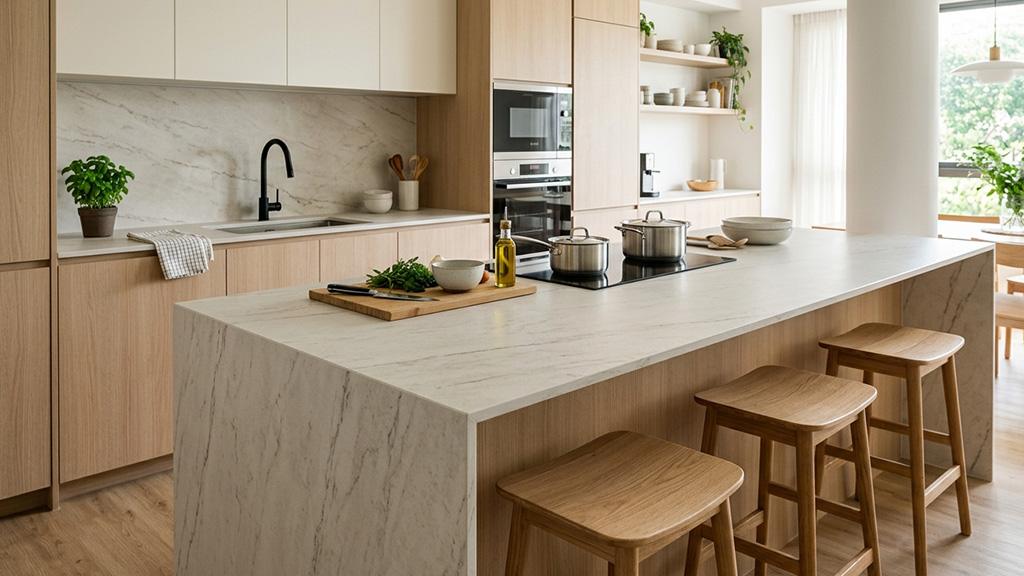
A 20mm slab is standard for a kitchen worktop surface. It provides sufficient weight and structural depth for most countertop layouts, including overhangs for breakfast bars and waterfall island edges. A 12mm slab works well for wall cladding and backsplash panels where a slimmer profile is preferable. The 6mm option is used for cabinet door fronts and furniture panels where minimal weight matters.
Large-format slabs, some up to 3,200mm by 1,440mm, allow fabricators to produce long runs of countertop with minimal visible seams. In a galley kitchen or a long island, a single slab can often cover the full run without a join. The visual result is a continuous surface that reads as one plane rather than sections.
Finishes include polished, matte, and textured options. Stone-look patterns replicating marble, concrete, and slate are widely available, with digital printing techniques producing finishes detailed enough to be convincing in a finished installation. For homeowners weighing sintered stone Singapore options against natural stone, the design range is now comparable while the maintenance requirement is significantly lower.
“The design flexibility of sintered stone has closed most of the gap with natural stone aesthetically. The practical gap (no sealing, no heat damage, no staining) still runs clearly in sintered stone’s favour for a working kitchen.”
What Countertop Installation Involves
The installation process for a sintered stone kitchen top differs from laminate or solid surface in a few important ways. Understanding the process helps homeowners ask the right questions before appointing a supplier.
Templating is the first step. A fabricator takes precise measurements of the kitchen layout, including the position of the hob, sink, and any wall returns. Sintered stone cannot be adjusted on site the way softer materials can. An accurate template is the foundation of a clean install.
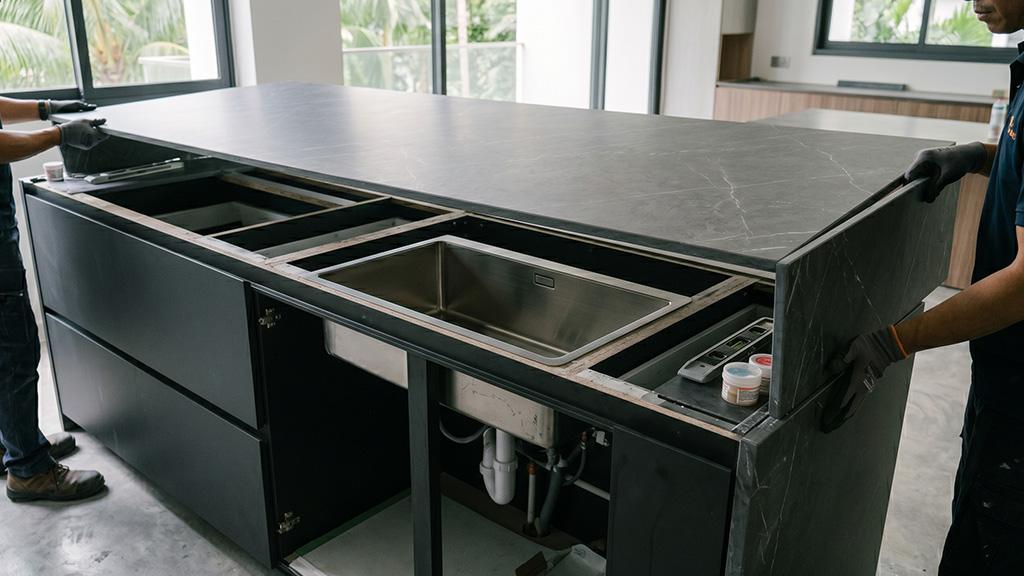
Fabrication involves cutting the slab to the template using water-jet or CNC machinery. Edge profiles are shaped at this stage. Common profiles include pencil-round, bevelled, and square edges. Waterfall edges and mitre joints, where the countertop continues vertically down the side of an island, are achievable with sintered stone but require precision fabrication. The absence of resins in the material means sintered stone is harder to work than quartz and requires experienced operators with the correct tooling.
Support is a structural consideration that matters more with sintered stone than with thicker materials. Cutouts for hobs and sinks create unsupported spans. The HDB renovation guidelines for building works require that countertop installation in HDB kitchens is carried out by registered renovation contractors. This applies to sintered stone as it does to any surface replacement involving hacking or structural change.
Seams should be placed away from high-stress areas. A seam positioned directly over a sink cutout or at a corner joint is a risk point. An experienced fabricator will advise on seam placement during the templating stage.
TSD’s guide to sintered stone countertops in Singapore covers fabrication precision in detail, including edge profile options and how installation quality affects long-term performance.
Sintered Stone vs Quartz: Which Makes More Sense for Your Kitchen?
This is the comparison most Singapore homeowners land on when researching kitchen countertops Singapore. Both are engineered surfaces. Both are non-porous and low-maintenance. The differences come down to heat tolerance, fabrication handling, and cost.
Quartz contains approximately 7 to 10 percent polymer resin, which gives it some flexibility but reduces its heat tolerance. Sustained heat from a hot pan placed directly on quartz can cause scorching or discolouration. Sintered stone contains no resin and handles direct heat without damage, which matters in a kitchen where pots come off the gas hob and onto the bench.
Quartz is slightly more forgiving under impact. The resin content acts as a buffer against sharp blows, reducing the risk of chipping at edges. For a busy household with young children, that difference is worth weighing.
On cost, sintered stone generally sits above quartz at the premium end, reflecting the more demanding fabrication process and material cost. The TSD comparison of sintered stone vs quartz countertops breaks down where each material wins across different kitchen conditions.
“Choosing between sintered stone and quartz isn’t a question of which is better. It’s a question of which performs better in your specific kitchen, for your cooking habits and your tolerance for maintenance.”
Is a Sintered Stone Kitchen Top Right for Your Renovation?
A sintered stone kitchen top suits homeowners who cook frequently, use high-heat burners, and want a surface that performs without ongoing maintenance. The material handles Singapore’s humidity and cooking environment well, requires no sealing, and stays visually consistent over many years of use. For homeowners who want a natural stone look without natural stone’s maintenance demands, sintered stone is a practical route. The key is choosing a supplier who handles fabrication and countertop installation in-house, with the tooling and experience that sintered stone requires.

Frequently Asked Questions
1. How long does a sintered stone kitchen top last?
With proper installation and standard care, a sintered stone kitchen top can last decades. The material does not fade, stain, or degrade with age under normal kitchen conditions. Its appearance in year fifteen is typically close to what it was on installation day, provided no sharp impact damage has occurred at edges.
2. Does sintered stone need to be sealed?
No. Sintered stone has a water absorption rate below 0.1 percent, which makes it effectively non-porous at the manufacturing stage. Unlike granite or unsealed marble, a sintered stone kitchen top never requires sealing, waxing, or surface treatment.
3. Can sintered stone be used in HDB kitchens in Singapore?
Yes. Sintered stone is suitable for HDB kitchen countertops. Any countertop replacement involving hacking or wet works must be carried out by an HDB-registered contractor under a valid renovation permit. Homeowners can confirm which works require a permit through the official HDB renovation guidelines.
4. What is the best thickness for a sintered stone kitchen top in Singapore?
For a standard kitchen countertop, 20mm is the most common and practical thickness. It provides structural depth for overhangs and hob or sink cutouts without unnecessary weight. Thinner profiles of 12mm are used for island tops with mitre edges or for wall cladding applications.
5. How does countertop installation for sintered stone differ from other materials?
Sintered stone requires precise templating and CNC or water-jet fabrication. The material cannot be trimmed easily on site. Experienced operators are needed to manage the hardness of the slab during cutting and edge profiling. Correct cabinet support beneath cutout areas is essential to avoid cracking under load.
Sintered stone has earned its reputation in Singapore kitchens through consistent performance across the conditions that matter most: heat, humidity, daily cleaning, and long-term appearance. Understanding what goes into fabrication and countertop installation, not just the visual appeal of the material, puts you in a better position to make a decision that holds up over time. That knowledge also makes conversations with suppliers more productive.
If you’re planning a kitchen renovation and want to compare sintered stone options across formats, finishes, and thicknesses, TSD’s full range of surfaces covers everything from slim 6mm wall panels to 20mm kitchen tops, with fabrication and installation handled in-house. You can also review TSD’s overview of kitchen countertops Singapore homeowners commonly consider to see how sintered stone compares across the full material landscape.