Key Takeaway
- Engineered stone is a manufactured surface material that is non-porous, needs no sealing, and holds up better than most natural stone in a daily kitchen.
- The two main types are quartz countertops and sintered stone. They look similar but perform very differently under heat.
- Quartz suits most HDB and condo kitchens well. Sintered stone is the better choice for high-heat cooking zones or outdoor use.
- Neither type needs sealing, polishing, or special cleaning products, which makes both a practical fit for Singapore’s humid climate.
- Knowing the difference between the two helps you pick the right material before fabrication begins, not after.
Introduction
Most homeowners planning a kitchen renovation come across the term “engineered stone” early on. Suppliers mention it. Interior designers recommend it. But the category covers more than one material, and the differences between them matter more than most people realise before they sign a quote.
Quartz countertops and sintered stone both fall under the engineered stone umbrella. Both are non-porous. Both come in designs that mimic natural stone. Both suit a kitchen renovation in Singapore far better than marble or unsealed granite for day-to-day use. But they are made differently, they handle heat differently, and they sit at different price points. Treating them as the same thing leads to the wrong choice for your kitchen.
The confusion is understandable. In showrooms, a quartz slab and a sintered stone slab in the same marble finish can look almost identical. The difference only becomes clear when you ask how they perform under a wok flame, what happens when you spill lime juice on them, or how they hold up after ten years of daily use. This guide answers those questions plainly.
This guide explains what engineered stone is, how the two main types compare, and what each one is best suited for in a Singapore home.
What Is Engineered Stone?
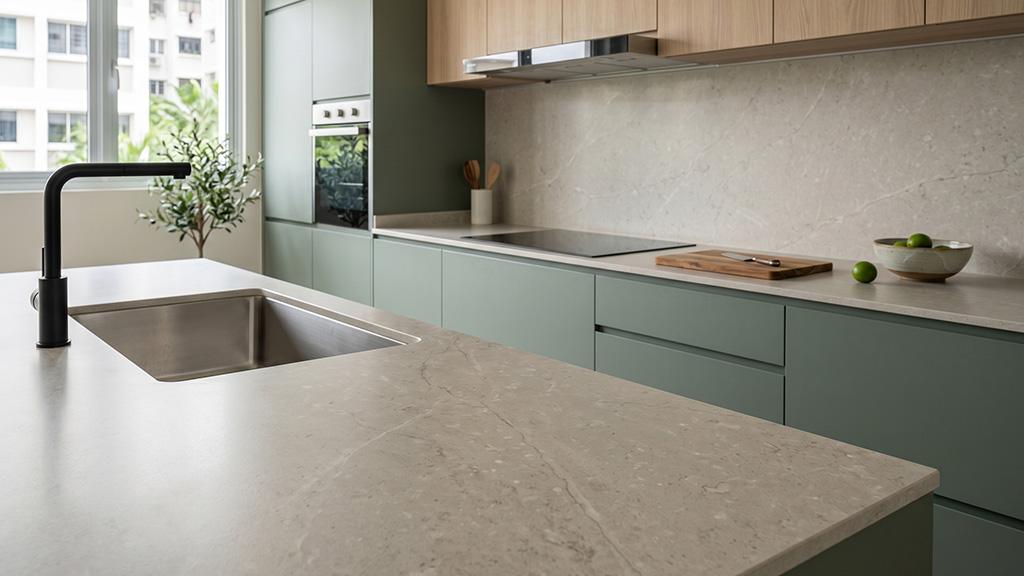
Engineered stone is a surface material made from natural minerals that have been processed into a dense, non-porous slab. Unlike natural granite or marble, which are quarried and cut from rock, engineered stone is manufactured to a consistent standard. Every slab from the same batch looks nearly identical. Two types exist under this term: quartz countertops, which use crushed quartz bound with resin, and sintered stone, which fuses minerals under extreme heat and pressure with no resin at all. Both are non-porous and need no sealing, but they perform differently in practice.
Quartz vs Sintered Stone: How They Compare
Both are engineered stone, but they are made in entirely different ways. Understanding the difference helps you pick the right one for your kitchen.
Quartz countertops are made from about 90 to 95% crushed quartz mixed with 5 to 10% polymer resin and pigments. The resin binds the quartz particles together and fills any gaps, creating a non-porous surface. It also gives quartz a slight flexibility that makes it more forgiving under impact. The downside is heat. Resin softens when it gets very hot. Placing a pan directly from a high-heat gas hob onto a quartz surface can cause discolouration or micro-cracking over time. Using a trivet prevents this. For most Singapore kitchens, this is a simple habit to adopt.
Sintered stone is made without resin. Natural minerals like silica, feldspar, and quartz are compressed under around 25,000 psi and fired at over 1,200 degrees Celsius. The result is a slab that is denser than quartz, contains no binder layer, and handles direct heat without any damage at all. It is also UV-stable, which means it won’t fade outdoors. The trade-off is cost and brittleness. Sintered stone costs more than quartz and requires more skilled installation because it chips more easily at unsupported edges.
Here is a side-by-side comparison:
| Feature | Quartz Countertops | Sintered Stone |
| Main composition | 90–95% quartz + resin | 100% natural minerals, no resin |
| Heat tolerance | Moderate: use trivets near hob | High: handles direct heat safely |
| Scratch resistance | Very good | Excellent |
| Impact resistance | Good: resin adds flexibility | Lower: can chip at edges |
| Needs sealing? | No | No |
| Outdoor use? | No: UV can yellow the resin | Yes: fully UV-stable |
| Price range | Mid to upper | Upper to premium |
| Best for | Most HDB and condo kitchens | High-heat zones, outdoor kitchens |
According to This Old House, engineered quartz offers exceptional hardness and stain resistance, with colour consistency that natural stone cannot match. TSD’s full comparison of sintered stone vs quartz countertops goes deeper on heat tolerance, budget, and which kitchen layouts suit each material.
“Quartz and sintered stone look similar in a showroom. The difference shows up in the kitchen, once the hob is on and the cooking starts.”
Engineered Stone vs Natural Stone: A Plain Comparison
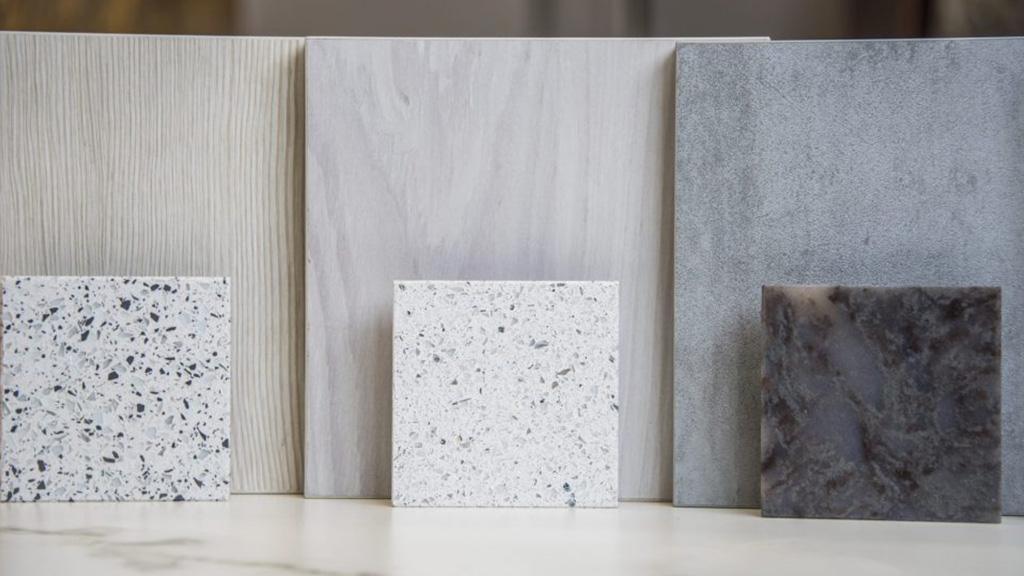
Natural stone like granite and marble has qualities engineered stone can’t fully copy. Each slab is unique. The veining and depth of real marble, in particular, have a visual richness that engineered finishes can only approximate.
But for a working Singapore kitchen, natural stone asks more of you. Here is how the two categories compare on the things that matter day to day:
| What matters | Engineered Stone | Natural Stone (Granite/Marble) |
| Needs sealing? | Never | Yes: every 1 to 2 years for granite, more often for marble |
| Stain resistance | High: non-porous surface | Lower: liquids can penetrate if unsealed |
| Acid damage (etching)? | No: surface is chemically stable | Yes: lime juice, vinegar, and soy sauce can dull marble permanently |
| Humidity resistance | Excellent | Moderate: sealing required to manage moisture |
| Appearance consistency | Same across all slabs | Every slab is different |
| Maintenance effort | Wipe down with mild soap | Regular sealing and careful cleaning are required |
| Cost | Mid to premium | Mid to very high, depending on stone type |
The etching point is one that most homeowners don’t hear about until after installation. Etching happens when acidic substances react with the surface of marble and dull the finish. A sealant does not stop etching. It only stops liquid from soaking in. Engineered stone doesn’t etch at all because the surface is chemically stable.
Singapore’s renovation platform Qanvast notes that engineered quartz is non-porous, meaning you almost never need to worry about staining or bacterial growth from moisture. For a busy household using the kitchen multiple times a day, that difference is worth understanding before you choose.
“Natural stone looks beautiful on day one. Engineered stone looks the same on year ten. For most Singapore kitchens, that trade-off is easy to make.”
Which Type of Engineered Stone Suits Your Kitchen?
Not every kitchen needs the same material. Here is a simple way to think about it:
Choose quartz countertops if:
- Your kitchen is in an HDB flat or condo and gets regular daily use.
- You cook frequently but don’t place very hot pans directly on the counter.
- You want a wide range of colour and pattern options at a mid-range price.
- You want a surface that is easy to clean and never needs sealing.
Choose sintered stone if:
- Your kitchen has a high-output gas hob and you cook with a wok regularly.
- You want an outdoor kitchen or alfresco cooking area where UV resistance matters.
- You want the longest possible lifespan with no resin layer to degrade over time.
- You have a larger renovation budget and want the most heat-resistant option available.
To put it in practical terms: a four-room HDB kitchen used for daily family cooking, including stir-fries and soups, suits quartz well. The hob and counter are typically separated by a backsplash zone, and hot cookware doesn’t land directly on the countertop surface. Quartz handles that environment without issue.
A condo with an open-concept layout where the island countertop runs flush with the cooking area is a different scenario. If the homeowner cooks with a high-output gas burner and wants the freedom to put a hot wok straight down without thinking about it, sintered stone removes that concern entirely. The higher cost reflects that specific advantage.
For most kitchen renovation Singapore projects, quartz is the practical default. It performs well, costs less than sintered stone, and handles the demands of daily local cooking without needing any special habits beyond using a trivet near the hob.
For higher-heat kitchens or outdoor builds, sintered stone is worth the extra investment. TSD’s guide to sintered stone countertops Singapore homeowners choose covers the material’s heat resistance, available formats, and installation requirements in detail.
Is Engineered Stone the Right Choice for Your Renovation?
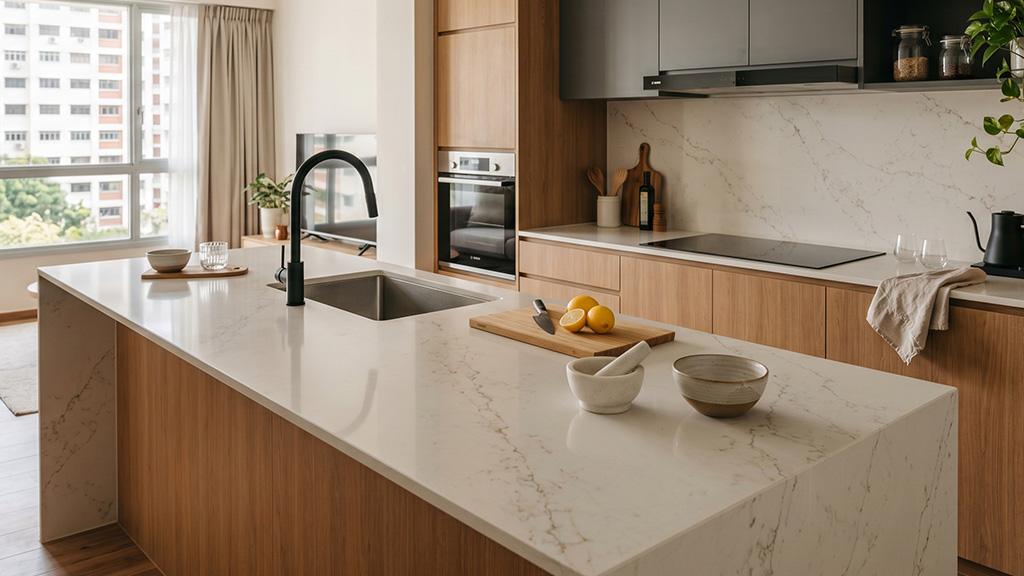
Engineered stone suits most homeowners planning a kitchen renovation Singapore who want a non-porous, low-maintenance surface that never needs sealing. For most HDB kitchens and condos, quartz countertops offer the best balance of performance and cost. For high-heat cooking zones or outdoor kitchens, sintered stone delivers better durability. Both outperform natural stone on maintenance, and both come in designs that closely match the look of granite, marble, and concrete.
Frequently Asked Questions
1. What is the difference between engineered stone and natural stone?
Engineered stone is manufactured from crushed minerals and binding agents, producing non-porous slabs that need no sealing and look consistent across every piece. Natural stone is quarried from the earth, has natural variation in pattern, and is porous, which means it needs periodic sealing to resist staining and moisture.
2. Is quartz the same as engineered stone?
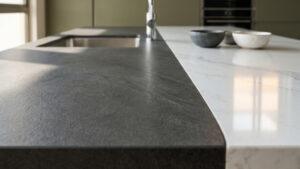
Quartz countertops are the most common type of engineered stone, but not all engineered stone is quartz. Sintered stone is also an engineered stone, but it contains no polymer resin and is made through a different high-heat process. The two materials look similar but perform differently, especially under heat.
3. Does engineered stone need to be sealed in Singapore?
No. Both quartz and sintered stone are non-porous by manufacture and never need sealing. This is a major practical advantage over natural granite and marble, which need periodic resealing to stay resistant to moisture and staining.
4. Which engineered stone is best for a kitchen renovation in Singapore?
Quartz countertops work well for most kitchen renovation Singapore projects. They are non-porous, easy to maintain, and available in a wide range of designs. For kitchens with high-heat cooking zones or outdoor applications, sintered stone is the stronger choice because it handles direct heat without risk of surface damage.
5. How long does engineered stone last in a Singapore kitchen?
With standard daily care, engineered stone countertops typically last 15 to 20 years or more. Sintered stone tends to last even longer because it has no resin layer that can dull or deteriorate over time. Proper installation matters for both: good cabinet support and correct seam placement extend the lifespan significantly.
Engineered stone has become the standard countertop choice in Singapore renovations for straightforward reasons. Both quartz and sintered stone resist staining and humidity without needing any upkeep beyond a simple wipe-down. The decision between the two comes down to heat exposure, budget, and how you actually use your kitchen. Getting that right before fabrication saves time and avoids expensive replacements later.
One thing worth doing before you finalise your choice: visit a showroom and look at both materials under the same lighting. Photographs online rarely capture how a finish reads in person, and the thickness and edge profile of a slab can change the look significantly. Running your hand across a matte sintered stone panel and a polished quartz slab in the same colour gives you information that no product listing can. It also gives your supplier a chance to ask the right questions about your kitchen layout, cooking habits, and renovation timeline before they prepare a quote.
If you’re ready to compare options in person, TSD’s range of surfaces covers quartz, sintered stone, and granite across formats and finishes, with in-house fabrication and installation in Singapore. You can also browse TSD’s detailed guide to quartz countertops Singapore homeowners choose to see how selection criteria apply to your specific kitchen layout.