Key Takeaway
- Sintered stone wall panels are one of the most durable and low-maintenance materials for feature walls in Singapore homes.
- Large-format slabs with minimal grout lines create a cleaner, more premium finish than individual tiles across the same area.
- The material works in living rooms, bedrooms, bathrooms, and kitchens, with different finishes suited to each space.
- Stone-look wall panels in sintered stone require no sealing, resist moisture, and don’t fade, making them suitable for both indoor and outdoor feature walls.
- Planning the slab size, finish type, and lighting before installation makes a significant difference to the final result.
Introduction
A feature wall does one job well: it gives a room a clear focal point. Done well, it grounds the space and makes the rest of the room feel considered. Done poorly, it looks like an afterthought, or worse, a visual distraction that clashes with everything around it.
Sintered stone wall panels have become one of the more popular feature wall choices in Singapore homes over the past few years. Not just for high-end condos or commercial lobbies, but increasingly in HDB renovations where homeowners want a hotel-quality finish without the ongoing maintenance that natural marble or granite requires.
This guide covers the main feature wall ideas where sintered stone performs well, how to choose the right finish for each room, and what to plan before you commit to installation. Practical, room-by-room, with the detail that most inspiration articles leave out.
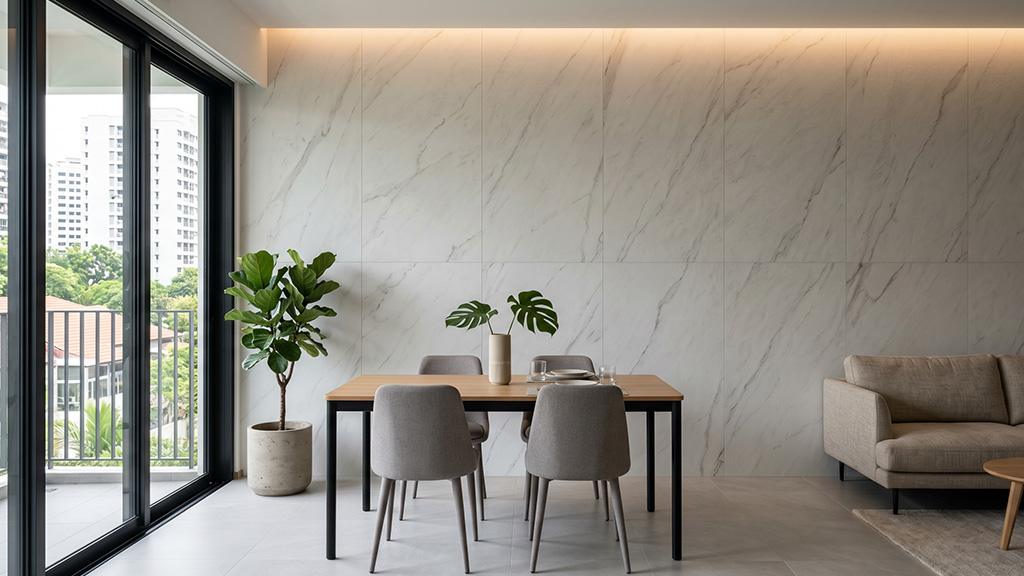
What Are Sintered Stone Wall Panels?
Sintered stone wall panels are large-format surface slabs made from natural minerals, including silica, feldspar, and mineral oxides, fused under extreme heat and pressure. The sintering process produces a non-porous, dense material with virtually zero water absorption. Unlike ceramic tiles or natural marble, sintered stone wall panels require no sealing, resist moisture and staining, and don’t etch when exposed to acidic substances. They are available in thicknesses as slim as 6mm for wall applications, which makes them light enough for vertical installation without straining the wall structure. Finishes range from polished and matte to textured, with stone-look designs replicating marble, concrete, slate, and travertine.
Living Room Feature Walls: The TV Wall Done Properly
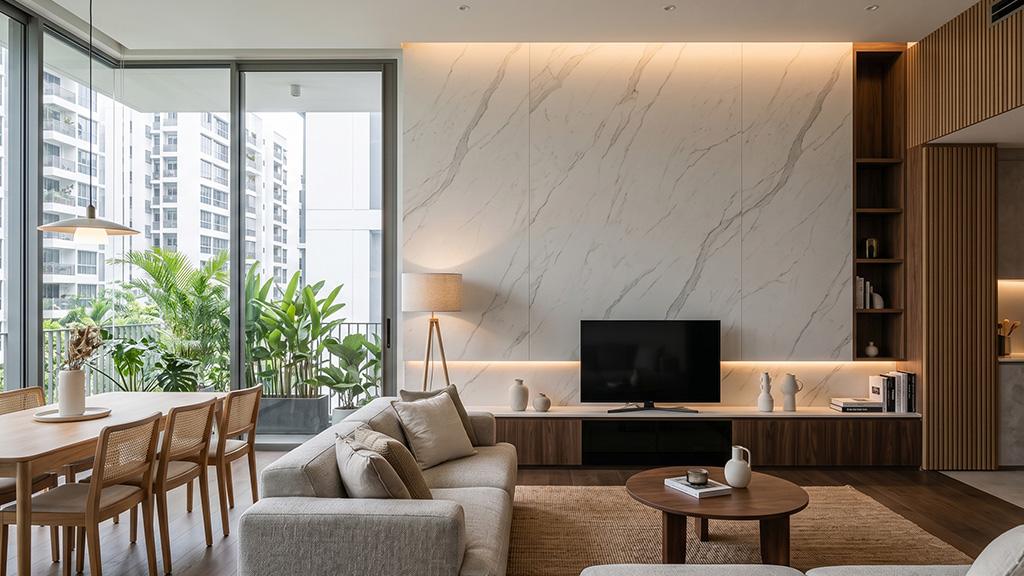
The TV wall is the most common feature wall in a Singapore living room. Most homes treat it as a functional requirement and do the minimum. A stone-look wall panel behind the television changes that calculus entirely.
A large-format sintered stone slab, running floor to ceiling or countertop to ceiling, creates a continuous visual plane. The veining in a marble-effect finish draws the eye and gives the wall a sense of depth that paint or wallpaper simply cannot produce. Brands like Dekton and Neolith offer marble-look finishes where a single 3,200mm by 1,440mm slab can cover most of a living room wall with one seamless piece, or two book-matched pieces for a symmetrical effect.
The practical benefits matter equally. A living room feature wall made from sintered stone does not need dusting or wiping beyond a standard clean. It won’t peel, crack, or discolour from air conditioning condensation, which is a real issue for painted walls in Singapore’s climate. For a room that doubles as a home office or a family space with children, that durability removes a maintenance concern entirely.
Lighting amplifies the effect. Recessed cove lighting positioned above the panel or LED strips built into the TV unit below cast light across the surface and highlight the texture of the finish. Matte and honed finishes read particularly well under warm lighting, while polished finishes work better in well-lit rooms where the reflectivity adds brightness rather than glare.
For feature walls in HDB living rooms, checking HDB’s renovation guidelines for building works confirms which wall finishes require a permit and which can proceed without one. Most sintered stone wall panel installations on internal non-structural walls fall under standard finishing works and do not require prior approval, though a registered contractor must carry them out.
“A living room feature wall in sintered stone doesn’t require you to choose between looking good and being practical. Both come with the same slab.”
Bedroom Feature Walls: The Bedhead Wall
The bedhead wall is the second most common feature wall request in Singapore bedrooms. A well-executed bedhead wall makes the entire bedroom feel more intentional, and it’s one of the easier walls to work with because it carries no functional load: no TV cables, no power sockets to work around.
Sintered stone wall panels work particularly well here in matte and honed finishes. The softer, non-reflective surface suits the quieter visual language of a bedroom and reads as warmer than a polished finish in a smaller space. Textured finishes that replicate sandstone or rough concrete add physical depth to the wall without requiring any additional furnishings around it.
For a condo master bedroom, a full-height sintered stone panel behind the bed, running from the floor to the ceiling, makes the ceiling feel higher than it is. In a smaller HDB bedroom, a half-height panel from floor to mattress height is a lighter intervention that still creates a clear focal point without making the room feel heavy.
The non-porous surface also removes a hygiene concern that painted or wallpapered bedhead walls carry in Singapore. A sintered stone panel behind a pillow area doesn’t absorb moisture or harbour dust in the same way that textured paint or fabric finishes do.
Bathroom Feature Walls: Where Sintered Stone Really Earns Its Place
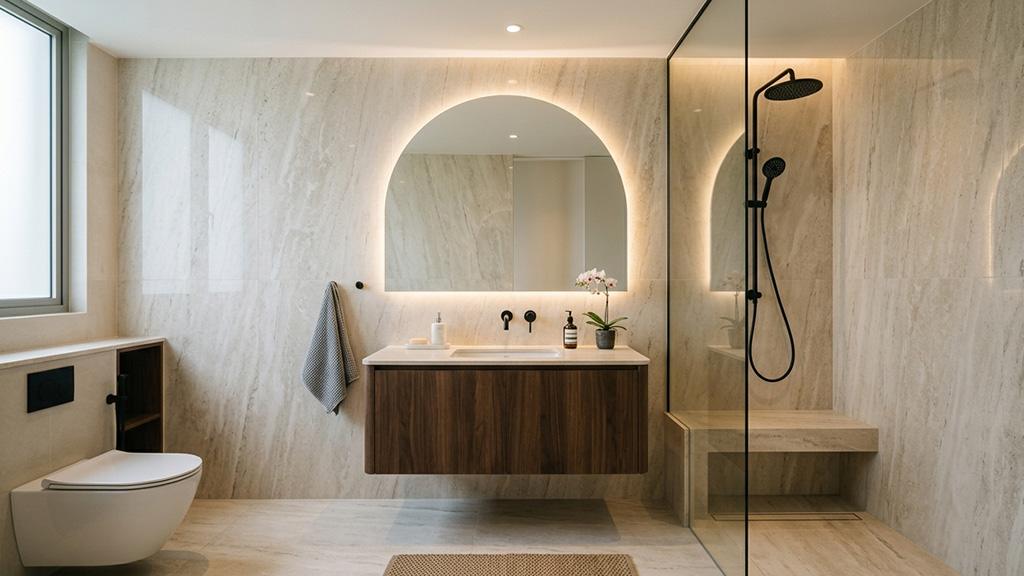
Bathrooms are where sintered stone wall panels justify their cost most clearly. A bathroom feature wall behind the vanity, or a full wet wall behind the shower, puts every other material to the test. Moisture, steam, cleaning products, and daily contact all act on a bathroom surface in ways that a living room wall never experiences.
Natural marble looks beautiful in a bathroom but requires sealing and careful maintenance to stay that way. Grout between tiles collects mould and discolouration over time, especially in Singapore’s humidity. Sintered stone wall panels in a bathroom remove both problems at once. The non-porous surface sheds moisture, resists cleaning products, and has no grout lines in a full-slab installation.
Stone-look wall panels in a marble or travertine finish behind a floating vanity are one of the most popular interior design Singapore requests TSD receives. The visual effect of a floor-to-ceiling stone panel behind a wall-mounted basin unit creates a spa-like aesthetic that homeowners associate with boutique hotels. The maintenance reality is a weekly wipe-down with a damp cloth.
For shower enclosures, sintered stone panels at 6mm thickness are installed directly onto waterproofed walls. The result is a grout-free shower wall that looks cleaner, stays cleaner, and lasts considerably longer than tiled alternatives. TSD’s overview of sintered stone countertops and surfaces in Singapore covers the material’s moisture and stain resistance properties in detail.
“The bathroom is where low maintenance stops being a convenience and becomes a genuine performance standard. Sintered stone meets that standard.”
Kitchen Feature Walls: The Backsplash and Beyond
Kitchen feature walls typically mean the backsplash zone, but sintered stone wall panels can extend beyond the standard splashback height to create a full feature wall behind the hob and countertop area.
A full-height kitchen feature wall in sintered stone, running from countertop to the underside of overhead cabinets and continuing up to the ceiling, creates a unified surface that reads as a single plane rather than a wall with a functional section added to it. In open-concept kitchens where the cooking zone is visible from the living area, this finish lifts the entire space.
The practical case is strong. Sintered stone handles direct heat, grease, and steam without any surface damage. It doesn’t absorb cooking odours or liquids. A single-panel installation eliminates all grout lines in the cooking zone, which is precisely the area where grout discolouration happens fastest in Singapore kitchens.
For homeowners considering the full range of uses for sintered stone wall panels in their home, TSD’s guide to elevating spaces with sintered stone wall panels covers residential and commercial applications with a Singapore-specific context.
Choosing the Right Finish for Your Feature Wall
Not all sintered stone finishes suit every room. Here is a straightforward guide:
Polished finishes reflect light and add brightness. They suit living rooms with good natural or artificial light, and work well in larger bathrooms. In smaller or darker spaces, the reflectivity can feel cold.
Matte finishes absorb light and create a softer, warmer effect. They suit bedrooms, Japandi-style interiors, and any space where the goal is calm rather than drama. They are also more forgiving of fingerprints and minor marks in daily use.
Honed finishes sit between polished and matte. The surface is smooth to the touch but carries minimal sheen. They suit bathrooms and contemporary living rooms where you want the tactile quality of polished stone without the full reflectivity.
Textured finishes, including rough concrete or slate-look surfaces, add physical dimension to a wall. They work well as accent panels in living rooms or outdoor feature walls where depth and visual interest are the goal.
This Old House notes that engineered stone surfaces offer colour and pattern consistency that natural stone cannot replicate, which is directly relevant to feature walls where a continuous, uninterrupted stone finish across a large area depends entirely on slab-to-slab uniformity.
What to Plan Before Installation
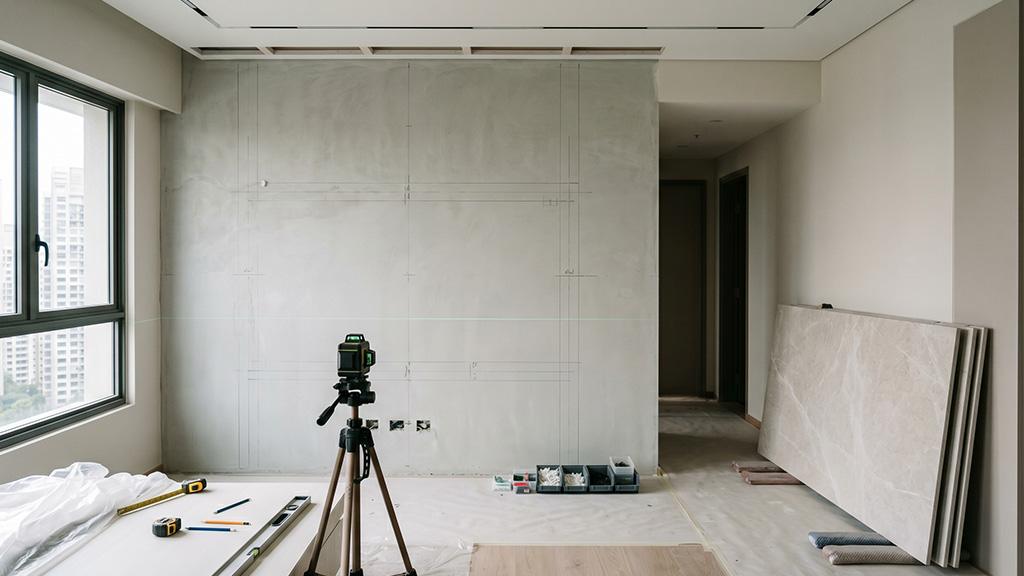
Feature wall installation for sintered stone is not the same as hanging wallpaper or applying paint. A few things to work out before any material is ordered:
Wall condition and substrate. Sintered stone panels must be installed onto a flat, sound substrate. Uneven walls need to be levelled first. The adhesive system used for non-porous surfaces differs from standard tile adhesive, and using the wrong product causes bond failure.
Panel size and seam placement. Large-format panels minimise seams but require careful planning around room dimensions. A seam placed at eye level on a bedhead wall reads differently from one placed at the edge of the panel, near a corner. Your fabricator should plan this before cutting.
Lighting. Decide whether you want integrated cove lighting, LED strips, or recessed downlights before the panels are installed. Retrofitting lighting to a finished sintered stone wall is significantly harder than planning it before the panels go up.
Thickness. For wall applications, 6mm is the standard. It is light enough for vertical installation and carries the same surface properties as thicker slabs used for countertops.
TSD’s guide to sintered stone wall panels covers the installation process in detail, including substrate requirements, panel formats, and how to achieve grout-free finishes in practice.
Are Sintered Stone Wall Panels the Right Choice for Your Feature Wall?
Sintered stone wall panels suit homeowners who want a durable, low-maintenance feature wall with a premium stone-look finish. They perform well in every room of a Singapore home, handle the local climate without degradation, and require no sealing or specialist cleaning. The right panel size, finish type, and lighting plan make the difference between a feature wall that elevates the room and one that simply fills a wall.

Frequently Asked Questions
1. Can sintered stone wall panels be used in HDB flats in Singapore?
Yes. Sintered stone wall panels are suitable for HDB feature walls. At 6mm thickness, the panels are lightweight and don’t place excessive load on walls or structures. Any installation involving wet works or structural changes should be carried out by an HDB-registered contractor.
2. Do sintered stone wall panels need to be sealed?
No. Sintered stone is non-porous at the manufacturing stage and never requires sealing. This is one of the main advantages over natural marble or granite wall panels, which need periodic sealing to resist moisture penetration, especially in wet areas.
3. What is the best room for a sintered stone feature wall in Singapore?
All rooms suit sintered stone feature walls, but bathrooms show the clearest performance advantage. The non-porous, grout-free surface handles moisture, steam, and cleaning products without degrading. Living rooms show the strongest visual impact, particularly on a TV wall with complementary lighting.
4. How thick should sintered stone wall panels be for a feature wall?
For most feature wall applications, 6mm panels are the standard. They are light enough for vertical installation, carry the same surface properties as thicker slabs, and suit both full-height and half-height installations. Thicker panels are used for countertops, not wall cladding.
5. How do sintered stone wall panels compare to large-format porcelain tiles?
Sintered stone and large-format porcelain share non-porous surfaces and similar visual ranges, but sintered stone is denser, harder, and more resistant to heat and UV exposure. Sintered stone is the stronger choice for outdoor feature walls and kitchen backsplash zones. Porcelain tiles are generally lower in cost and more widely available at smaller formats.
Sintered stone wall panels give Singapore homeowners a surface that delivers a premium aesthetic without the maintenance demands of natural stone or the limitations of paint and wallpaper. Whether you’re planning a living room TV wall, a bathroom vanity backdrop, or a full-height kitchen feature, the material holds up under the conditions that Singapore interiors face daily.
If you’re ready to see what sintered stone wall panels look like across different finishes and formats, TSD’s showroom carries a full range with in-house fabrication and installation in Singapore.