Key Takeaways
- Cooking intensity should drive your first filter. High-heat daily cooking narrows the field quickly, sintered stone or granite hold up best, while solid surface and quartz need more care under flame.
- Non-porous surfaces make the most sense for Singapore kitchens. Humidity and frequent cooking create real hygiene risks on porous materials. Whereas quartz, and sintered stone all handle this better than unsealed granite.
- Layout complexity affects which material works best. Compact HDB kitchens with L-shapes or tight corners benefit from invisible seams. Solid surfaces are the only material that can deliver that smoothly.
- Maintenance expectations should be set before purchase. Granite requires annual sealings; the other three don’t. If the household has limited time for upkeeps, lower-maintenance options are better.
- Design direction and function can coexist with the right material choice: Each surface has a distinct visual identity. Map the aesthetic goals to the materials, then meet them and ensure the performance specs match with the daily routine.
Introduction
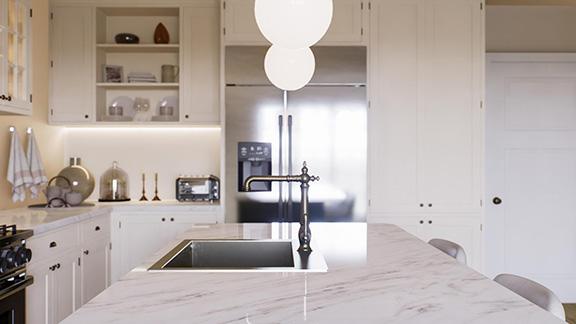
A countertop is one of the most used surfaces in any household and one of the least reversible decisions in a kitchen renovation. Choosing kitchen countertops in Singapore involves a specific pattern that is beyond aesthetics.
Singapore experiences high humidity levels which reach approximately 84% together with its residents’ heavy cooking practices and small kitchen spaces which disrupt the long-term performance of countertop materials. Property owners show increasing demand for surfaces that refuse to absorb liquids and withstand high temperatures while maintaining easy cleaning because those surfaces handle daily use, moisture, stains and cleaning products.
This guide focuses on the comparison framework, the four key areas to evaluate before any material is shortlisted. The climate, the cooking style, the kitchen layout, and even the cleaning products in the cabinet all play a role in how well a surface performs over time.
Learn More : Silestone Singapore: Explore Premium Quartz Surfaces That Combine Style With Easy Maintenance
The Singapore Kitchen is Not a Generic Space
Before walking through the comparison criteria, it helps to acknowledge what makes kitchen countertops in Singapore, a distinct category. Three conditions consistently shape material performance here that do not apply in most other markets.
-
Tropical Humidity
Singapore’s year-round humidity increases the degradation of porous surfaces. Stones like unsealed granite absorb moisture quickly, which, over time, can create mould growth at the joins and darken the surface near the sink. Non-porous countertop materials, such as quartz, solid surface, and sintered stone, are far more resistant to this effect.
-
High-Heat and Pigment-Heavy Cooking
Wok hei cooking, daily frying, and dishes involving turmeric, chilli, and tamarind are normal in Singapore households. These have two simultaneous stresses on a countertop: first, the thermal shock from sudden heat, and second, the deep pigment exposure that can permanently stain surfaces without adequate sealing. Not all stone surfaces handle both well.
-
Compact Layouts
The majority of kitchen renovation Singapore projects take place in HDB flats, where the kitchen runs between six and ten square metres on average. In that space, every decision is zoomed in, including how visible joins are, how curved edges are possible, and how much the countertop contributes to the overall sense of space.
The 4 Areas That Actually Determine the Right Fit
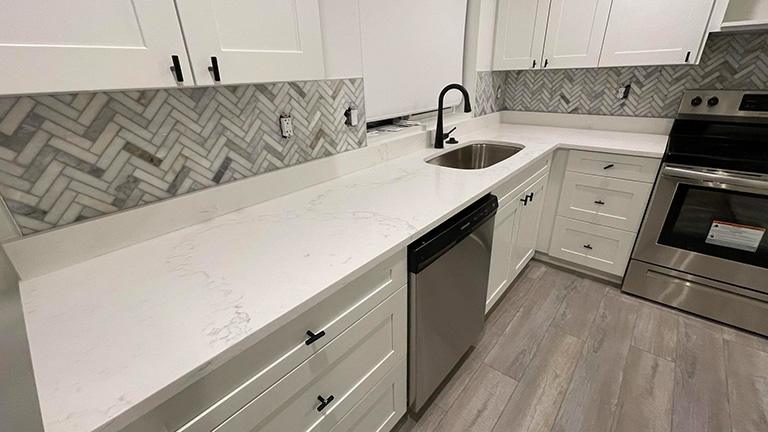
Once the local context is clear, the evaluation comes down to four areas. Running any countertop material through all four gives a reliable picture of whether it suits your specific situation.
-
Area 1: Daily Cooking Habits
This is the most important filter and the one most commonly skipped. Cooking habits determine what kind of physical stress the countertop faces every day.
Ask yourself how often your household uses a wok or cooks over a high flame. If you are thinking daily, heat resistance becomes a non-negotiable. Stones like granite and sintered perform well in this category. Quartz tolerates moderate heat but should not have hot pots placed directly on it. Solid surface has the lowest heat tolerance of the four common options.
Staining is the second cooking-related concern. Turmeric, chilli oil, and dark sauces leave permanent marks on porous surfaces, if not wiped immediately. The ones that cook these dishes regularly, a non-porous countertop material is the only realistic option, which rules out unsealed granite.
- Heavy wok cooking daily: Granite or sintered stone
- Moderate cooking with some high heat: Quartz or sintered stone
- Light meal prep and reheating: Any material prioritises aesthetics and budget
- Heavy pigment use (curries, sauces): Avoid porous surfaces; choose quartz, sintered stone, or solid surface
-
Area 2: Kitchen Layout and Configuration
Layout determines where the joins will fall and whether certain design features are even possible. This matters more than most homeowners realise.
- In an L-shaped or U-shaped kitchen, countertop joins occur at the corners. With the most stone surfaces, those joints are visible; the skill of the fabricator determines how neat they look, but they cannot be made invisible.
- Solid surface is a common countertop material, with joins that can be fused and polished. For hygiene-conscious homeowners or those who dislike visible lines in their kitchen, this is a meaningful difference.
- Integrated sinks, where the sink bowl is part of the countertop rather than a separate fixture, are only possible with solid surface. This eliminates the rim that collects grease and grime around conventional sinks, a real advantage in a busy kitchen.
For long straight runs in open-plan kitchens or islands, the seam question is less pressing. The choice can be based more freely on aesthetics and performance.
How Does Each Material Performs Across the Four Areas?
The table below maps each common countertop material against the four comparison areas. Use it as a quick reference during shortlisting conversations with your designer or supplier.
| Comparison Factor | Solid Surface | Granite | Quartz | Sintered Stone |
| Heat from wok/high-flame cooking | Low tolerance — trivets required | High — handles heat well | Moderate — avoid direct contact | Very high — best performer |
| Staining from turmeric, chilli oil | Non-porous — resists stains well | Porous — stains without sealing | Non-porous — resists stains | Non-porous — resists stains |
| Impact from dropped cookware | Can dent — repairable by buffing | Hard — chips possible but rare | Hard — chips possible | Extremely hard — very chip-resistant |
| Suitability for daily heavy cooking | Moderate — better for light use | Good — if sealed regularly | Very Good — low maintenance | Excellent — built for high use |
| Visible seams at joins | None — fused invisibly | Visible on all joins | Slightly visible | Slightly visible |
| Curved or shaped edges possible | Yes — fully shapeable | Limited — standard profiles | Limited — standard profiles | Limited — standard profiles |
| Integrated sink (no separate rim) | Yes — can be seamlessly fused | No | No | No |
| Suitable for compact HDB kitchens | Excellent — seamless finish saves visual space | Moderate — seams visible in tight layouts | Good — wide colour range helps | Good — slim slab options available |
| Annual sealing required | No | Yes — at minimum once yearly | No | No |
| Ease of daily cleaning | High — mild soap and water | Moderate — avoid acidic cleaners | High — mild soap and water | High — very low maintenance |
| Scratch repair at home | Yes — fine scratches buffable | No — professional repair needed | No — fills visible | No — surface too hard to sand |
| Hygiene (bacteria resistance) | Excellent — non-porous | Poor (unsealed) / Good (sealed) | Excellent — non-porous | Excellent — non-porous |
| Colour/pattern consistency | High — uniform batches | Low — natural variation per slab | High — engineered consistency | Moderate — varies by brand |
| Replicates marble/concrete look | Moderate | No — natural granite patterns only | Good — wide pattern range | Excellent — very convincing replicas |
| Suitable for minimalist aesthetics | Very good — clean, seamless surfaces | Moderate — natural variation can clash | Very good — consistent finishes | Excellent — slim, refined slabs |
| Edge profile options | Unlimited — fully customisable curves | Standard to ornate carved profiles | Standard profiles | Standard profiles |
| Indicative cost (SGD/metre run) | SGD 200–600 | SGD 350–900 | SGD 400–1,000 | SGD 500–1,200 |
| Installation complexity | Moderate — seamwork requires skill | High — heavy, needs support | Moderate | High — very heavy slabs |
| Long-term value / lifespan | 15–20 years with care | 20+ years if sealed regularly | 15–20 years | 20+ years |
Which Questions Homeowners Ask at the Wrong Stage?
Homeowners typically ask their renovation questions at an inappropriate time because they should have asked those questions earlier in the process. The answers to their questions about renovation work will become more expensive to obtain because their existing work has reached advanced stages of completion.
-
“Which material is the most popular right now?”
Quartz is the most commonly installed countertop material in Singapore kitchen renovation projects, but that reflects its broad suitability rather than a universal fit. However, cooks at very high heat every day may be better served by sintered stone regardless of what is trending.
-
“Can I change my mind after installation?”
Countertop replacement is expensive and disruptive, in most kitchens, it involves removing the sink, disconnecting plumbing, and potentially disturbing the cabinetry. Time spent comparing materials before installation is time saved from a difficult and expensive change later.
-
“Is a higher price always better?”
Not for every household. Sintered stone outperforms solid surface on heat resistance, but if you cook at moderate temperatures, you are paying a premium for performance you will not use.
The goal is not the highest-rated material, it is the right material for your specific comparison areas.
also read : Granite Countertops Singapore: Timeless Beauty and Unmatched Durability for Your Luxury Kitchen
Conclusion
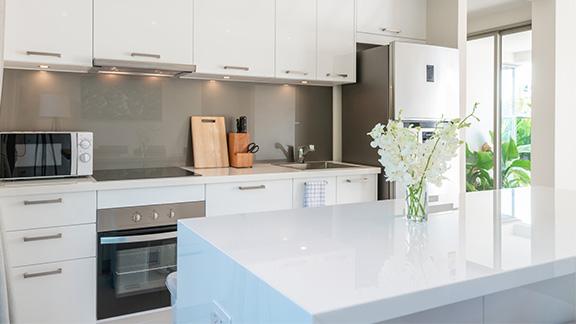
The surface you choose for your kitchen will be there for the next 15-20 years. It will face daily heat, moisture, staining agents, and physical impact, and it will be wiped down thousands of times. Getting that decision right is less about which material is premium and more about which one suits how your household actually lives.
The four comparison areas, cooking habits, layout, maintenance, and design direction, give you a structure for that evaluation before any showroom conversation. Use them to sharpen your brief, and the shortlisting process becomes considerably more straightforward.
TSD is structured as a one-stop surface specialist, managing every stage of the project internally. With years of experience in both residential and commercial stonework, TSD helps property owners compare materials not just by appearance, but by how they perform in actual Singapore kitchens.
Get a minimalist countertop, a heat-resistant kitchen island, granite countertops Singapore solutions, marble-inspired dining table top, quartz table tops, custom fabrication, edge profiling, or a professional installation services based on how your household truly uses the space.
Explore premium kitchen countertops Singapore homeowners trust, compare quartz countertops Singapore collections, or discuss customised sintered stone Singapore solutions, contact TSD today. Call +65 6908 5147 or visit the showroom at 16 Joo Koon Circle.
FAQs
-
What should I compare first when choosing kitchen countertops in Singapore?
Start with daily cooking habits, specifically, heat levels and the types of ingredients you cook with regularly. This single factor eliminates or confirms several materials immediately. From there, work through layout, maintenance, and design in that order.
-
Which countertop materials work best for Singapore’s climate?
Non-porous materials, quartz, solid surface, and sintered stone, are better suited to Singapore’s humidity and cooking patterns than natural granite. They resist moisture absorption, do not require sealing, and are easier to maintain at a hygienic standard in a tropical environment.
-
How do countertop materials affect a kitchen renovation in Singapore?
The material choice affects both the renovation process and the kitchen’s long-term performance. Heavier materials like granite and sintered stone may require additional structural support.
-
Are stone surfaces a good choice for HDB kitchens?
Stone surfaces, granite, quartz, and sintered stone, all work in HDB kitchens, but with different trade-offs. Quartz is the most practical for compact spaces: it is non-porous, widely available, and available in a wide range of finishes.
-
Does the type of countertop material I choose affect the resale value of my kitchen in Singapore?
In the HDB resale market, the countertop material itself rarely drives significant valuation differences. What matters more is the overall condition and cohesion of the kitchen finish.