Key Takeaways
- A curved kitchen island places different structural and fabrication demands on a surface material than a straight countertop run does.
- Not every stone handles curves equally. Sintered stone and quartz both work well, but they require waterjet or CNC cutting rather than standard bridge saw cuts.
- The tightness of the curve radius directly affects material suitability. Tighter radii eliminate some options.
- Edge profile choice matters more on a curved island than anywhere else in the kitchen, because it determines how the curve reads visually and how safe the surface feels to navigate around.
- Working with a fabricator who has in-house waterjet capability is the most reliable way to achieve a clean, chip-free curved edge on any stone surface.
Introduction
A typical homeowner looks at a kitchen island much like he would look at any other choice of surfaces; he decides on the material first and shape second. That logic fits for a straight island run. It fails for a curved kitchen island.
As stated in the Houzz kitchen renovation statistics, almost all people who either add or renovate their kitchen islands (98%) use storage elements in the island. In the same statistics, 39% prefer islands with a length between 6 feet and 7 feet, whereas 34% prefer larger islands.
Curve geometry brings a different perspective to the discussion. The seamless appearance of this feature in a showroom picture is the result of an intricate process that involved fabrication from specialised machinery, tolerance of the radius, and material compatibility with the manufacturing process. Certain materials do well in making curves. Other materials tend to chip, fracture at the edges, or create a seam that ends up at the worst possible spot for a curve.
The intention is not to dissuade people from making a curved island. On the contrary, it is to make sure that they know what they are getting into before deciding on the material and the radius. What should be decided before proceeding with fabrication are the following issues, what is the right material for your curve and what can you expect from the fabrication process.
What is a Curved Kitchen Island?
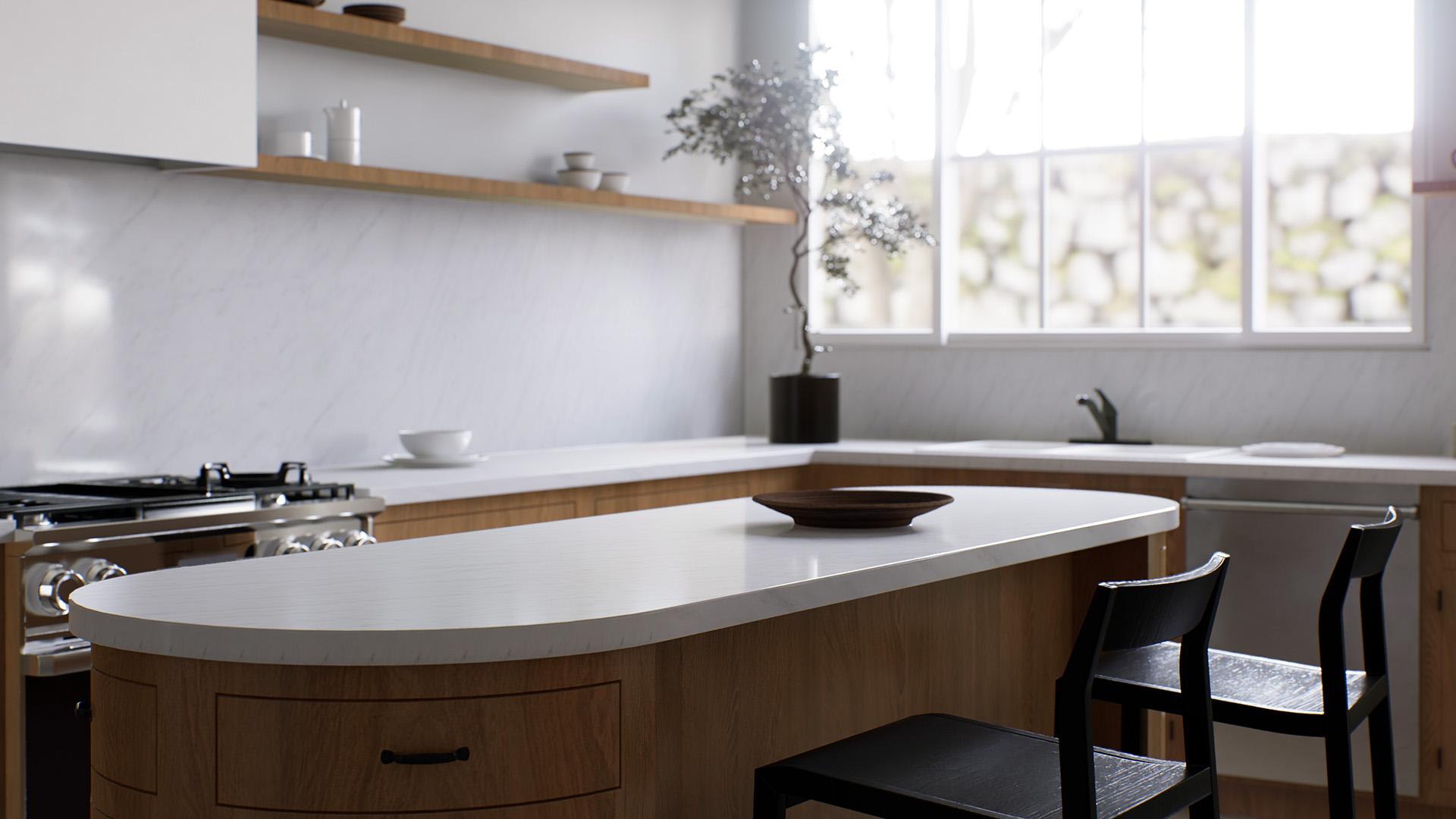
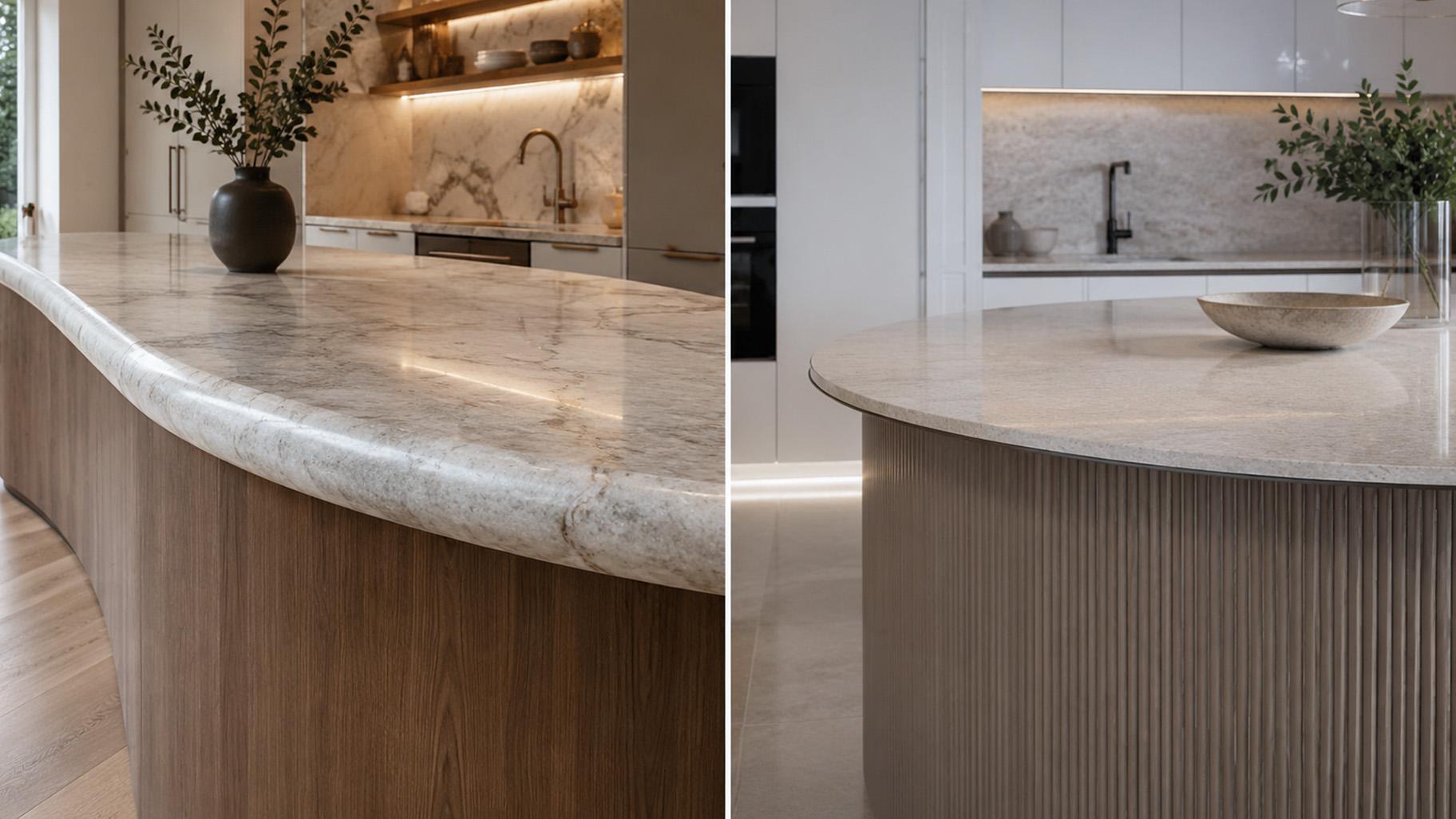
A curved kitchen island is an independent kitchen counter whose one or several sides have a curve rather than being straight. The curve can be either throughout the entire length of the counter, at one end, or on the side where there will be seating in the form of a bow front.
There are also some kitchens that are entirely oval or pill-shaped. Other kitchens feature a slight curve on one side, whereas the other side is straight. The radius of the curve is the most crucial factor when selecting materials for the counter.
How the Curve Radius Changes Everything?
A gradual curve, typically between 600mm and 900mm radius, gives a fabricator far more flexibility than a tight radius below 300mm. The tighter the curve, the more demanding the cutting process becomes, and the more the material’s brittleness or flexibility under stress matters.
| Material | Performance on Curves | Main Risks at Tight Radii | Fabrication Requirements |
| Granite | Handles gradual curves well under waterjet cutting. The kerf is narrow, the edge face stays clean, and the material’s density helps it hold its profile without fracturing. | Granite becomes more brittle at tight radii. Thin curved sections have less mass to resist stress, which can lead to internal fractures days or weeks after installation due to weight or thermal movement. | Waterjet cutting is preferred for clean, stable curved edges. |
| Quartz | Behaves more predictably across a wider range of radii because its resin content provides slightly more tolerance for tension. | The main issue is edge chipping if tooling is incorrect or blade speed is poorly calibrated. Quartz remains rigid and non-flexible despite being less brittle than granite. | Requires properly calibrated tooling and precise cutting speeds for curved sections. |
| Sintered Stone | Delivers highly precise and permanent curved profiles when fabricated correctly. The zero-porosity surface also prevents moisture infiltration at curved edges over time. | Its extreme hardness makes it the most difficult material to cut on curves. Standard equipment causes visible chipping that polishing cannot fully conceal. | Requires waterjet or high-tolerance CNC tooling. Standard bridge saw methods are unsuitable for precise curved cuts. |
As detailed in the Dynamic Stone Tools guide to waterjet cutting for stone, custom-radius kitchen islands specifically require waterjet cutting because standard bridge saw methods cannot achieve the same precision edge quality on non-linear shapes. Before selecting a material or committing to a tight curve radius, confirm your fabricator has this capability.
Material Performance on a Curved Kitchen Island
| Material | Advantages | Limitations | Fabrication Notes | Best Use |
| Sintered Stone | Strongest long-term performance. No etching, sealing, or moisture infiltration risk. Holds finish permanently. Large slabs up to 3200mm reduce seam joints. | Most demanding material to fabricate on curves. | Requires waterjet or CNC tooling. Equipment must be calibrated to the slab thickness and brand density. | High-performance curved islands with minimal maintenance. |
| Quartz | Widely available in Singapore. Handles a broad range of radii well. Better resistance to edge chipping than natural stone. Easier seam colour-matching. | Heat sensitivity at edge zones. Overhangs beyond ~200mm require additional support planning. | Performs consistently during fabrication and works well for prep and dining surfaces. | Multi-functional islands used for cooking and seating. |
| Granite | Ideal for natural stone movement and unique veining. Performs well on gradual curves. | Higher fracture risk below 300mm radii. Seams require careful grain alignment. | Requires experienced fabricators familiar with natural stone curvature work. | Homeowners prioritising natural aesthetics and variation. |
| Marble | Elegant natural appearance. Works well on low-contact seating sides. | Etches under acidic contact. A softer surface requires careful edge polishing. | Similar curve tolerance to granite but needs more delicate finishing work. | Decorative or dining-side applications rather than heavy prep zones. |
Edge Profile on a Curved Island
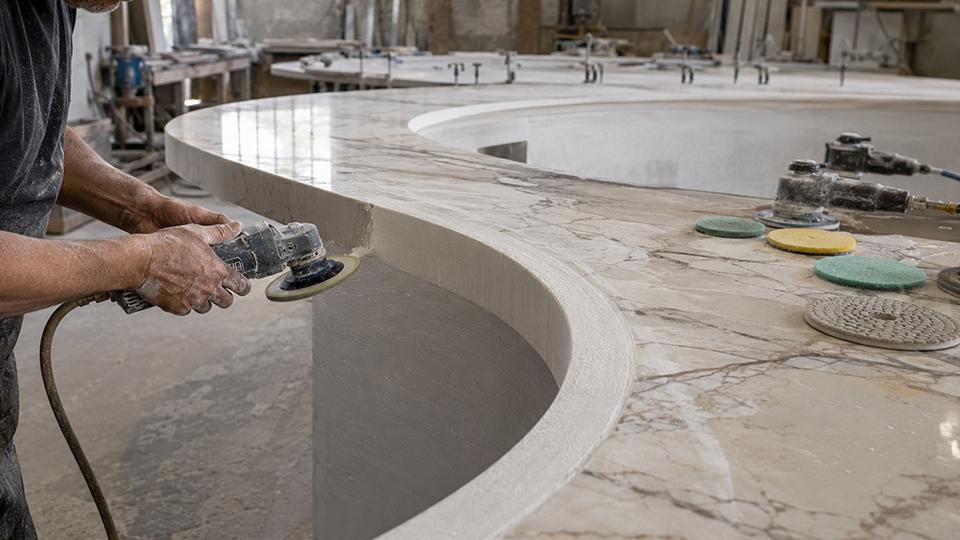
Edge profiles behave differently on curved stone than on straight runs. A standard eased edge on a straight counter reads as a clean, simple line, but on a curved island, the same profile changes visually depending on slab thickness and how light moves across the curve.
- Thicker profiles
- Bullnose or laminated edges emphasise the curve visually.
- Make the island feel heavier and more substantial.
- Work best in larger kitchens where the island is the visual anchor.
- Thinner profiles
- Can appear slightly insubstantial on large curved islands.
- Provide less visual weight to the curve.
On a curved kitchen island table used for seating, the edge profile also affects comfort and safety.
- A sharp eased edge can feel uncomfortable against the thighs during extended seating.
- A soft bullnose or pencil-round profile removes this issue.
- According to Ideal Home, rounded curved islands are safer in family kitchens because they reduce hip and shin impact points in high-traffic areas.
The edge profile also affects finishing after waterjet cutting.
- A raw waterjet edge is smooth but unpolished.
- Fabricators polish the edge to match the slab face before applying the profile.
- On long curved perimeters, polishing and profiling are time-consuming.
- Confirm the chosen profile can be applied consistently across the entire curve, including inside or concave sections.
Seam Planning on a Curved Island
Most curved kitchen islands require at least one seam because the perimeter exceeds the standard slab length of 2800mm to 3200mm. Seam placement on a curved island requires more planning than on a straight run.
- A seam should never sit at the apex of the curve, where visual exposure is highest.
- It should be placed toward one end of the island or in an area partially hidden by seating.
- The seam also requires solid cabinet support beneath it.
- On curved cabinet bases, seam placement must be coordinated with the cabinetmaker’s support structure.
As noted by Dynamic Stone Tools:
“Seam placement on an island is one of the most consequential decisions in stone fabrication. It affects structural durability, aesthetic quality, and customer satisfaction simultaneously.”
Material handling also differs at the seam point.
- Sintered stone
- Uses a straightforward adhesive seam.
- No moisture infiltration risk.
- Granite and marble
- Require rodding beneath curved seams.
- This involves cutting underside channels and inserting epoxy-bonded steel rods for added tensile strength.
- Confirming this process before cutting helps prevent common post-installation seam failures on natural stone curves.
What to Confirm Before Your Fabricator Begins?
Before cutting begins, ask your fabricator for a digital island layout showing:
- The full curved perimeter
- Seam positions
- Cabinet support points
- Curve radius at every section
Radius changes are common in custom curved islands, and each variation must be accounted for in the cutting programme.
Confirm how the curves will be cut.
- Waterjet and CNC routers
- Both are suitable for curved stone fabrication.
- Produce precise, chip-free edges when properly calibrated.
- Require operators experienced with the specific material.
- Bridge saw with hand finishing
- Signals limited capability on curved work.
- Requires further questioning before proceeding.
Also confirm the chosen edge profile can be applied consistently across the full curve, including inside or concave sections.
- Bow-front islands often require concave edge profiling at the ends.
- Concave sections are more technically demanding than convex curves.
- Not all fabrication shops have the tooling for this work.
For kitchen countertops Singapore projects involving curved forms, material selection and fabricator choice should happen together. The right material with the wrong fabricator, or the right fabricator with the wrong material for the curve radius, both lead to poor results.
Is a Curved Kitchen Island Right for Your Kitchen?
A curved kitchen island works best in open-plan kitchens where the island sits in open space and improves traffic flow from all sides.
- Functions well as both a prep surface and social counter.
- Creates a softer transition between kitchen and living areas than a rectangular island.
- Particularly effective in Singapore open-concept condo layouts where the island is visible from the living space.
A curved island is less practical in certain layouts.
- Compact kitchens where the curve reduces usable floor space.
- Islands positioned against walls or enclosed on three sides.
- In these cases, straight or L-shaped islands are more practical and cost less to fabricate.
If a curved island suits your layout, finalise these decisions together during the planning stage:
- Material selection
- Fabrication method
- Edge profile
Resolving these details before ordering stone produces the best overall result. Discover more about choosing the right stone material for a kitchen island table and how each performs in the Singapore context.
FAQs

- What stone is most suitable for a curvy kitchen island?
Sintered stones and quartz both work well in curvy kitchen islands. Sintered stones provide the best long-term performance of the surface without any possibility of etching, sealing, or moisture in the seams. Quartz is more accessible and reacts uniformly to different degrees of curves. Granite is appropriate for slow curves but needs attention when it comes to tighter curves. Marble is a good choice aesthetically but not for the main working area of the island.
- Is there a possibility of curved stone being cut by any fabricator for the kitchen island?
No, there isn’t a guarantee. Curved stone, especially sintered stone and tight quartz, has to be cut using a waterjet or CNC machine in order to get a smooth edge. Otherwise, without such machinery, fabricators use bridge saws and manual polishing, resulting in poorer quality when dealing with non-linear cuts. Always check the cutting methods before choosing the fabricator.
- Why do different curvatures affect material costs?
Tight curves lead to an increase in production time, tool wear, and chances of material waste in case of a repeat cut. All these contribute to increased production costs. As a rule of thumb, any curvature of the island below 300 mm needs to be addressed upfront before ordering the stone.
- Does the design of curved kitchen islands involve using more seams compared to straight islands?
There is no need for using additional seams, but seam placement is much more difficult in the case of curved islands. A seam in a curved island cannot fall into the apex of the curve, must fall over a point of support on the cabinet base, and take into account the visual interpretation of the seam from the principal view of the room. In this way, the seam location becomes a much less flexible parameter in the case of a curved island.
- Is it harder to process curved sintered stone than curved quartz?
Sintered stone is harder to process than quartz because of its high material density; it can be processed by waterjet or special CNC tools designed for this material. When properly done, the result is superb. If the wrong processing tools are used, there is an edge chipping problem that cannot be fixed later. This material is somewhat less sensitive to slight deviations in calibration, while quartz is not.
Conclusion
Unlike the straight island countertop, the curved island countertop does not have anything to do with making things complicated but involves an entirely different process of fabrication that depends on factors such as choice of material, curve radius, edge treatment, and seam placement.
At TSD, we feel that these issues must be sorted out at the beginning so that the end result serves its purpose aesthetically as well as functionally. Our in-house fabrication process encompasses templating, waterjet cutting, edge profiling, and installation of the curved island countertop, and we do this using surfaces such as quartz, granite, marble, terrazzo, and sintered stone.
For those intending to create a curved kitchen island, we encourage you to contact us prior to its production. Our address is 16 Joo Koon Circle Singapore 629047, contact number +65 6908 5147, and email is tsd.enquiry@gmail.com, where you can ask about the right materials to use, the right edges, as well as the process of fabrication in relation to your curve radius.
We provide consultations via appointments to aid home owners in assessing their surfaces, edge profiles, and fabrication needs. Whether small condo kitchens or big open space kitchens, we always work with our clients during the entire process from choosing materials all the way to the installation of their kitchens.