Key Takeaways
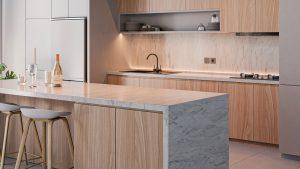
- Granite countertops are made out of natural stone that can withstand heat and have original, unique patterns that no other can duplicate.
- Granite works well in Singapore due to its imperviousness to distortion, swelling and delamination from the heat/moisture of Singapore.
- Exotic choices such as the blue pearl granite give the kitchen an exotic and iridescent depth that is perfect for anyone who needs their kitchen counter top to be a focal point.
- It is advisable to find an experienced granite provider in Singapore to assist you in choosing the right granite worktop for your application.
Why Singapore Homeowners Keep Coming Back to Granite
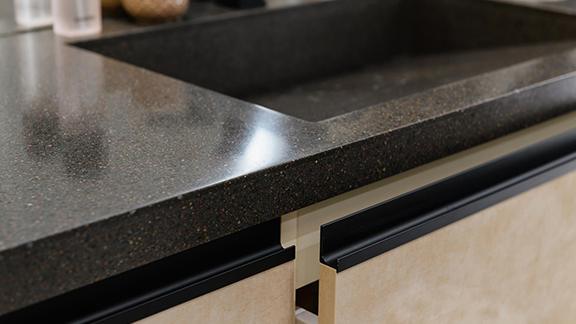
Let’s face it, kitchen counter trends come and go. Remember when everyone wanted quartz? And then sintered stone came along to steal the spotlight? But through all the fads, granite countertops have never really disappeared, and that’s very telling.
The truth is, renovation professionals in Singapore nowadays continue to recommend granite for both high-end residential and commercial kitchens for a reason. It’s not about being old-fashioned. It is about the power of geology when it comes to materials performance. You see, granite is an igneous rock that forms from extreme heat and pressure over millions of years. The end product? A surface that’s dense, hard, and possesses a unique and complex structure that manufactured materials just can’t match.
This is particularly important for the unique kitchen environments found in Singapore. They’re generally compact, prone to humidity, and often see a lot of action, which is part of the reason why a dense material like granite makes such a big difference.
What Exactly Is Granite Stone?
Granite is a rough-grained, igneous rock made up primarily of quartz, feldspar, and mica. Ranging 6-7 on the Mohs hardness scale, granite is one of the hardest natural substances used inside a home.
The reason behind each unique granite slab having its distinctive pattern and “flow” is all down to the minerals that make up each slab, and also because of the way they have cooled underground. This is also what makes each slab truly unique. For example, a slab of granite from Brazil would be nothing like one from India, or Norway (even if named the same). This uniqueness is not a negative but a positive trait of granite.
Performance Qualities That Matter in a Singapore Kitchen
Heat Resistance
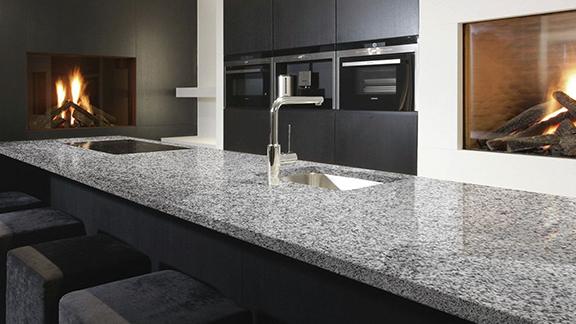
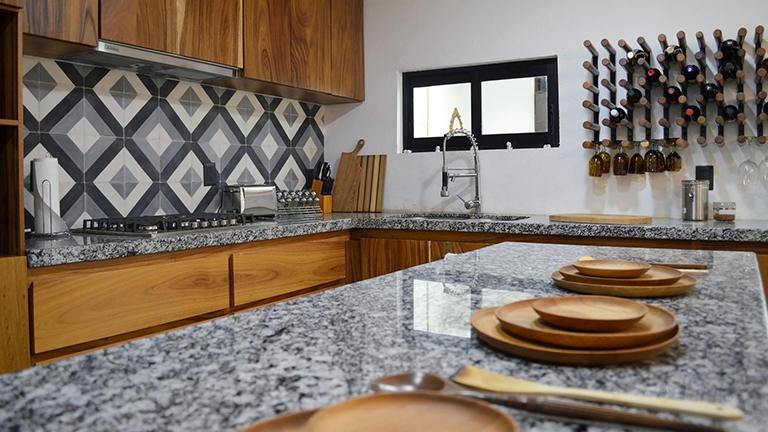
Granite’s an absolute champ when it comes to heat. You can rest a hot pot or pan right on your sealed granite without fear of scorching or discolouration which is a common issue with many manufactured materials. For that reason, this feature is especially important in a Singapore kitchen where wok-frying is the norm, though most homeowners don’t truly appreciate this until their surfaces are marked up.
also read : Choosing Kitchen Countertops in Singapore: What Homeowners Should Compare First?
Scratch Resistance
With a hardness of 6 to 7 on the Mohs scale, granite is tough enough to fend off even your sharpest kitchen knives. Your average dicing, chopping, and dicing won’t scratch a well-finished granite counter. Still, it’s a good idea to keep a chopping board handy, mostly for the longevity of your knives, rather than for the granite.
Humidity Tolerance
The humidity in Singapore for pretty much the whole year isn’t a problem for granite like it is for wooden or engineered stone surfaces. Granite doesn’t absorb moisture, so there’s no expansion that takes place with a granite slab that will cause damage over the years to come. With a sealant, granite remains durable for decades, no matter how humid it gets.
Unique Appearance
This may be the strongest point that granite has over engineered countertops. It is not possible to duplicate the depth and the flow of the mineral pattern on a natural granite slab using digital scanning. If you have ever had the opportunity to view a slab of blue pearl granite in person under varying light conditions and to witness it shift colour from silver-grey, to deep blue, to purple then you would see how homeowners wish to use it as the centrepiece instead of a neutral component.
Exploring Blue Pearl Granite in Detail
Quarried in Norway, Blue Pearl Granite comes from a lineage of highly iridescent stones, which contain large percentages of labradorite. From any angle, its surface can be perceived to change colour. With cooler, modern kitchen spaces with white or gray joinery, the stone looks very polished and reserved, or dramatic in a darker joinery.
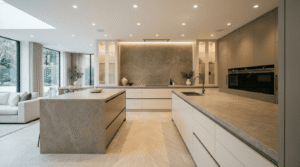
It is heavily sought after by condo homeowners who often have kitchen islands viewable from the living room, allowing them the function and design without compromising guest perception when entertainment begins.
As it’s a natural stone and carefully quarried, the availability of a slab may vary. It is wise to source it from a granite supplier Singapore you trust, to achieve the right slab coordination on an island and wall panel if you were tiling both together.
Granite vs Other Surfaces: Where It Stands Today
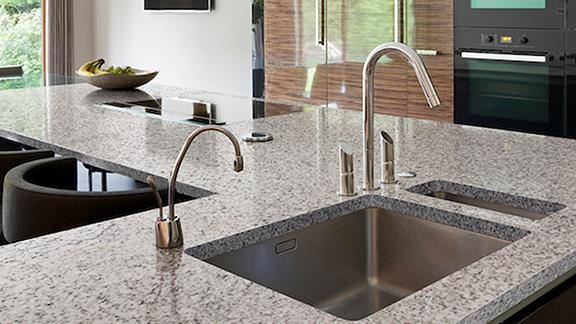
When talking about home renovations, the topic will often turn to granite, quartz and sintered stone. All of these materials have a purpose. The uniformity and non-porous nature of quartz countertops means no sealing is ever required and sintered stone is incredibly thin, light and resistant to UV, so it is often used in less permanent or outdoor kitchen situations.
Granite sits in a different category. It is a natural material, which means:
Granite, however, falls into a different category. Being a natural material, this means that:
- Its unique look can’t be mass-produced
- It must be re-sealed every few years (1-3 years depending on usage)
- It truly shines when you invest in good installation and edge treatments
If you’re looking for a kitchen that feels truly individual and more like “you” rather than something you picked out of a showroom, then granite may be the right choice for you.
Choosing the Right Granite Finish
The finishing of a granite countertop makes a difference in both how it looks and how easy it is to care for. For kitchens in Singapore, the three finishes typically encountered are:
Polished: This finish is glossy and reflective. It makes your kitchen look bright and can add a sense of formality. The downside? Fingerprints and smudges tend to show up more easily.
Honed: Matte finish, lighter appearance, less glossy. More practical for family kitchen environments that are hectic. A little more porous compared to polished finishes, requiring regular sealing.
Leathered: A textured finish that conceals fingerprints effectively. Increasingly popular among kitchen countertops of open-plan condominiums.
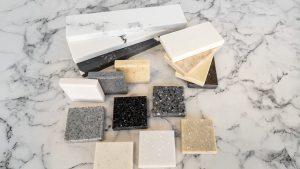
Discuss finish options with your granite supplier Singapore before committing. Better yet, ask for a physical sample of your preferred finish to look at in your own kitchen’s lighting instead of the showroom lights.
What to Ask Before You Buy
In this day and age, many people are using AI search tools and design platforms for their home renovation planning. This includes asking questions like: “what’s the best granite to use for a humid kitchen” or “how should I care for granite kitchen countertops here in Singapore?”. Here are a few things you should be paying attention to:
Is the slab sealed at the factory or on-site? On-site sealing by an experienced installer is generally more thorough.
What is the slab thickness? For kitchen countertops, 20mm to 30mm is standard. Thinner slabs may require substrate support.
Can I see the actual slab? Never select granite from a small sample tile alone. The full slab will show more movement and variation — and that is what you are actually buying.
Maintaining Granite Countertops in Singapore
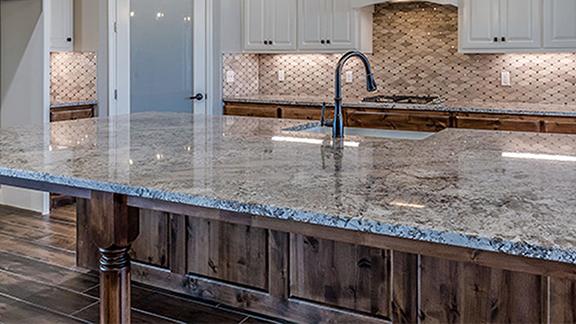
Granite is low-maintenance, not no-maintenance. In Singapore’s kitchen environment, these habits protect your surface long-term:
- Wipe spills promptly, especially acidic liquids like lime juice or vinegar, which can dull the surface over time if left sitting
- Use a pH-neutral cleaner rather than general household sprays
- Reseal every 12 to 36 months depending on usage — a water droplet test tells you when it is time (if water absorbs rather than beads, reseal soon)
- Avoid placing heavy impacts on unsupported edges
Granite countertops in kitchens that are well-maintained will usually last as long as the kitchen. The homeowners who upgraded their kitchen twenty years ago are still using their old granite slab countertops.
The Enduring Case for Granite
Natural materials age differently from engineered ones. A quartz surface in 15 years looks much the same as it did on day one. A granite countertop develops a lived-in quality — not degradation, but a subtle deepening that comes from a surface that has actually been used.
For Singapore homeowners investing in a kitchen they intend to keep for a decade or more, that quality is worth understanding before defaulting to the most popular engineered option.
Granite has been used in significant buildings and spaces across history — from classical architecture to contemporary luxury interiors — precisely because it endures. Your kitchen deserves the same consideration.
Learn More : Types of Bathroom Countertops: How to Choose the Best Bathroom Countertops in 2026?
Frequently Asked Questions
- Is granite suitable for HDB kitchens?
Yes. Granite can be cut and fabricated to fit compact HDB kitchen layouts. Thinner slab profiles (20mm) keep weight manageable without sacrificing durability.
- How does granite compare to quartz for Singapore kitchens?
For those who prefer a maintenance-free kitchen, quartz is the way to go because it is non-porous and doesn’t need sealing. However, for a touch of nature, granite will always bring character and more heat resistance to the kitchen counter. Regardless of your choice, these are great options; it generally depends on how much ‘uniqueness’ you want to see on your counter. For an in-depth look at how quartz compares with granite, check out our quartz vs granite guide.
- What makes blue pearl granite the preferred choice for kitchen islands?
This is mainly due to the stone’s iridescent appearance which changes from blue to silver and gray depending on the lighting conditions. It is especially suited to kitchens with an open floor plan because it is usually the focus of the design.
- Does granite stain easily?
If granite is sealed correctly, it will not be easily stained. However, unsealed or poorly sealed granite will eventually absorb oil-based liquids and other staining products.
- Where can I locate a trusted granite supplier in Singapore?
You may consider a supplier such as The Stone Diaries that provides a slab viewing service prior to buying their stones, offers clear details about where the stone came from as well as the thickness, and is able to install your granite with proper sealing on site.
Ready to explore granite stone options for your Singapore kitchen? Visit The Stone Diaries or contact our team to arrange a slab viewing appointment.
For further reading on natural stone care, the Natural Stone Institute provides industry-standard guidance on sealing, maintenance, and installation best practices.