Key Takeaways
- A Japandi kitchen Singapore renovation lives or dies by its surface decisions. The countertop is the most visible horizontal plane in the space and must carry the style without disrupting it.
- Matte and honed finishes are the default for Japandi because they absorb light rather than reflect it, producing the diffuse, calm surface quality the aesthetic depends on.
- Stone-look sintered stone gives Japandi kitchens the organic texture of natural stone without the sealing and etching maintenance that marble and limestone require.
- Colour tone matters as much as finish. Japandi palettes run warm, not cool. Beige, warm grey, off-white, and soft taupe work. Stark white and cold blue-grey don’t.
- Countertop edge profile is a detail most Japandi guides skip. A slim eased or pencil-round edge on a 20mm slab reads correctly; a thick laminated edge or ogee profile works against the aesthetic entirely.
Introduction
Most kitchen renovation content treats Japandi as a cabinet and colour decision. Choose light oak doors, keep the palette neutral, add black hardware, and the style follows. That framing is useful as far as it goes, but it stops too early. In a Singapore kitchen where the countertop is visible from the living and dining area and occupies one of the largest continuous surfaces in the home, the material and finish choice at the worktop level determines whether a Japandi kitchen actually reads as calm and intentional or simply looks like a minimalist kitchen that hasn’t been finished yet.
The countertop details that matter in a Japandi kitchen are specific. They are not especially complicated, but they are easy to get wrong when the surface decision is treated as secondary to cabinetry. This blog maps those details precisely: which finishes, which tones, which surface characters, and which edge profiles work in a Japandi kitchen in Singapore, and which ones quietly undermine the whole composition.
What Is a Japandi Kitchen?
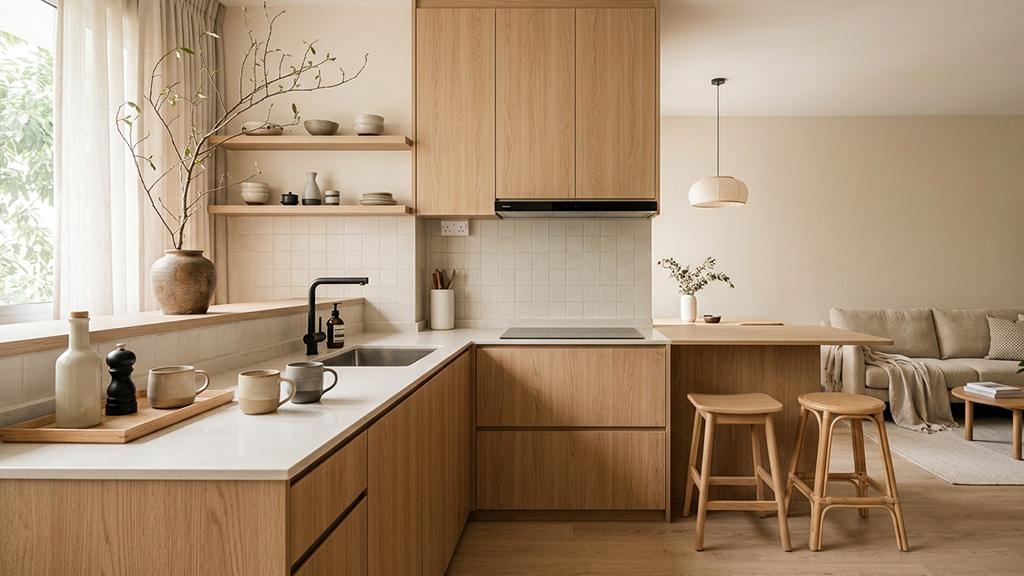
A Japandi kitchen blends Japanese minimalism with Scandinavian functionality. The result is a kitchen that prioritises calm, natural materials, and intentional restraint over decoration or visual complexity. According to Ideal Home’s guide to Japandi versus Wabi-Sabi kitchens, Japandi is neat and purposeful, with soft neutral colours, simple cabinetry, and a mix of light woods and black accents. Cabinetry in a Japandi kitchen is simple: flat slab doors in light oak tones or neutral hues, with hidden or minimal hardware. Every element earns its place.
In Singapore, Japandi translates particularly well to open-plan condo and HDB layouts where the kitchen is visible from the living zone. The uncluttered aesthetic suits compact spaces, and the emphasis on surface quality over surface quantity means a well-chosen countertop material does significant visual work in a small footprint.
Why the Countertop Is the Most Demanding Surface in a Japandi Kitchen
In a Japandi kitchen, every visible surface must contribute to a single impression: calm, warm, and deliberate. Cabinets, flooring, and backsplash all play a role, but the countertop occupies the most exposed horizontal plane and carries the most daily contact. It is where light falls most directly, where imperfections read most clearly, and where a material that performs inconsistently over time becomes a visible problem.
Corner Renovation’s Japandi kitchen materials guide identifies stone as a grounding material in Japandi kitchens, playing a functional and architectural role where countertops become part of the restrained design rather than just work surfaces. Subtle pattern and a barely noticeable finish character look particularly effective, maintaining a calm and refined look. This is the brief that every Japandi kitchen Singapore countertop selection must meet.
The Finish Decision: Matte, Honed, or Polished
Finish is the single most consequential decision for a Japandi kitchen countertop, ahead of material and ahead of colour. Polished finishes reflect light, amplify movement in the stone pattern, and draw attention to the surface itself. In a Japandi kitchen, the countertop should recede slightly rather than dominate. A polished surface does the opposite. It competes with the calm material palette rather than supporting it.
Matte finishes absorb light and produce a flat, quiet surface quality. They suit the Japandi aesthetic directly, but carry a practical consideration in Singapore kitchens: a matte finish on a porous natural stone will show cooking residue and moisture contact more readily than a polished finish on the same material. The maintenance requirement increases. For homeowners who want a low-maintenance Japandi kitchen in Singapore, this is worth knowing before specifying a matte natural stone.
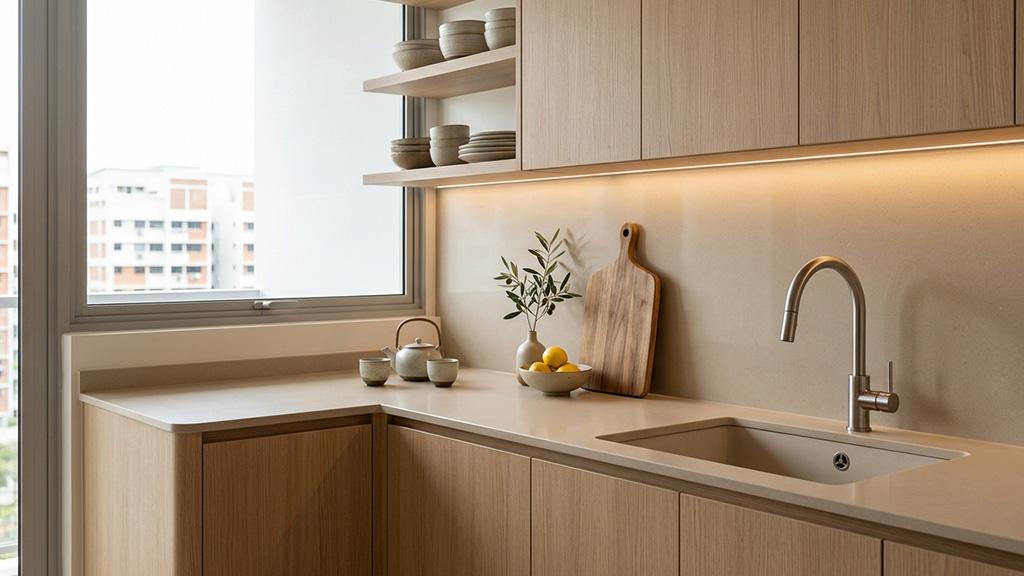
Honed finishes occupy the practical middle ground. The surface is smooth without shine, producing the low-reflectivity quality that Japandi requires while remaining easier to clean than a full matte finish. Honed sintered stone in a warm grey or beige tone is one of the most functional surfaces available for a Japandi kitchen Singapore renovation because it delivers the aesthetic without the maintenance burden.
“Matte surfaces are an important detail of the Japandi style, supporting a calm and soft atmosphere. They are soft to the touch, reduce glare, and give the space a refined softness.” (Ideal Home, Japandi vs Wabi-Sabi Kitchens)
Colour Tone: Warm, Not Cool
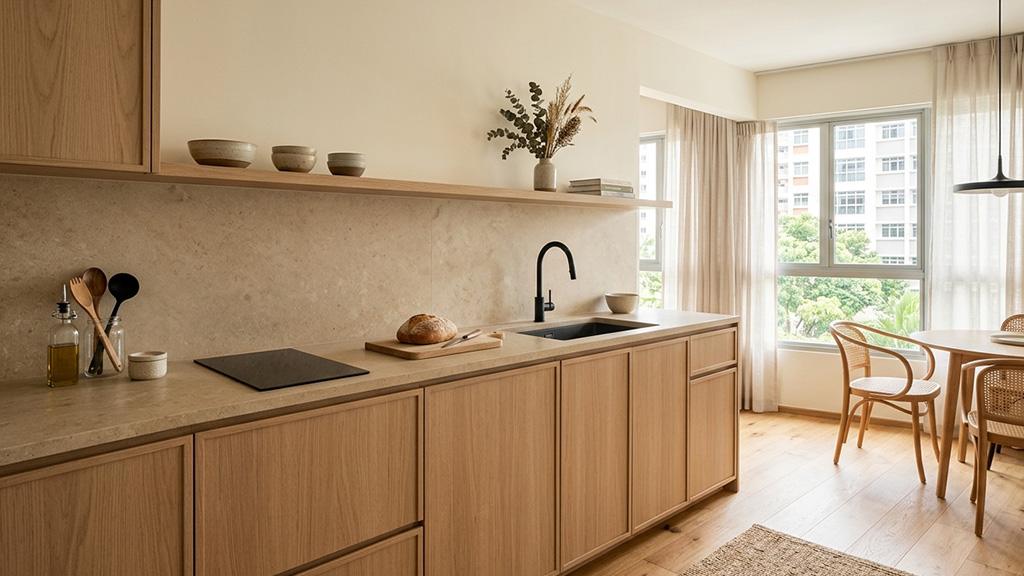
Japandi palettes run warm. The fusion of Japanese and Scandinavian influences produces an aesthetic grounded in natural, earthy tones rather than the clinical cool whites and cold greys that dominated minimalist interiors a decade ago. In practical countertop terms, this means the stone tone must carry a warm undertone, not a cool one.
Warm beige, soft taupe, warm grey with a sand or yellow cast, off-white with a cream bias, and pale stone finishes in the travertine or limestone family all sit within the Japandi colour range for kitchen countertops in Singapore renovations. These tones sit comfortably beside light oak cabinetry and warm timber flooring because they share an undertone. They read as part of the same palette rather than separate elements competing for attention.
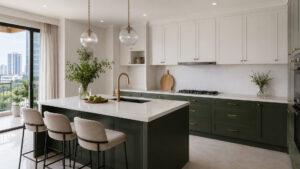
Cool tones work against the composition. Stark white, particularly in high-gloss polished finishes, makes a Japandi kitchen feel clinical and unfinished. Cold blue-grey, which performed well in the Scandi-minimal interiors of the early 2010s, sits in the wrong undertone family for Japandi. It creates a temperature conflict with the warm wood tones that anchor the style. Darker tones, such as soft charcoal or deep warm grey, work well in Japandi kitchens where the island is a contrasting element, but only when the undertone remains warm rather than cool.
Which Surfaces Work Best in a Japandi Kitchen in Singapore
Sintered Stone: The Most Practical Japandi Surface
Sintered stone in a honed or matte finish is the material that aligns most cleanly with Japandi requirements in Singapore. The surface is zero-porosity, meaning it requires no sealing, resists staining from daily cooking without specialist cleaning products, and handles the humidity of Singapore’s climate without surface degradation over time. Its resistance to high heat makes it suitable for placement beside gas hobs, which is a practical necessity for Singapore’s predominantly gas-equipped kitchens.
The design range available in sintered stone covers every Japandi-relevant tone: warm concrete effects, soft limestone looks, travertine-inspired patterns, and quiet beige and grey slabs with subtle movement. Large-format sintered stone slabs also minimise seam count, which matters in a Japandi kitchen where visual continuity across the countertop run is part of what creates the calm impression. You can review the full range of granite countertops and natural stone options in Singapore that suit Singapore’s renovation requirements to understand what’s available for Japandi applications.
Stone-Look Surfaces: Organic Character Without Natural Stone Maintenance
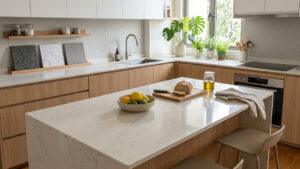
For homeowners who want the visual quality of natural travertine, limestone, or marble in their Japandi kitchen but don’t want the maintenance that natural stone requires, stone-look sintered stone and engineered surfaces deliver the aesthetic accurately. A well-manufactured stone-look surface in a warm limestone or travertine pattern is visually indistinguishable from natural stone in a finished kitchen, and the performance difference is significant: no sealing, no etching risk from acidic contact, and consistent colour retention under Singapore’s humidity and UV exposure.
The key specification detail is finish. Stone-look surfaces for Japandi kitchens should be specified in honed or matte, not polished. A polished stone-look surface reads as decorative rather than architectural, which contradicts the Japandi brief. In matte or honed, the same material reads as natural and grounded.
Quartz: Controlled, Clean, and Consistent
White and light grey quartz in a honed finish is a reliable Japandi countertop choice for Singapore homeowners who prioritise predictability and maintenance simplicity. Quartz’s engineered consistency means colour and pattern don’t vary between slabs, which is useful in an open-plan layout where continuity across a long kitchen run matters. The non-porous surface requires no sealing and handles Singapore’s daily cooking demands well.
The specification constraint is tone. Cool white quartz with blue-grey undertones pulls the Japandi composition toward clinical minimalism rather than warm restraint. Specify warm white, off-white, or warm grey quartz with a honed finish, and the result sits correctly in the Japandi palette. Quartz with heavy or dramatic veining introduces too much visual movement for a Japandi brief: the pattern competes with the calm the style requires. Subtle or fine veining in a tone-on-tone reading works.
Granite: Natural Warmth for Japandi Applications
Warm-toned granite in a honed finish suits Japandi kitchens where the countertop material is intended to read as natural and slightly aged rather than engineered and perfect. Granite’s unique grain character adds the kind of quiet tonal variation that aligns with the organic material sensibility both Japanese and Scandinavian design traditions share.
The practical consideration is maintenance. Granite requires sealing, typically annually, in a high-use Singapore kitchen. In a Japandi kitchen where the design intention is low-effort daily living, the sealing requirement is worth knowing before specifying. For homeowners who want the visual quality of natural stone without the sealing routine, sintered stone or a high-quality stone-look surface is the more appropriate specification.
Edge Profile: The Detail Most Japandi Guides Skip
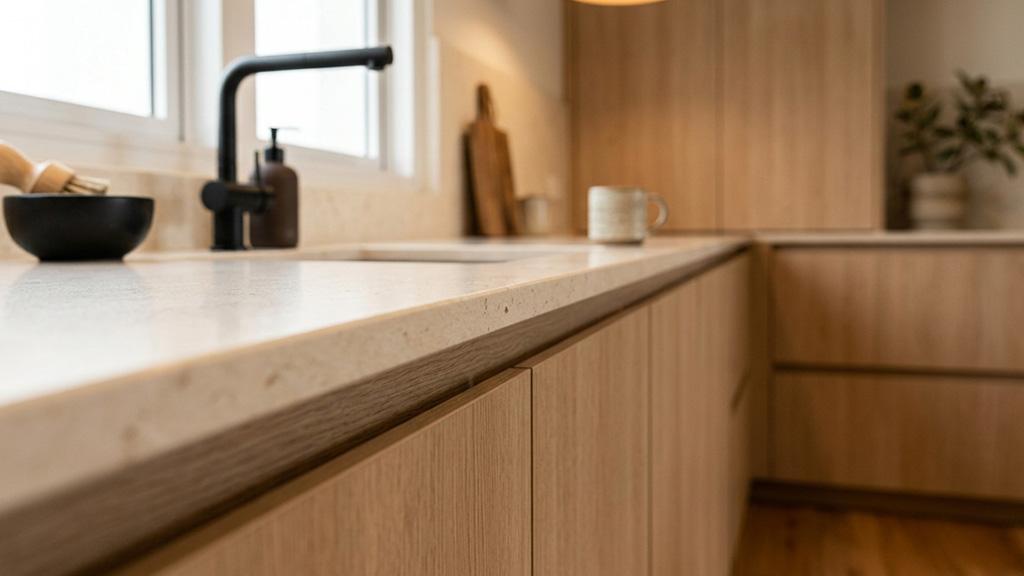
Edge profile is rarely discussed in Japandi kitchen content, but it makes a visible difference to whether a countertop reads correctly within the style or subtly fights it.
A Japandi countertop edge should be slim, clean, and undecorated. An eased edge, which is a crisp right angle with slightly softened corners, is the default. A pencil-round edge, with a very small consistent radius across the full length, is equally appropriate and slightly softer to the touch, which suits the warmth the style aims for. Both profiles allow the eye to read the countertop as a clean architectural plane rather than a decorative element.
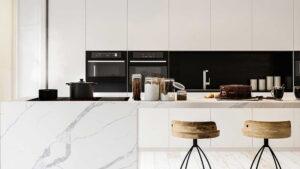
What doesn’t work in a Japandi kitchen: thick laminated edges that increase the apparent slab depth to 40mm or more, ogee profiles with their curved and stepped character, bevelled edges with a prominent chamfer, and waterfall edges on the island that extend to the floor as a statement feature. These profiles are legitimate choices in other kitchen styles, but they add visual complexity that conflicts with the Japandi brief of restraint and calm.
“Each element in a Japandi kitchen has a purpose. From the cabinetry to the countertop, the focus is on clarity and functionality — minimising visual clutter and contributing to the calm functioning of the space.” (Ideal Home, Japandi vs Wabi-Sabi Kitchens)
What Japandi Kitchens Get Wrong in Singapore
The most common failure in Singapore Japandi kitchens is selecting the right surface material in the wrong finish. A warm beige sintered stone in a high-gloss polished finish becomes a reflective element that reads as contemporary luxury rather than Japandi calm. The material tone is correct; the finish undermines it.
The second most common failure is extending the Japandi aesthetic to the countertop selection but defaulting to a cool-toned material because cool neutrals were associated with minimalism for a long time. A cool grey quartz that would have looked at home in a Scandi-minimal kitchen in 2015 works against a Japandi composition in 2026 because the warm-material palette that distinguishes Japandi from cold minimalism requires warm undertones throughout, including the countertop.
The third failure is edge profile inconsistency. A warm honed sintered stone in the right tone, terminated with a thick laminated edge profile, introduces a visual heaviness that sits oddly in a Japandi kitchen. The edge is a small detail, but because it runs the full length of every countertop, it accumulates visual weight across the entire kitchen.
FAQS

1. What countertop material is best for a Japandi kitchen in Singapore?
Sintered stone in a honed or matte finish is the strongest material choice. It delivers the calm, low-reflectivity surface quality Japandi requires, handles Singapore’s humidity and high-heat cooking without sealing, and is available in the warm beige and soft stone tones the style depends on. Stone-look surfaces in travertine or limestone patterns are a close alternative for homeowners who want natural-stone character without natural-stone maintenance.
2. What colour countertop suits a Japandi kitchen?
Warm, muted tones work: soft beige, warm grey, off-white with a cream bias, and pale stone finishes. Cool tones, stark white, and cold blue-grey work against the Japandi palette because they create a temperature contrast with the warm wood cabinetry that anchors the style.
3. Should Japandi kitchen countertops be matte or polished?
Matte or honed, not polished. Polished finishes reflect light and draw attention to the surface, which works against Japandi’s aim of a calm, receding surface. Honed is often the better practical choice for Singapore kitchens because it produces the same low-reflectivity quality as matte with slightly better resistance to daily cooking residue.
4. What edge profile works in a Japandi kitchen in Singapore?
An eased or pencil-round edge on a standard 20mm slab is the correct specification. Both profiles keep the countertop reading as a clean architectural plane. Thick laminated edges, ogee profiles, and statement waterfall island treatments add visual complexity that conflicts with the Japandi brief.
5. Can stone-look surfaces work in a Japandi kitchen?
Yes, and they are often the best practical choice. A high-quality stone-look sintered stone in a warm limestone or travertine pattern, specified in matte or honed finish, delivers the organic surface character Japandi requires without the maintenance that natural stone demands in Singapore’s climate. Specifying the finish correctly is the critical step: the same stone-look surface in a polished finish reads as decorative rather than architectural.
Conclusion
A Japandi kitchen Singapore renovation succeeds when the surface decisions support the aesthetic as precisely as the cabinet and colour decisions do. Finish, tone, surface character, and edge profile each contribute to whether the countertop reads as calm and grounded or inadvertently works against the style it’s meant to carry. Getting these details right requires understanding what Japandi actually asks of a surface, and matching the material specification to that brief rather than treating the countertop as an afterthought.
TSD supplies and fabricates stone and sintered stone countertops across the full range of finishes and tones relevant to Japandi kitchen applications. If you’re planning a renovation and want to see how specific materials and finishes perform in a Japandi brief, visit the showroom at 16 Joo Koon Circle, call +65 6908 5147, or email tsd.enquiry@gmail.com to arrange an appointment.