Key Takeaways
- Stone surface installation involves a sequence of decisions, each of which affects the final result in ways that cannot be corrected after the slab is cut.
- The most important conversations with your stone supplier happen before templating, not after installation day.
- Different stone types carry different maintenance requirements. Knowing these upfront determines whether your surface stays in good condition over the years of daily use.
- Singapore’s humid climate, compact kitchen layouts, and high-heat cooking habits create specific conditions that affect which stone performs well and how installation should be planned.
- A supplier who answers these questions directly, with specifics rather than generalities, is a supplier who understands what they’re doing.
Introduction
Most problems encountered during the process of renovation when dealing with stone are not fabrication problems but information problems. The homeowners did not have enough information to question whether the seams will be in good positions before the slab was cut. They did not make sure if the stone had to be sealed before placing a hob on top of it. They did not verify if the cabinet base is level before taking the template.
Global Engineered Stone Countertops, from the Freedonia Group, reports that global demand for engineered stone countertops is expected to increase 5.4% per year to 97 million square meters in 2028, owing to increasing residential remodeling efforts and demand for long-lasting kitchen and bathroom surfaces. As countertop designs become more customised, pre-fabrication planning takes on added importance in all stone surface installations.
This is not an inherent flaw on the part of the homeowner. Most of the questions that come up only make themselves apparent after there has been a problem. That is why the templating, seams, and coordination of the countertop design must be made clear prior to fabrication.
These are the issues addressed in this blog. What questions to ask from the stone installer prior to taking any measurements at all, what should be clarified during the templating process, what should be known regarding your particular material, and what happens after the installation. For all homeowners who plan a kitchen renovation in Singapore using stone surfaces, asking these questions will help to safeguard the results.
What is Stone Surface Installation?

Installation of stone surfaces is the procedure that consists of measuring, fabricating and installing the stone or engineered stone surfaces such as countertops, vanity tops, wall panels and backsplashes in a residential or commercial building.
The installation procedure entails template making of the exact measurements of the area, cutting the slab to those measurements in the fabrication shop, edging and installing the stone surface in place. In the case of kitchen countertop Singapore installation, it involves planning seam placement, dealing with cut-outs for sinks and hobs among other activities.
Questions to Ask About Your Stone Material
-
Does this material require sealing, and how often?
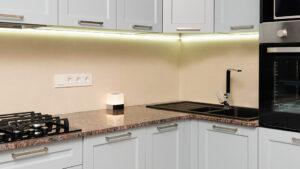
The sealing requirement depends entirely on the stone material selected. Granite is a porous natural stone that typically requires sealing every 12 to 24 months, depending on usage and porosity level. Without sealing, granite absorbs oils, moisture, and cooking stains more quickly, particularly in Singapore’s humid climate.
Quartz does not require sealing because its resin-bound composition creates a non-porous surface resistant to moisture and staining. Sintered stone also does not require sealing due to its zero-porosity structure produced through extreme heat and pressure during manufacturing. If a supplier recommends sealing a sintered stone countertop, that recommendation should be questioned carefully.
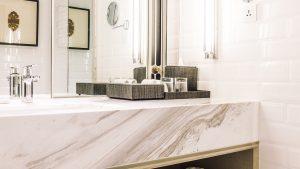
Marble requires regular sealing and is more vulnerable to etching from acidic substances than other common . Lemon juice, vinegar, and certain cleaning products can permanently dull an unsealed polished marble surface. This is a material characteristic rather than a defect.
-
How will this material perform next to a gas hob?
Gas hobs remain common in Singapore kitchens, and wok cooking exposes nearby countertop areas to sustained high heat.
- Sintered stone
- Sintered stone countertop Singapore handles direct high heat without damage.
- Manufactured under temperatures far beyond domestic cooking heat.
- Increasingly used in high-use Singapore kitchens.
- Quartz
- Performs well under moderate heat.
- Prolonged exposure above roughly 150°C may cause resin discolouration or micro-cracking.
- Heat protectors and trivets help minimise risk.
- Granite
- Naturally heat-resistant.
- Marble
- More heat-sensitive than granite.
- Heat marks appear more easily on polished finishes.
-
Will the surface be available in enough slab quantity for the full layout?
This question is especially important for natural stone installations. Granite and marble are quarried in finite batches, meaning slabs from the same quarry block will appear similar but not perfectly identical. For kitchens requiring multiple slabs, suppliers should confirm all pieces come from the same batch so colour and movement variation remain controlled across seams and different sections.
Quartz and sintered stone are manufactured products with minimal batch variation. Their consistency across slabs makes them particularly practical for larger kitchens or layouts requiring long continuous countertop runs.
As Houzz Singapore notes:
“The questions you ask before the stone is cut protect you far more effectively than any warranty offered after.”
Questions to Ask About the Installation Process
-
When should templating happen relative to cabinet installation?
Templating should only happen after cabinets are fully installed, levelled, and secured. A template taken before the cabinet base reaches its final position will not reflect the actual dimensions the stone needs to fit, making this one of the most preventable causes of installation problems.
As noted in the Dynamic Stone Tools countertop installation guide, even slight cabinet movement after templating can affect the final countertop fit. Confirm directly with your supplier that templating will not begin until the cabinet base is complete and levelled. If templating happens too early, correcting the issue may require the stone to be remade entirely.
-
Where will the seams fall?
Ask your supplier to show the planned seam layout on a kitchen diagram before fabrication begins.
- Seams should sit over cabinet support.
- They should not fall over unsupported spans such as:
- Dishwasher voids
- Open drawer cavities
- Hob cutouts
In Singapore kitchens with islands or L-shaped layouts, seams are usually unavoidable because slab sizes are finite. The key issue is not the existence of seams but whether they are positioned for structural stability and minimal visual disruption.
For kitchens using gas hobs, seams should remain at least 100mm away from the hob to reduce thermal stress on the adhesive joint. This is especially important if the hob sits near a corner or run ending.
-
How are sink and hob cutouts handled?
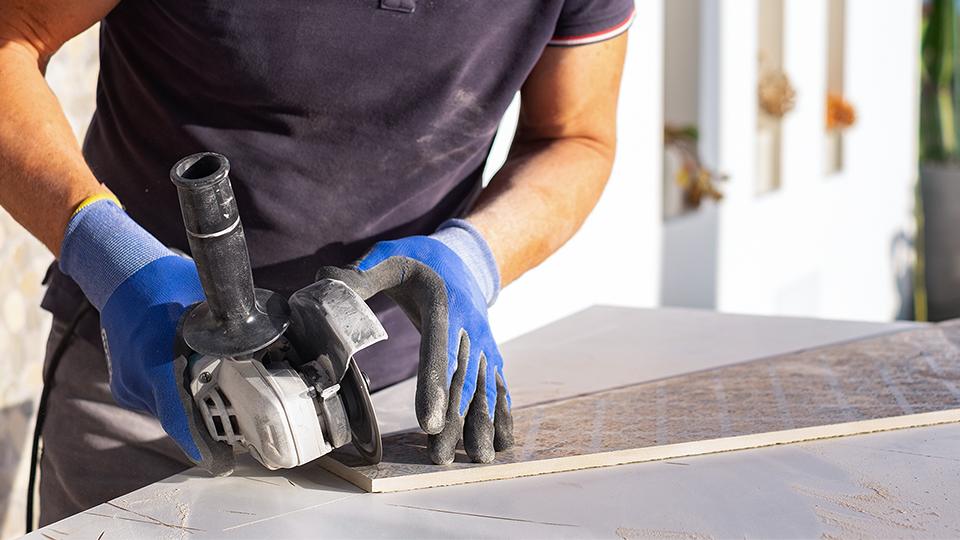
Cutouts weaken the stone sections surrounding the opening. Narrow sections beside sinks or hobs are more vulnerable to cracking under weight or pressure. Good fabricators reinforce these areas using a process called rodding.
- Fibreglass rods are bonded into underside channels beneath the slab.
- This increases tensile strength around vulnerable cutout zones.
Ask whether the sink and hob cutouts in your layout will be reinforced this way.
Integrated stone sinks require even more specialised fabrication, including:
- CNC routing
- Internal radius profiling
- Reinforcement at every basin corner
This type of fabrication should only be handled by suppliers experienced in integrated stone sink work.
-
Is fabrication done in-house or outsourced?
This directly affects quality control, scheduling, and accountability. Suppliers handling fabrication in-house can monitor every stage closely and make adjustments quickly if required. Outsourced fabrication depends on a third party’s workmanship standards and production schedule.
Ask directly:
- Who cuts the stone?
- Where is fabrication carried out?
- How is quality checked before delivery if the work is outsourced?
Questions to Ask About Your Specific Layout
-
What overhang is safe without additional support?
Stone countertop overhangs, the section extending beyond the cabinet base, have structural limits. For 20mm quartz or sintered stone, unsupported overhangs beyond roughly 200mm increase the risk of stress cracking over time, especially along breakfast bars and island seating edges.
Beyond this distance, additional support becomes necessary.
- Corbels or brackets should be embedded into the cabinet base.
- These supports help carry the stone’s weight and resist bending stress.
This measurement should be confirmed for every overhang in the kitchen, including:
- Breakfast bars
- Waterfall islands
- Extended preparation counters
Do not assume support is automatically included simply because the overhang appears in the design drawing.
-
What finish suits my kitchen’s light conditions?
Surface finish changes how stone behaves under lighting conditions.
- Polished finishes
- Reflect light and make surfaces appear brighter and more visually prominent.
- Work well in compact Singapore kitchens with limited natural light.
- Under strong LED downlights, polished surfaces can create uncomfortable glare.
- Honed or matte finishes
- Absorb light and produce a softer, flatter appearance.
- Create a calmer visual effect in the kitchen.
- May show fingerprints and cooking residue more easily on some materials.
Ask to view the chosen finish under lighting conditions similar to your actual kitchen setup rather than relying only on showroom lighting.
As Houzz SG notes:
“Choosing a countertop isn’t just about what looks good in a showroom. It’s about what works in the actual light conditions, with the actual cooking habits, of the specific kitchen it’s going into.”
Questions to Ask About Care After Installation
-
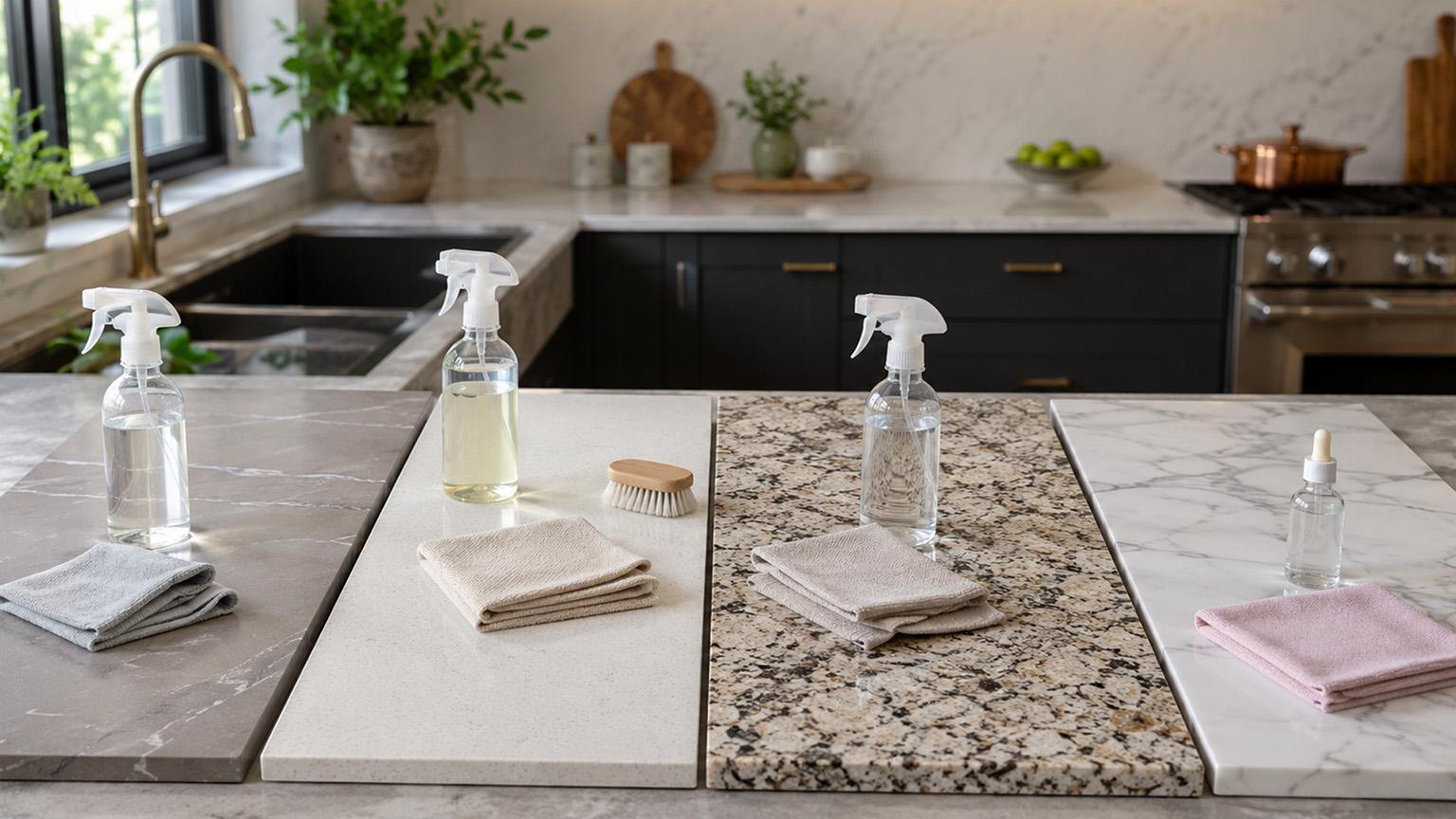
What cleaning products are safe for this material?
Cleaning requirements vary depending on both the material and the surface finish.
- Sintered stone
- Resistant to most cleaning products because of its zero-porosity surface.
- Prolonged exposure to highly alkaline or acidic cleaners may gradually affect the finish on some products.
- Quartz
- Should not be exposed to strong alkaline cleaners or solvents.
- Most standard kitchen cleaners are safe.
- Bleach-based products should be avoided.
- Granite
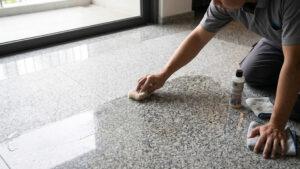
- Unsealed granite should be cleaned quickly after oily or acidic spills.
- Sealed granite tolerates most common kitchen cleaning agents well.
- Marble
- Requires the greatest care.
- Acidic cleaners and many kitchen degreasers can etch the polished surface.
- Only pH-neutral stone cleaners should be used.
Ask your supplier to provide these maintenance guidelines in writing before installation. Having clear care instructions during the first months of use helps prevent avoidable surface damage.
-
How long does the stone need before it is ready for full use?
Most countertop installations require 24 to 48 hours for seam adhesives and wall-joint silicone to cure fully before the surface is ready for continuous exposure to weight, water, and heat.
During this curing period:
- Heavy objects should not be placed over seam areas.
- Water should not run directly onto silicone joints.
- High heat exposure should be avoided.
These actions can weaken the final bond before curing is complete.
Ask your installer for the exact post-installation restrictions related to your material and adhesive system. Also confirm whether the curing period affects when the plumber can reconnect the sink.
Is Stone Surface Installation Right for Your Renovation?
Surfaces of stones work optimally if they go through a renovation process that is done in the right sequence; first are the cabinets, then templating once the cabinets are done, followed by fabrication in the workshop, and installation done after the plumber and electrician have worked, not before them.
Once the right installation process and right questions have been sorted out before the process of cutting is done, the surfaces of the stone will last for decades.The most important thing for someone thinking about renovating their kitchen in Singapore and wants to know how the different types of stone surfaces will work in their layout is to talk to a supplier who fabricates in-house.
FAQS
- What questions should I ask before the process of installing a stone surface is started?
Find out about the need for sealing of the stone that you have chosen, location of the seams in relation to your cabinetry, reinforcement of the areas which would have cut-outs, and whether the fabrication work would be done in-house. Make sure that the template would only be made once the cabinets have been leveled.
- Is there anything special in the preparation needed for sintered stone countertop installation in Singapore?
Yes, there is. Sintered stone is a very dense material, which needs special tooling like waterjet or CNC cutting for accurate edge and cutout work. The base for the cabinets needs to be leveled and secured completely prior to templating. Sintered stone requires special adhesives specifically designed for zero-porosity materials. Making sure that your fabricator has prior experience working with sintered stone is vital.
- What is the time required to install kitchen countertops in Singapore?
The typical time frame required for the installation of kitchen countertops is from 10 to 14 working days after templating. It includes templating, fabrication, profiling, and installation of the countertops. More complicated projects with elaborate edges, curves, sinks built in or unusual stones will take more time. Your supplier should provide you with a schedule at the templating stage.
- What is the major mistake made by homeowners prior to the installation of their countertops?
The major mistake is doing the template while the cabinet base is still not level and secure. Templates done in such conditions will give countertops that do not fit properly, hence leaving gaps along the walls and at the seams. The second major mistake is that of failing to inquire about the seam location prior to the cuts being made.
- May I see the whole slab before fabrication?
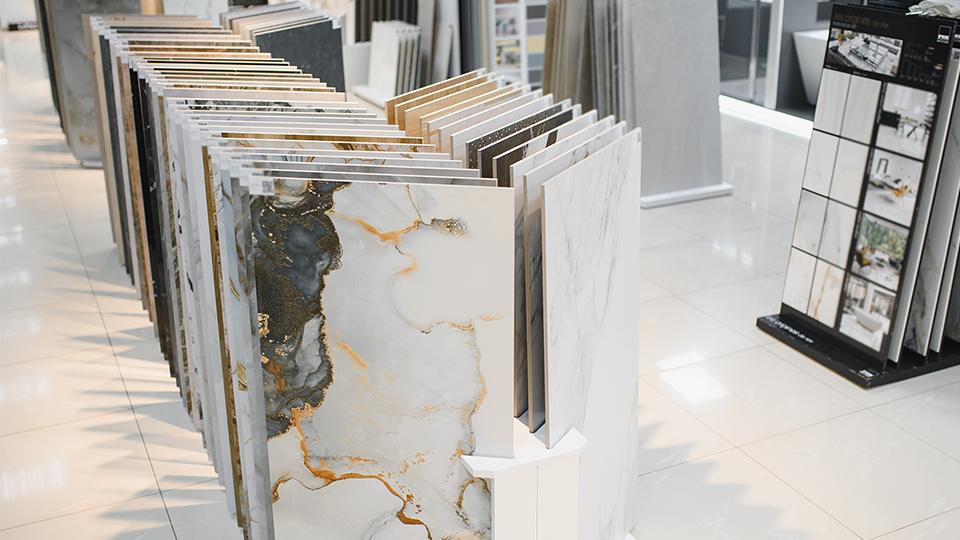
Absolutely yes; you must. You can request to be taken to the showroom or even the fabrication facility where you can see the whole slab that will be used in the fabrication of your countertops. For materials such as granite and marble, seeing the whole slab will give you an opportunity to see the actual movement, veining, and color variations of that slab.
Conclusion
Each stone surface installation starts with a series of decisions which are dependent on each other. Choosing a material without proper seam planning, or proper seam planning with an uneven cabinet base, might result in less-than-stellar work. Each question raised on this blog is important since it covers a possible mistake that could be avoided during the renovation process prior to fabrication.
At TSD, the entire process is in-house, from material selection and templating to fabrication, edge profiling, and installation. In our workshop, we cut and profile quartz, granite, marble, terrazzo, and sintered stone countertops in Singapore.
We also offer our customers consultation appointments and slab viewing to enable them to examine slab movements, color uniformity, finishes, and seam planning before any installation process begins. This will assist in reducing inconsistencies among the different sections of your kitchen in case of several slabs.
For any questions about stone surface installations, you are encouraged to visit us at Showroom, 16 Joo Koon Circle Singapore 629047 or contact us on +65 6908 5147 or tsd.enquiry@gmail.com to make an appointment.