Key Takeaways
- Kitchen countertop joints are not just a visual detail. They affect hygiene, structural durability, and how well your surface holds up over the years of daily use.
- A joint placed over an unsupported cabinet void or too close to a sink cutout is more likely to develop stress cracks over time.
- Different materials behave differently at joints. Quartz seams are typically consistent in colour and easier to match, while granite and marble require careful vein alignment.
- A qualified stone fabricator will show you the planned seam layout before cutting begins and explain the reasoning behind each placement decision.
Introduction

Most homeowners spend days deciding whether to use quartz, granite, or sintered stone. They evaluate finishes, care required, and edge treatment, yet they seldom consider the placement of the joints.
This issue usually comes up during installation when bad placement or mismatched adhesive becomes immediately obvious, while the well-done seam blends in with the rest of the countertop.
Joints in kitchen countertops appear in almost every kitchen due to the standard size of stone slabs. In the 2022 Houzz Kitchen Trends Study of the United States, homeowners tend to choose countertops in the kitchen depending on aesthetics and feel (69%) and then durability (57%).
It has been seen that the engineered quartz is still dominating the market in terms of countertops, accounting for 42%. Also, kitchen islands have become increasingly popular and are more than seven feet long (39%).
What Are Kitchen Countertop Joints?
The joints of kitchen countertops refer to the areas where two parts of the stone or surface are bonded to create a complete kitchen countertop. Joint areas are filled with matching colored glue, which is finished smoothly to create a uniform surface.
In a good installation job, joint areas will appear to be very thin lines within the pattern rather than openings or raised edges. The location, size, and finishing of joints depend on the fabrication process.
Why Joint Placement Determines Long-Term Performance?
A misaligned joint is not merely a matter of aesthetics. Stones are materials that resist compressive loads easily but cannot tolerate bending loads well. When joints are aligned above spaces where there are no supports like the area above the dishwasher and above a drawer, they are subjected to bending every time something is put above them. With time, such stress builds up at the point of attachment and ultimately leads to cracks.
Fabricators working to this standard typically:
- Plan seam locations before cutting begins
- Map seams against the cabinet layout
- Identify load-bearing support points
- Position joints where structural support is strongest
In Singapore kitchens, this becomes especially important for layouts that naturally create stress points, including:
- L-shaped kitchens with corner runs
- Kitchen islands with integrated sink cutouts
- Long galley-style counters running past multiple appliances
Each of these configurations creates at least one area where a joint must be carefully positioned to land on solid support.
“A seam planned wrong looks wrong forever. A poor installation day, bad support, rushed adhesive cure, undoes everything upstream.”
– Countertop World AR
Positioning also impacts moisture control and temperature control. A joint located adjacent to a gas range or main cooking area gets heat on one side and normal room temperature on the other side. In the case of quartz kitchen countertops, the temperature differential causes stress on the resin layer.
Most skilled fabricators keep the seam at least 100mm away from the heating source as a precaution. This is something you need to consider if you are designing a kitchen countertop Singapore customers use for wok cooking.
How Material Type Changes the Joint Challenge?
Not all materials present the same joint challenge. Fabrication requirements and seam visibility differ depending on the surface material used.
| Material | Joint Characteristics | Main Challenge |
| Quartz | Engineered for consistent colour and pattern, making seams easier to blend invisibly. Joints usually appear as thin lines rather than obvious pattern breaks. | Sensitive to heat stress near seam zones, especially beside powerful gas hobs in Singapore kitchens. Seam placement near the hob should always be discussed during fabrication. |
| Granite | Natural variation means no two slabs are identical. Good joints depend on matching grain direction, veining, and colour tone across the seam. Well-executed seams are difficult to notice under normal lighting. | Bold veining and movement require greater fabrication skill and careful slab orientation. Poorly matched seams remain highly visible. |
| Sintered Stone | Manufactured in large-format slabs, often up to 3200mm, allowing some kitchens to avoid seams completely. Zero-porosity surfaces also prevent moisture absorption or seam discolouration over time. | Material hardness requires specialist cutting and profiling equipment. Poor tooling leaves rough edge faces and wider visible seams. |
| Marble and White Stones | High-contrast backgrounds and heavy veining make seams easier to detect, even when tightly filled. Precision adhesive matching and accurate filling depth are especially important. | Calacatta, Statuario, and similar finishes require extremely precise fabrication because seams remain more visible than on darker or textured stones. |
The Mechanics of a Well-Executed Joint
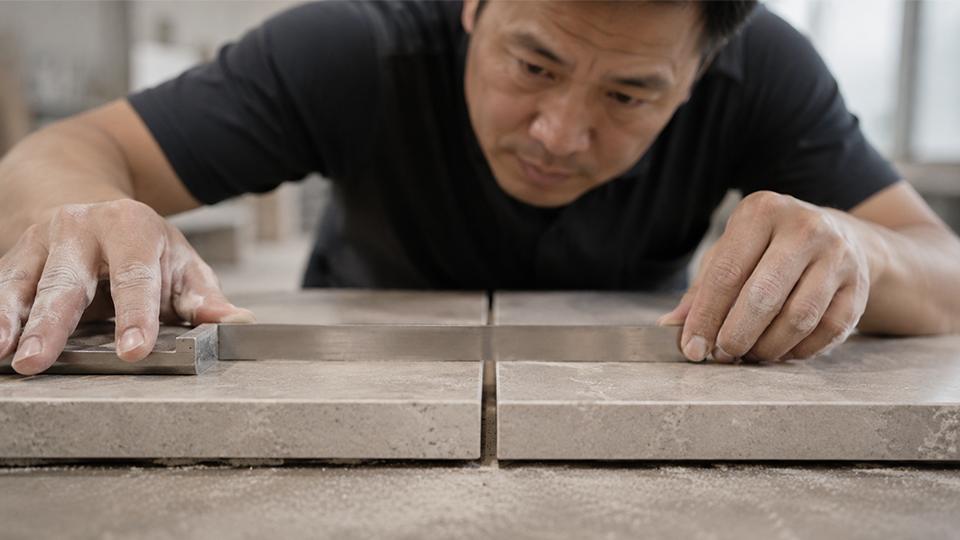
Understanding what happens during joint execution helps homeowners ask better questions. A professionally finished seam involves several technical steps that are often overlooked in renovation discussions.
-
Preparing the Stone Faces
The two stone faces meeting at the joint are cut to matching profiles. For a strong adhesive bond, the edges must be:
- Perfectly straight and evenly aligned
- Square enough to create tight contact between both surfaces
- Smooth without leaving rough edge imperfections
Interestingly, a seam face that is too polished can reduce adhesion. Adhesives bond more effectively to a slightly honed surface than to a mirror-polished one.
-
Adhesive Selection and Colour Matching
Professional fabricators typically use two-part epoxy systems for stone countertop seaming because they create a hard, stable bond with minimal shrinkage.
A properly executed seam requires:
- Accurate colour matching with the stone background
- Even adhesive application across the entire seam
- Clean filling without visible gaps or uneven texture
Even a tight joint becomes noticeable if the adhesive shade is mismatched.
-
Rodding for Structural Reinforcement
If a seam sits near a sink cutout or spans an area under 75mm wide, the underside of the stone is usually rodded.
This process involves:
- Cutting a reinforcement channel beneath the slab
- Installing fibreglass or steel support rods
- Filling the channel securely with epoxy
Rodding increases tensile strength at vulnerable areas without affecting the visible surface.
-
Final Seam Polishing
The finished seam will be polished to flushness with the rest of the surface. In commercial installation of kitchen countertops, any difference in height, known as lippage, between the two pieces of stone should be no more than 0.8 mm.
“The adhesive filling a seam does several jobs simultaneously: it bonds the two stone faces together for structural integrity, fills the gap so no voids remain that could trap water or bacteria, and provides the visible colour match that makes the seam recede.”
- Dynamic Stone Tools
In the case of kitchens that have a stone sink as part of its interior design scheme, the joint near the sink is the toughest area for the fabrication process. This joint is made up of thin sections of stones that will constantly be exposed to water and weight loading. In such cases, rodding is almost always necessary, and fabricator experience makes a major difference to long-term performance.
What to Ask Your Fabricator Before the Job Begins?
The questions asked during the templating stage often determine how satisfied homeowners feel after installation. A good fabricator should be comfortable discussing seam planning, structural support, and fabrication details before any cutting begins.
-
Ask About the Seam Layout
Request to see the seam layout mapped directly onto your kitchen plan before fabrication starts. Your fabricator should be able to explain:
- Where every joint will be positioned
- Which cabinet panels will support each seam
- How far seams will sit from appliances and heat zones
- Why specific seam locations were chosen
This discussion should happen naturally during templating rather than only after homeowners request it.
-
Ask About Pattern and Vein Matching
Seam positioning also affects the visual flow of the countertop surface, especially for natural stone materials.
Important questions include:
- How the seam will follow the stone veining or pattern
- Whether both pieces come from the same slab
- If matching slabs from the same batch will be used
For granite, marble, and heavily veined surfaces, proper alignment makes a major difference to seam visibility.
-
Ask About the Adhesive System
Homeowners should also ask what adhesive system will be used and how the seam colour will be matched to the material.
A professional fabricator should clearly explain:
- The type of adhesive being used
- How colour matching is handled
- What steps are taken to reduce visible seam lines
Vague answers at this stage are usually worth paying attention to.
-
Ask Whether Rodding Is Required
Certain countertop zones almost always require reinforcement support.
Ask whether rodding will be needed for:
- Undermount sink areas
- Narrow stone sections beside hob cutouts
- Sintered stone surfaces thinner than 20mm
- High-stress seam locations
If your kitchen includes any of these conditions, the answer will very likely be yes.
Are Kitchen Countertop Joints Right for Every Layout?
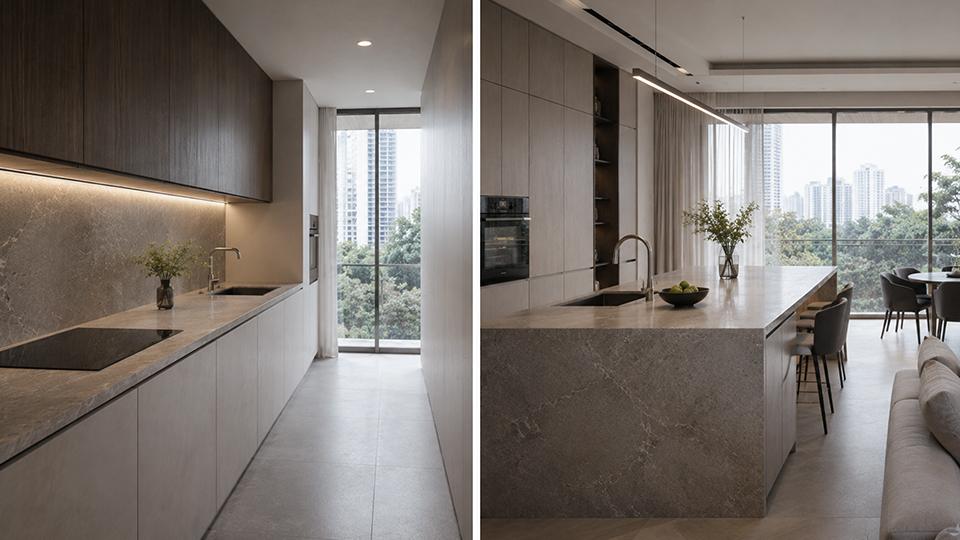
A joint is simply inevitable for almost all kitchens in Singapore. The issue is not whether the joint will be there but whether the joint has been done in such a way that renders it irrelevant in the daily activities of the homeowner.
If the kitchen has less than 2.8 to 3 meters in a straight line, then it might be possible to avoid using the joint, especially if the materials used are flexible enough. In fact, sintered stone has the ability to cover long runs in a single piece; this is one reason why some people prefer sintered stone as the material for open-plan kitchens in Singapore.
FAQs
- Will kitchen countertop joints always be visible?
No, that need not necessarily be the case. This depends on the kind of material, skill of the fabricator, and lighting environment. Seamlessness is easier to achieve with uniform material such as quartz. Materials with veining such as marble or heavily figured granite will have visible jointing to some extent, especially in raking lights. The seam of any material, if done correctly, ought to be invisible in normal kitchen lighting after a few days of use.
- What areas must avoid having a seam in a Singapore kitchen?
A seam should never fall over dishwasher voids or any unsupported cabinet span. It should be kept at least 100mm away from a gas hob because the heat of the cooking process exerts stress on the sealant used to bond the countertop joint. In an open kitchen plan with an island that fronts into the living space, the seam location can be avoided through planning.
- What should the width of a countertop seam be?
The industry guidelines suggest the use of a seam width not exceeding 1.6 mm. Most professional fabricators strive to achieve 1mm or even less. A seam significantly wider than 1.6 mm indicates the problem with the quality of the edge face or the speediness of fabrication. At that width, the seam becomes both more noticeable and structurally weaker.
- Do joints of sintered stone need to be treated differently from those of quartz?
Yes. The sintered stone must be fabricated using special equipment due to the hardness of the material. Edge faces should be properly cut and honed, not polished, in order to provide an adhesive bonding. While the sintered stone is non-porous and moisture does not affect the seam, the process of edge face fabrication is more complex compared to the fabrication of quartz.
- Is it possible to fix the joints in Singapore home kitchen countertops should they be damaged?
Problems like discoloration of the joints due to use of inappropriate glue and minor cracks on the joint area may be fixed by the stone specialist. It entails cleaning the area and replacing the joint glue with a new one of matching color. The best way however, is to prevent rather than fix joint problems because the fixed joint will not look as good as the joint done right initially.
Conclusion
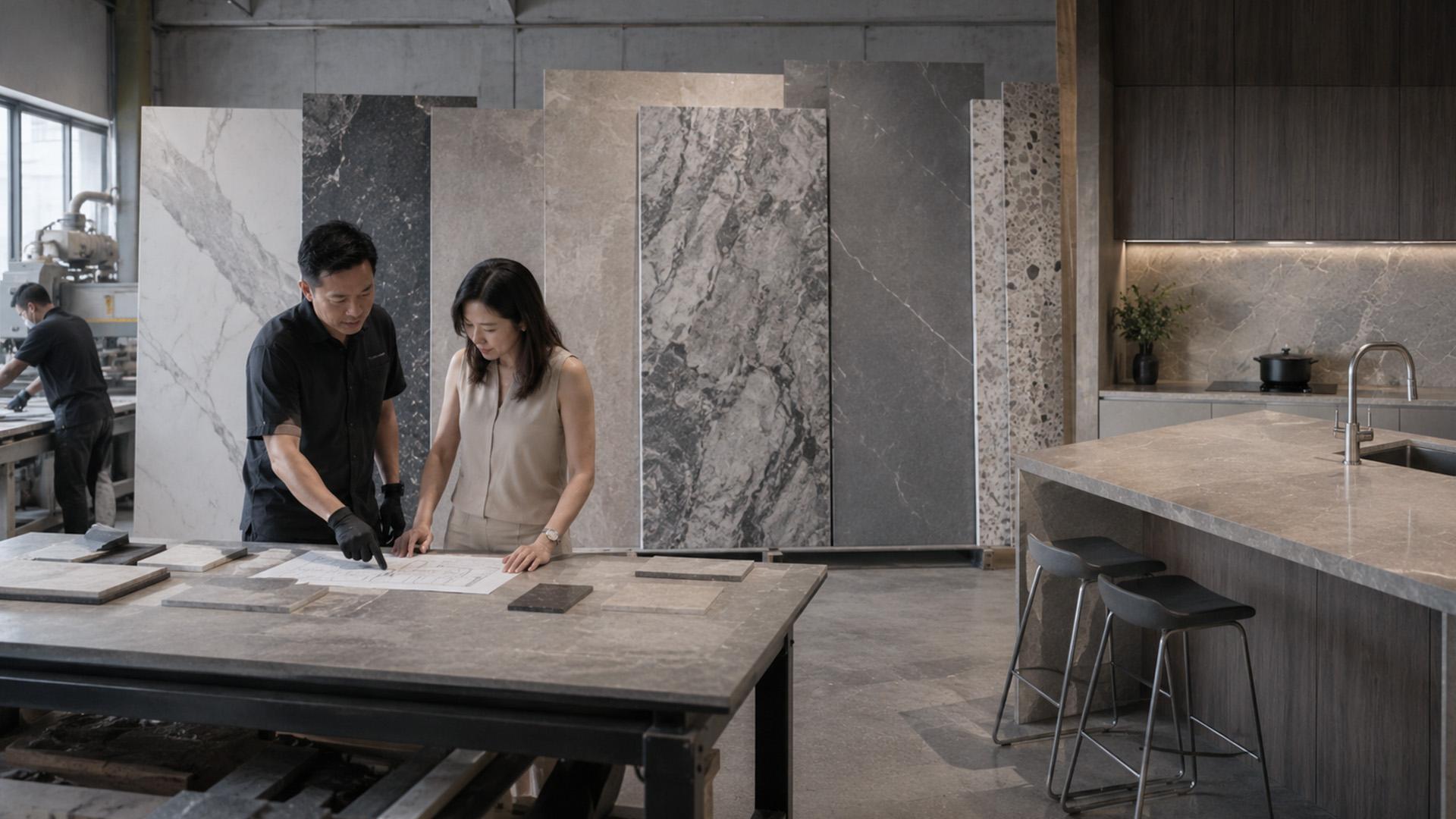
One of the best ways to assess the quality of the fabrication is through the joints found on the kitchen countertops. While people tend to focus on the selection of materials and the finishing of the surfaces, it is only when they notice where and how the joints were created that they realise whether their renovation was done well or not.
By understanding the functions of joints and seams, and what questions must be asked before the fabrication process even starts, you will find yourself in a better place.
At TSD, we take care of everything from selection to customisation and fabrication, and finally countertop installation by ourselves. We plan all the joints, install all seams, profile the edges, and polish everything in our own workshop that has everything for that, cutting and profiling areas.
We have an extensive array of products ranging from quartz, granite, marble, sintered stone, and terrazzo which can be used depending on your layout designs. Our larger format slabs measuring up to 3200 mm and custom edge profiles ensure that there is more seamless transitioning between countertops such as islands, galley counters, and sink installations where accuracy in fabrication is highly required.
In case you are interested in kitchen countertops in Singapore that give excellent finish and good seam transitioning, get in touch with our experts regarding your renovation project. You can visit us at 16 Joo Koon Circle Singapore 629047 or contact us at +65 6908 5147 or learn more about our stone surface fabrication and countertop services at TSD.