Key Takeaways
- Sintered stone table top is the only common countertop material rated for outdoor use in Singapore. UV stability and full weather resistance make it the go-to for al fresco kitchens and balcony surfaces, a genuine advantage no quartz or solid surface product can match.
- The sintered stone tabletop application is growing rapidly in Singapore. As open-concept dining areas become the norm, homeowners are specifying sintered stone table tops for their heat resistance, scratch resistance, and minimal daily upkeep, not just for kitchen countertops.
- The thickness of the tile affects both performance and budget. 12mm suits dining tables and vanities; 20mm is standard for kitchen tops; 30mm is used where a visually weighty or premium appearance is much needed. This is why it is suggested to always confirm the base cabinet and structural support before specifying 30mm.
- Curved edges require a visible join plan before finalising the design. As sintered stone cannot be bent, a curved edge profile requires the edge piece to be a separate segment, joined to the slab. For a straight-run kitchen, this is not an issue; for curved island designs, confirm its join placement with the fabricator upfront.
- Sintered stone prices in Singapore vary by brand, thickness, and finish. There are premium brands (Dekton, Neolith) that sit at the upper end. Less widely marketed brands from reputable factories can deliver comparable performance at the mid-range showroom visits, and sample comparisons are important before committing.
Introduction
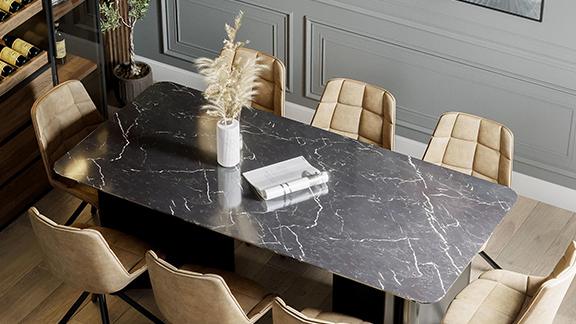
Something has shifted in how Singapore homeowners talk about countertops and table tops. Three years ago, quartz dominated the conversation at every showroom and renovation forum. Today, a growing share of BTO and landed renovation projects in Singapore are ending up with sintered stone, particularly for kitchen tops, dining tables, and outdoor surfaces.
Homeowners in Singapore now discuss countertops and table tops in a different manner than before. The kitchen design industry data showed that 78% of professionals regarded quartz as the top countertop material for 2026 yet three years prior quartz dominated every showroom conversation.
This guide covers what sintered stone is, how the manufacturing process creates its performance properties, where it works best across Singapore homes, and what to watch for before purchasing, including the one limitation homeowners consistently discover too late.
What is Sintered Stone and How Does it Get its Properties?
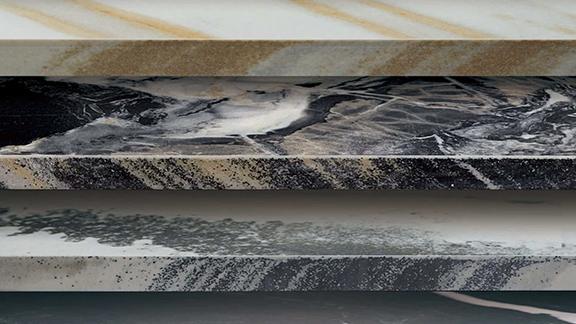
The term ‘sintered stone’ describes a manufacturing process as much as a material category. Sintering is the process of compressing raw mineral powders, a combination of natural minerals (quartz, porcelain, glass, and clay). All this happens under extreme heat (approximately 1,200°C) and pressure, without allowing the material to fully melt. The result is a dense, homogeneous slab in which the individual particles fuse at the molecular level.
Continue Reading : Best Kitchen Countertops Singapore in 2026: Solid Surface, Granite & Quartz
Physical Properties of Sintered Stone
- Mohs hardness: 7–8+, depending on mineral composition, among the hardest surface materials available commercially.
- Porosity: Near-zero, liquid cannot penetrate the surface, which eliminates bacterial harbouring and the need for sealants.
- Thermal tolerance: Typically rated above 300°C, surface contact handles direct work heat and hot cookware without damage.
- UV stability: Colour does not fade or shift under direct sunlight, the only common countertop material rated for permanent outdoor use in Singapore.
- Chemical resistance: Resists acids, alkalis, and commercial cleaning agents, including bleach, at normal concentrations.
- Thickness range: Available from 6mm (wall panels) to 30mm (heavy-duty countertops), giving design flexibility across applications.
Where Sintered Stone Works Across a Singapore Home?
One of the less understood aspects of sintered stone is how many surfaces in a Singapore home it is genuinely suited to.
The table below maps common applications to the specific performance advantages and Singapore-relevant context for each.
| Application | Why Sintered Stone Works Here | Thickness Rec. | Finish Options | Singapore Context |
| Kitchen countertop/Sintered stone kitchen top | Non-porous, handles | 20mm or 30mm | Matte, Polished, Textured | Most common application in Singapore HDB and landed renovations in 2025–2026 |
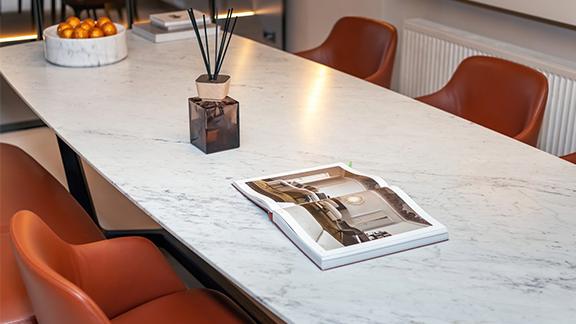
| Dining table top/Sintered stone table top | Scratch-resistant | 12mm or 20mm | Matte, Polished, Satin | Rapidly growing in Singapore open-concept dining areas paired with steel or timber bases |
| Island or breakfast bar | Large-format slabs | 20mm or 30mm | Polished, Matte, Flamed | Popular in landed and condo kitchen renovations where the island is a design centrepiece |
| Bathroom vanity top | Completely waterproof, | 12mm or 20mm | Matte, Polished | Increasingly specified in Singapore master bathrooms as a premium alternative to marble |
| Feature wall/TV console backing | Large thin slabs | 6mm or 12mm | Matte, Textured | Used in Singapore living rooms behind TV consoles and in entrance walls for a high-impact design statement |
| Outdoor countertop/Al fresco kitchen | UV-stable | 20mm or 30mm | Textured, Matte, Flamed | One of very few countertop materials genuinely rated for Singapore outdoor kitchen conditions |
Most people face it first as a sintered stone tabletop option, but the same thing, hardness, non-porosity, UV resistance, extends well beyond the kitchen.
Why Sintered Stone Fits Singapore Conditions Particularly Well?
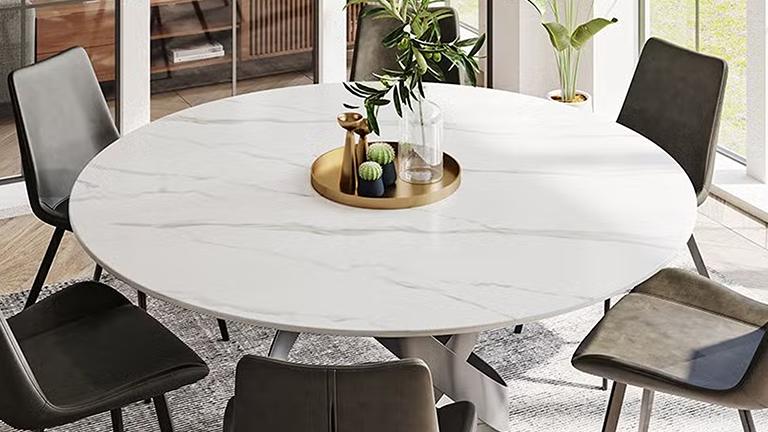
Not every high-performance surface material earns its premium price point in Singapore’s specific climate and cooking environment. Sintered stone does and for reasons that go beyond marketing language.
-
Singapore’s Cooking Intensity
Daily wok cooking over high flame, frequent use of deep pigment ingredients, and the preparation of oil-heavy dishes all stress a countertop surface in ways that moderate cooking climates do not. Of all common countertop materials, sintered stone handles this combination best. Its thermal tolerance removes the trivet discipline required by quartz.
Its non-porous surface means that turmeric paste wiped away within a reasonable time leaves no trace, whereas granite without sealing would absorb the pigment permanently.
-
Humidity and the Absence of Sealing Requirements
Singapore’s ambient humidity exerts slow but consistent pressure on any surface with micro-porosity. Granite left unsealed develops a progressively darker patina near the sink and along joins where water pools.
intered stone has no such vulnerability. As its surface is non-porous at a structural level, not just treated, humidity does not affect it. There is nothing to absorb. This matters most in households where countertop maintenance is not a high-priority habit.
-
Outdoor Applications That No Other Material Handles
Singapore’s outdoor kitchens, balcony surfaces, and al fresco dining areas face conditions that disqualify most countertop materials: direct UV exposure, monsoon rain, temperature swings, and constant moisture. Sintered stone is UV-stable, waterproof, and best for outdoors.
So, if your renovation needs an outdoor kitchen or an uncovered balcony table, sintered stone Singapore is the surface that fits without compromise.
Sintered Stone vs. Quartz vs. Granite vs. Porcelain Tile
Before committing to sintered stone for a kitchen top or table top, it helps to compare it honestly against the alternatives homeowners most commonly consider. The table below covers 13 performance and criteria:
| Performance Area | Sintered Stone | Quartz | Granite | Porcelain Tile |
| Heat resistance | Very High — direct heat tolerant | Moderate — trivets required | High — handles heat well | High — but grout lines are vulnerable |
| Scratch resistance | Extremely High — hardest surface | High — Mohs 7 | High — natural quartz hardness | High surface — grout can scratch |
| Stain resistance | Very High — fully non-porous, no sealing | Very High — non-porous | Low–Mod — sealing required | Moderate — grout lines absorb stains |
| UV resistance | Excellent — outdoor rated | Moderate — may yellow in direct sun | High — colour stable | Good — glaze is UV stable |
| Impact resistance | Very High — extremely dense | High — but edge chipping possible | High — chips on edge impact | Moderate — can crack under impact |
| Sealing requirement | None — ever | None | Yes — every 1–2 years | Grout sealing required |
| Large-format slabs | Yes — up to 3200 × 1600mm available | Yes — jumbo format available | Limited by natural quarry slab size | Yes — large format tiles available |
| Edge profile options | Standard — curved edges require joins | Standard profiles | Standard to ornate | Limited — tile edge exposed |
| Slab thickness options | 6mm, 12mm, 20mm, 30mm | 20mm, 30mm | 20mm, 30mm typical | 6mm, 9mm, 12mm (tiles) |
| Outdoor suitability | Yes — fully rated for outdoor use | No — not recommended outdoors | Partial — some grades are outdoor-rated | Yes — with appropriate grout |
| Repairability | Difficult — surface too hard to sand | Moderate — chip fills visible | Difficult — chips hard to hide | Individual tile replacement possible |
| Indicative cost (SGD) | SGD 500–1,200/metre run | SGD 400–1,000/metre run | SGD 350–900/metre run | SGD 100–400/metre run (supply only) |
| Lifespan under normal use | 20–30 years | 15–20 years | 20+ years if sealed | Tiles 20+ years, grout replaces every 5–10 years |
For a sintered stone table top, kitchen top, or outdoor surface, it is one of the few materials where the performance case and the aesthetic case point in the same direction.
Conclusion
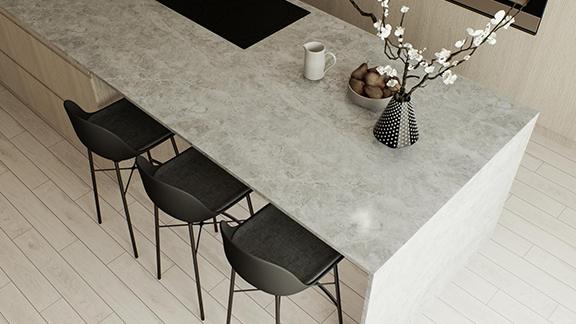
Sintered stone has earned its growing share of Singapore renovations not through marketing but through performance. It handles cooking intensity, humidity, daily scratches and heat exposure, and, uniquely, outdoor conditions that no other commonly specified countertop material can fully address.
The considerations for planning around join lines on curved edges, weight on base structures, and surface-print construction are manageable with proper fabricator guidance. They are not reasons to avoid the material. There are reasons to go into the decision with clear information.
As more homeowners across Singapore move towards sintered stone kitchen tops, dining tables, islands, and outdoor surfaces, choosing the right material and fabricator has become just as important as the design itself. At https://docs.google.com/document/d/1lVqfNaALNTxcE8bXney1F-0Aqprhjfobo_pnIjqGrfk/edit?tab=t.0 This also copied wrongly, we provide a complete end-to-end experience, from surface selection and customisation to fabrication, profiling, and installation, all under one roof.
With decades of combined experience in both commercial and residential stonework, We specialise in premium quartz, granite, marble, and sintered stone surfaces to modern Singapore lifestyles.
From sleek matte kitchen countertops to durable outdoor table tops and statement island counters, our team can recommend suitable options based on thickness, finish, edge profiling, durability requirements, and structural support considerations.
Contact TSD, visit our showroom located at 16 Joo Koon Circle, or call us at +65 6908 5147 to let our fully equipped fabrication facility customise surfaces with precision today.
Find Out More: White Quartz Countertops: Benefits, Design Ideas, and Buying Guide
FAQs
-
How does a sintered stone table top compare to quartz in Singapore kitchens?
A sintered stone kitchen top outperforms quartz in two areas specifically relevant to Singapore cooking: heat resistance and UV stability.
-
What thickness of sintered stone should I choose for a kitchen top in Singapore?
For a sintered stone kitchen top on standard HDB base cabinets, 20mm is the most common and recommended thickness.
-
Is sintered stone in Singapore priced similarly to quartz?
Sintered stone in Singapore is generally priced like quartz. The indicative cost for supply and installation runs from approximately SGD 500 to SGD 1,200 per metre run, depending on the brand, thickness, finish, and edge profile.
-
Can sintered stone be used outdoors in Singapore?
Yes, and there are a few countertop materials that can be used outdoors in Singapore. This way, you don’t even have to compromise. Sintered stone is UV-stable, meaning its colour does not fade under direct tropical sunlight.