Key Takeaways
- A wood and stone kitchen works when the two materials are in the right proportion and the right tonal relationship. Too much of either, or misaligned undertones, is what causes most pairings to fall flat.
- The 60/40 rule is a practical starting point: one material leads, the other supports. Wood as cabinetry with stone on the countertop and backsplash is the most natural expression of this in a kitchen.
- Undertone alignment matters as much as colour. Warm-toned wood reads naturally with warm-toned stone. A cool-grey stone surface beside warm oak cabinetry creates a subtle tension that many homeowners sense without being able to name.
- Stone-look surfaces in sintered stone give the visual weight of natural stone alongside the consistency and maintenance advantages that wood-heavy kitchens in Singapore need.
- Finish matters too. A honed or matte stone countertop sits more naturally beside natural wood grain than a polished surface, which can create a formal contrast that works against the warmth wood introduces.
Introduction
Wood and stone are among the most instinctively paired materials in kitchen design. Both are natural, both carry organic variation, and both have been used in domestic spaces for centuries. The combination feels right before any design decision is made.
What makes a wood and stone kitchen succeed is more specific than instinct. The balance between materials, how much of each and how their tones relate, determines whether the kitchen feels grounded or heavy. That is where most pairings fall short.
This piece covers the specific decisions that produce a pairing that works: proportion, tone, material selection, and placement, mapped specifically to kitchen design in Singapore conditions.
What Makes a Wood and Stone Kitchen Work?
A successful combination is one where each material does something distinct and the result is a visual quality that neither achieves alone. Wood introduces warmth, grain pattern, and natural softness. Stone brings solidity, weight, and a cooler, more structural character.
As Ideal Home notes, wood softens the harder feel of stone in a kitchen scheme. The reverse is equally true: stone anchors the warmth of wood and prevents the room from reading as too soft. The pairing works because each material provides what the other lacks, as long as the balance between them is managed correctly.
The Balance Problem: Why Most Pairings Fall Flat or Feel Heavy
Most failures come from one of two directions. The first is too much wood. When timber appears across the full cabinet run, the island, and the shelving, the stone countertop becomes a single accent in a timber-dominant room. The stone’s structural quality disappears, and the space reads warm but flat.
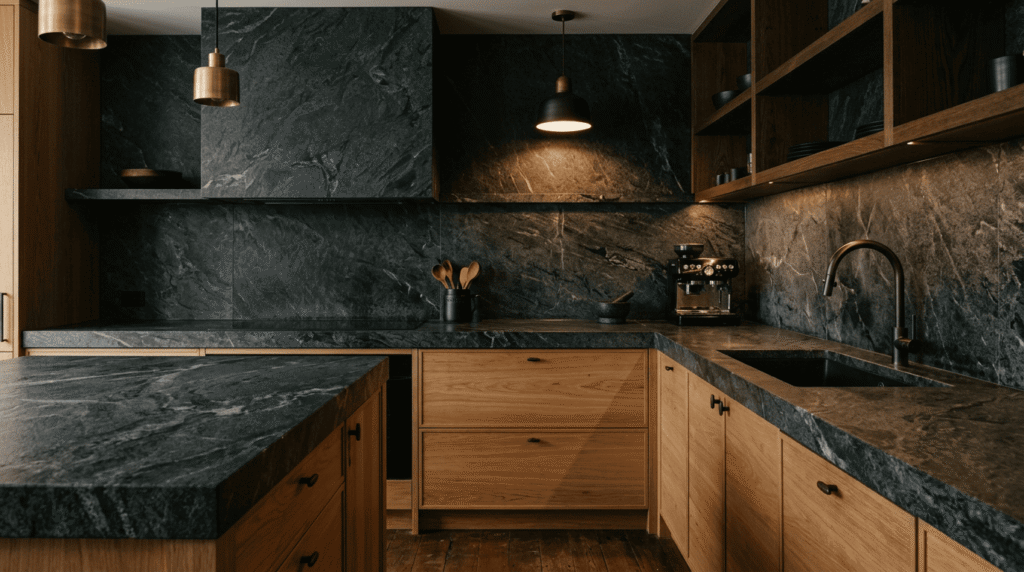
The second failure is too much stone. A dark stone countertop and backsplash across the full kitchen length, against natural oak cabinetry below, can overwhelm the wood entirely. The warmth the wood introduces at the lower level disappears under the visual weight of the stone above.
The working balance for most kitchens is roughly 60 percent of one material and 40 percent of the other. In a Singapore kitchen, wood as the cabinet material with stone on the countertop and backsplash is the most practical expression of the 60/40 rule.
The balance problem in this pairing is almost always about proportion. One material should lead. The other should support. When both compete for dominance, the kitchen reads as unresolved.
Tone and Undertone: The Decision That Determines Whether Wood and Stone Agree
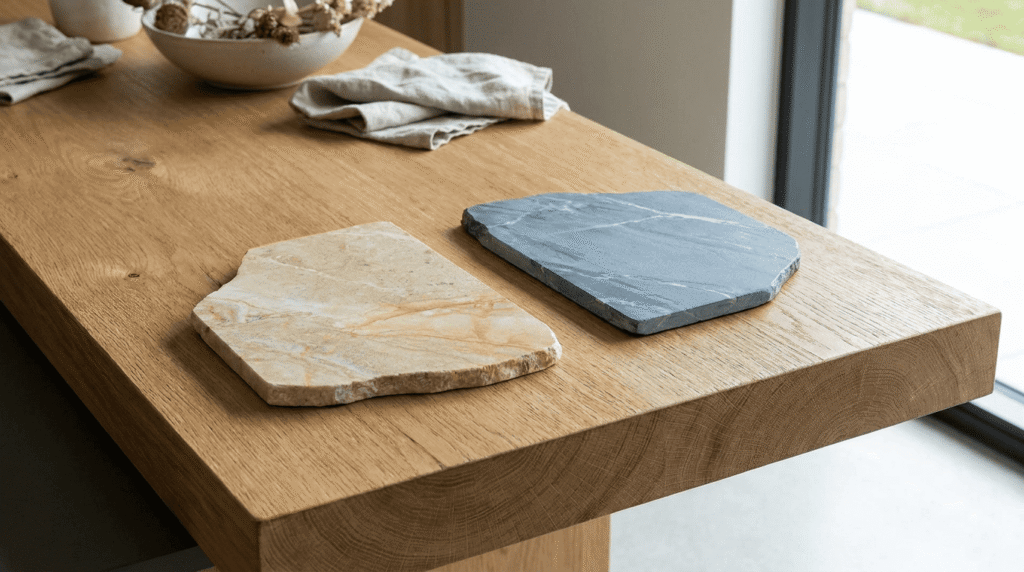
Getting the proportion right is the structural decision. Getting the tone right is what determines whether the materials actually agree in the finished room.
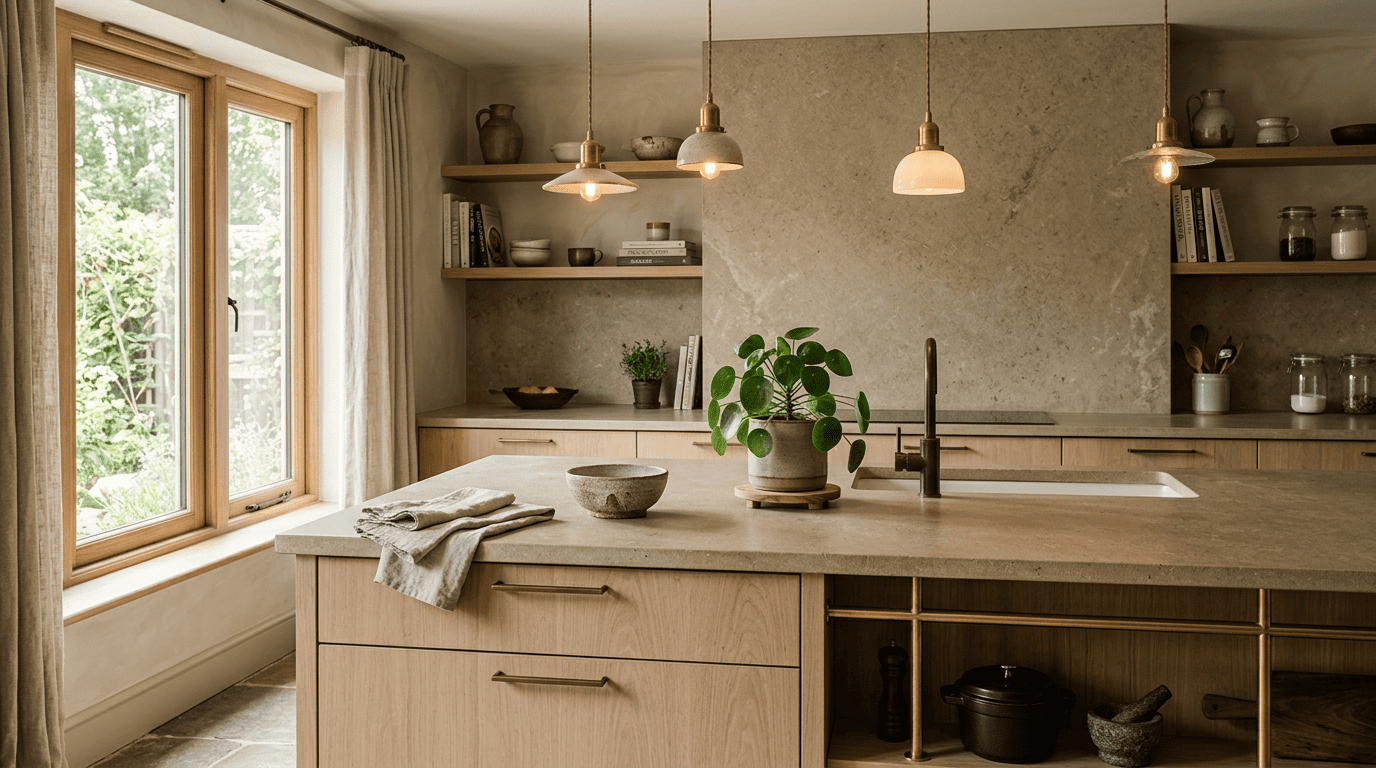
Wood almost always carries a warm undertone. Pale oak runs warm cream to yellow-gold. Walnut runs warm red-brown. Ash runs a cooler warm tone. Stone varies significantly. A warm-toned stone in cream, sandy beige, or warm grey reads naturally beside warm wood because both share the same undertone temperature. A cool-toned stone in blue-grey or stark white sits apart from warm wood despite how closely the named colours seem to match in a showroom.
Homes & Gardens notes that cool blues and grays create a disconnect that throws off the entire kitchen when paired with warm oak. A warm-toned surface is what keeps both materials reading as a cohesive pair. The undertone relationship is the deciding factor.
Undertone is the invisible decision in a wood and stone kitchen. Two materials that look coordinated in a showroom can sit apart from each other once installed, because their secondary hues pull in different directions under domestic lighting.
The method: identify the undertone of the wood cabinetry first, then select a stone surface that carries a compatible undertone temperature. Always view both together in the actual kitchen under real lighting before committing.
Which Stone Surfaces Work Best Alongside Wood
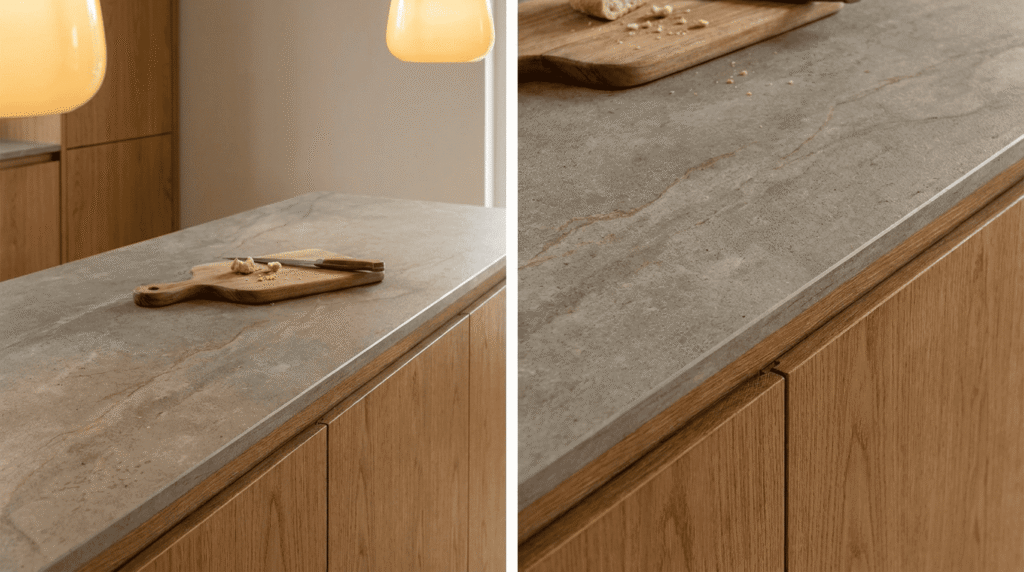
Sintered stone in warm stone-effect or concrete-effect finishes is the most practical choice for a Singapore kitchen. Its tonal variation and organic patterning complement wood grain rather than competing with it. It handles Singapore’s heat, humidity, and cooking conditions without sealing, which matters in a kitchen where nearby wood cabinetry already requires moisture awareness. Stone-look surfaces in sintered stone carry the visual character of natural stone while offering large-format consistency that coordinates cleanly with continuous wood cabinetry. Our guide to sintered stone surfaces for Singapore interiors covers how these finishes achieve the depth of natural stone in local conditions.
Quartz in a warm neutral tone is a reliable alternative. Its consistent colour makes it predictable to coordinate with wood that carries natural tonal variation across its grain. A warm cream or sandy greige quartz beside pale oak reads as a deliberate pairing. Trivets near the hob are the one practical habit quartz requires.
Natural granite carries organic variation that engineered surfaces approach but don’t fully replicate. A warm-toned granite in sandy beige or salt-and-pepper brings a surface character that complements wood grain at a material level. Both read as naturally variable rather than manufactured. Periodic sealing in Singapore’s humid conditions is the maintenance consideration.
Where Each Material Should Sit in the Room
Wood should occupy the zones where warmth reads naturally. Stone should occupy the zones where durability and visual weight are needed.
In most Singapore kitchens, this means wood as lower cabinet material and stone on the countertop and backsplash. The lower cabinets carry the grain character and warmth the wood contributes to the scheme. The stone countertop provides the structural surface for food preparation and the visual weight that anchors the kitchen. A stone backsplash in the same tonal family extends that continuity up the wall above the countertop.
Keeping upper cabinets in a lighter or painted finish prevents the kitchen from going timber-heavy. Our overview of kitchen countertops Singapore homeowners use covers how material and finish choices coordinate across the full kitchen layout.
How to Apply the Pairing in a Singapore Kitchen
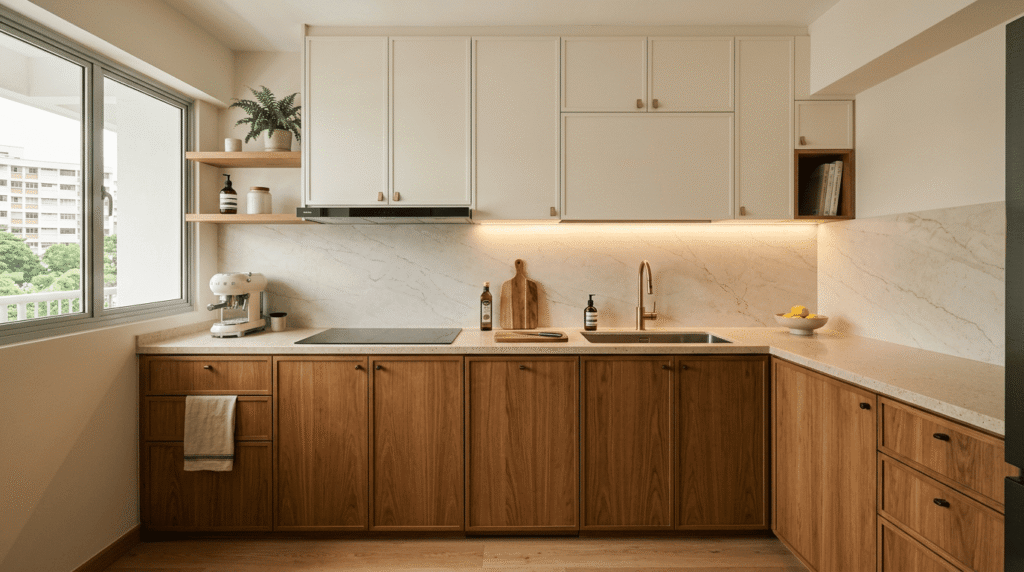
This combination translates well to HDB and condo formats, with one consideration: a compact layout amplifies every balance decision. In a galley or L-shaped kitchen under 8 square metres, a heavy dark stone countertop against full-run oak cabinetry reads more overwhelmingly than the same combination in a larger open-plan space. The proportion rule applies more strictly here.
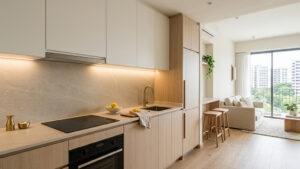
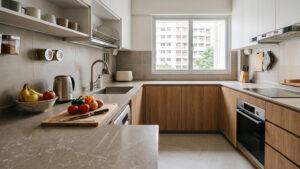
The combination that works most reliably in Singapore’s compact kitchen formats is warm oak or timber-veneer lower cabinetry with a light warm-toned honed stone countertop and a large-format sintered stone backsplash panel. This keeps the wood warm and visible at the lower level, the stone structural at the countertop, and the backsplash continuous without grout-line fragmentation. For the kitchen design Singapore homeowners find most versatile in this pairing, our kitchen backsplash materials guide covers how sintered stone panels work alongside wood-dominant cabinetry.
FAQS
1. What makes a wood and stone pairing feel balanced rather than heavy?
Proportion and undertone. Wood should occupy roughly 60 percent of the visible surface area, with stone providing structure at the countertop and backsplash. Warm-toned stone coordinates naturally with warm wood grain. Cool-toned stone creates a visual tension that can make the pairing feel unresolved, even when each material looks correct in isolation.
2. Which countertop colour ideas work best with warm wood cabinetry?
Warm neutrals work most naturally: cream, sandy beige, warm greige, and light warm grey. These share the same undertone temperature as natural oak, so the pairing reads as connected. Stark white and cool grey countertop colour ideas can work as deliberate contrast choices, but they require the wider scheme to support that contrast consistently.
3. What is the best stone surface for this pairing in Singapore?
Honed or matte sintered stone in a warm stone-effect or concrete-effect finish is the most practical choice. It carries enough organic tonal variation to complement wood grain without competing with it, handles Singapore’s cooking environment without maintenance, and comes in large-format slabs. Warm-toned quartz is a practical alternative for homeowners working to a tighter budget.
4. Does finish matter when pairing stone with wood?
Yes. A honed or matte stone countertop sits more naturally beside natural wood grain than a polished surface. The polished finish creates a high-gloss-beside-natural-grain contrast that works against the organic warmth the wood and stone pairing is built on. A honed finish diffuses light in a way that reads more cohesively alongside wood grain under kitchen lighting.
5. Does this pairing work in a small Singapore HDB kitchen?
Yes, with tighter proportion management. In a compact layout, lighter warm-toned stone on the countertop and backsplash paired with warm oak lower cabinetry keeps the space open rather than heavy. Avoid dark stone countertops in compact kitchens with wood cabinetry: the combination adds visual weight that a small space absorbs less gracefully than a larger open-plan kitchen.
Conclusion
This pairing earns its place through decisions, not defaults. Proportion, undertone, and surface selection all determine whether the combination feels grounded or assembled by accident. In Singapore’s compact kitchen formats, those decisions carry particular weight. If you’d like to see how warm-toned stone surfaces work alongside wood cabinetry in person, we carry sintered stone and quartz across warm finishes at our Singapore showroom.