Key Takeaways
- Continuous kitchen surfaces work best in compact layouts with a quiet stone pattern and tight fabrication. Applied in the wrong kitchen, the look magnifies every imperfection instead of hiding it.
- Running the same material from worktop to backsplash solves a real problem in small kitchens: the more surfaces you introduce, the more cramped the room feels.
- Four conditions favour this approach: compact galley or U-shaped kitchens, open-plan layouts with an island, kitchens with integrated sinks, and renovations committing to one material throughout.
- Knowing when not to do it matters just as much. Large kitchens, bold two-tone cabinetry, and heavily veined countertops are all reasons to stop at the worktop and let the backsplash do something different.
- Sintered stone handles continuous surfaces better than most materials because it comes in large-format slabs, tolerates direct heat, and needs no sealing.
Introduction
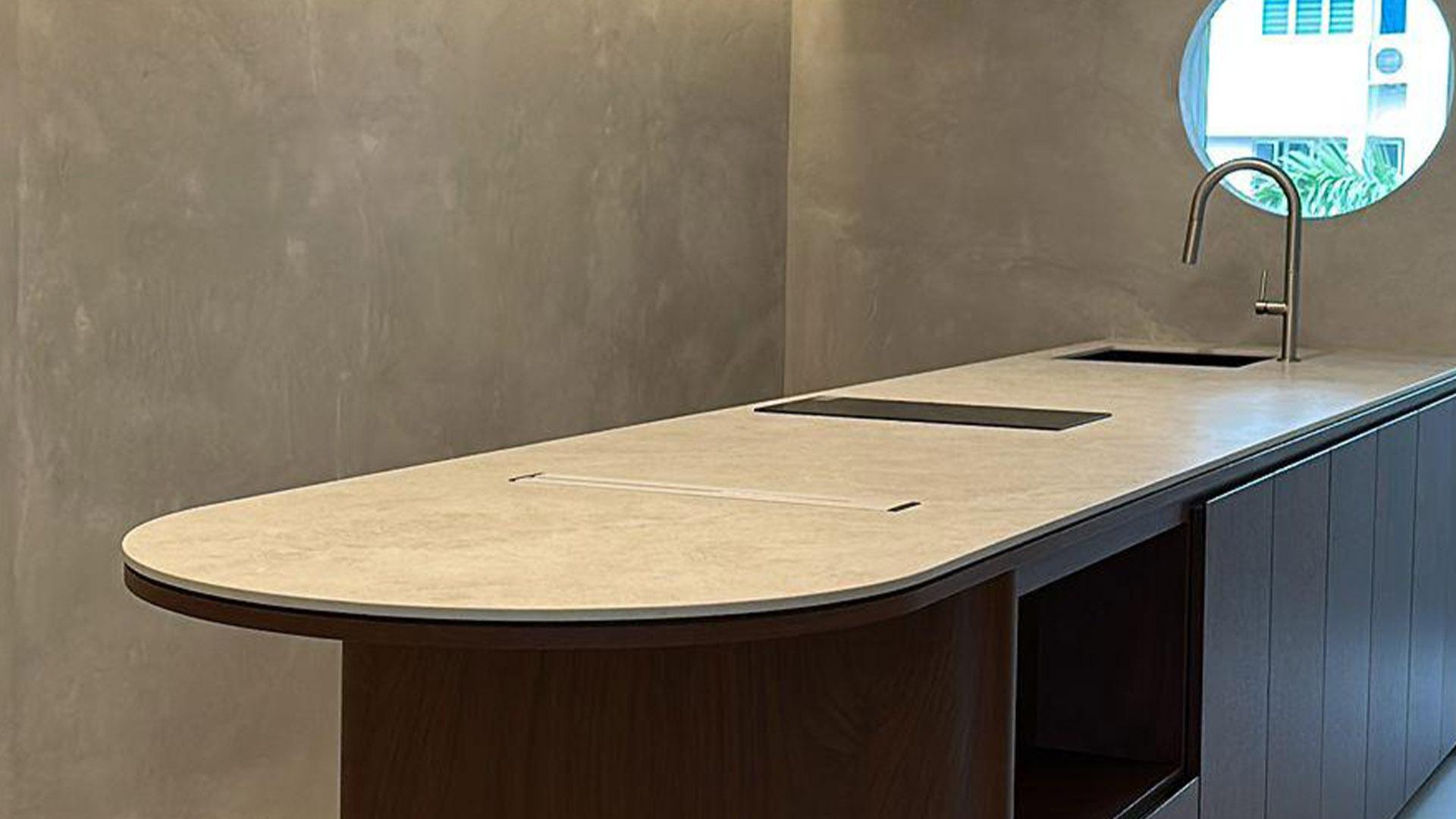
You have seen the look. Stone on the worktop keeps going straight up the wall: no tile border, no grout line, no change in material until it hits the upper cabinets. On a mood board it looks effortless. In practice, it is one of the more considered decisions you can make in a kitchen renovation.
The 2026 Houzz Kitchen Trends Study found slab backsplashes among the fastest-growing upgrades in recent renovations. Homeowners are moving away from tiled walls, toward fewer surfaces, fewer joints, fewer things to clean. It makes sense. But wanting the look is not the same as knowing whether your kitchen is set up for it.
What Are Continuous Kitchen Surfaces?
At its simplest: one material, used across more than one surface in the same kitchen, fabricated so the joins are invisible or nearly so.
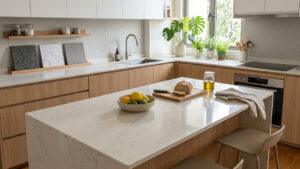
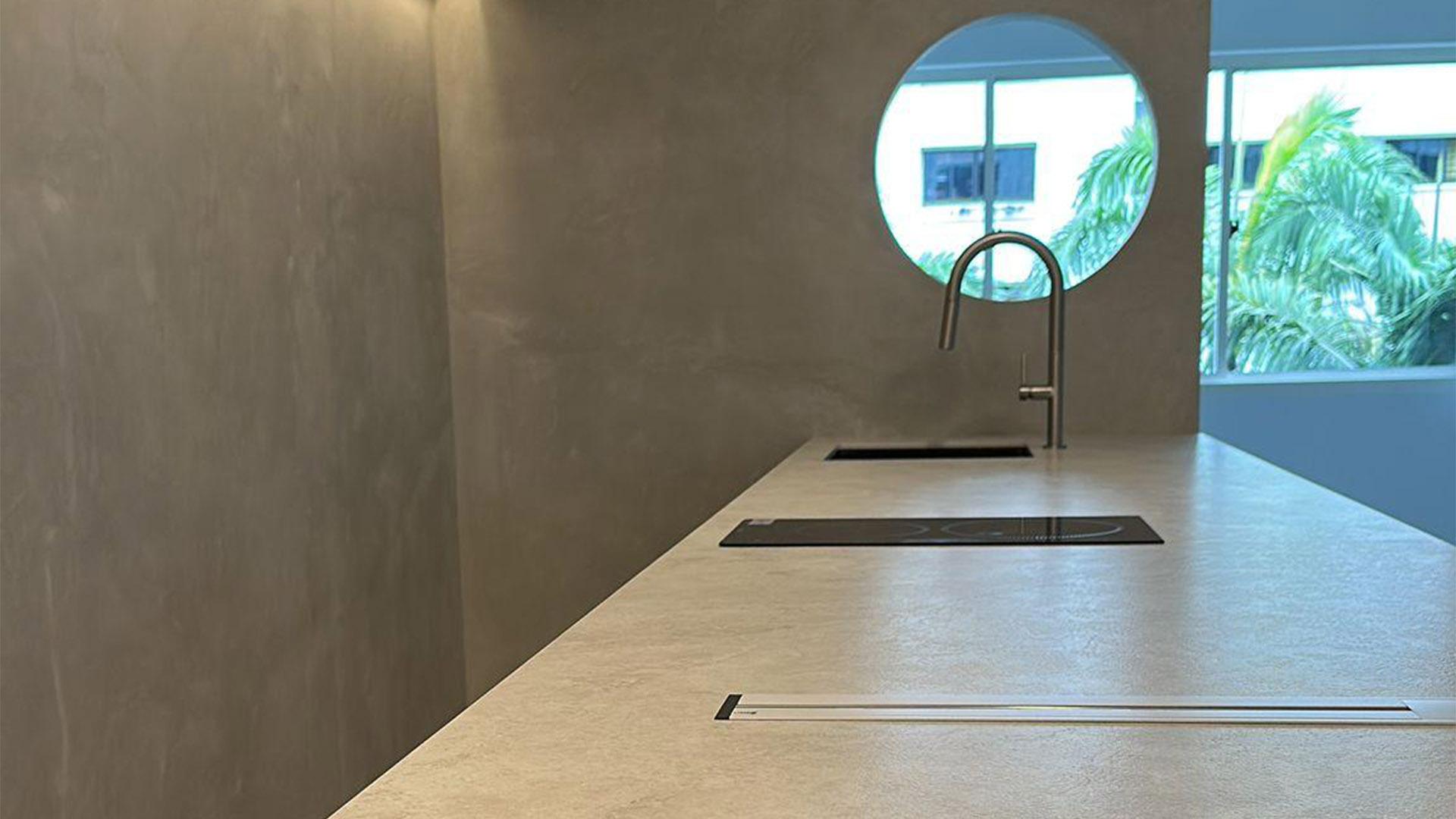
The most common version is running the same stone up the kitchen backsplash from the worktop. But continuous kitchen surfaces go further than that. A waterfall island drops the worktop stone down the side panel to the floor. An integrated sink carves the basin from the countertop slab itself. No rim, no lip, nothing to catch water or food debris. Some kitchens do all three.
What makes these different from simply buying matching tiles is that the material does not restart. Veining runs across the join. Colour stays consistent. The eye does not register a boundary because there is not one.
“Done well, the kitchen stops reading as a collection of surfaces. It reads as one thing. That is a harder effect to achieve than it looks.”
Why It Works Particularly Well in Singapore Kitchens
Singapore kitchens are small. Not by accident. HDB flats can give you as little as six square metres of kitchen. Plenty of condo units are not much more generous. In a space that tight, every material you add is another thing the eye has to process.
Tiles behind the hob, a different countertop edge, laminate panels on the island side. Each one is a visual stop. The eye moves across the room and keeps registering breaks. In a small kitchen, that registers as clutter even when the room is spotless.
Running one continuous surface across the worktop and up the wall removes those stops. Your eye sweeps across the kitchen without catching on anything. The room feels calmer. It reads as bigger. And a continuous kitchen backsplash with no grout lines behind the hob is genuinely easier to keep clean. One pass with a damp cloth and you are done.
Four Conditions Where Continuous Kitchen Surfaces Work Best
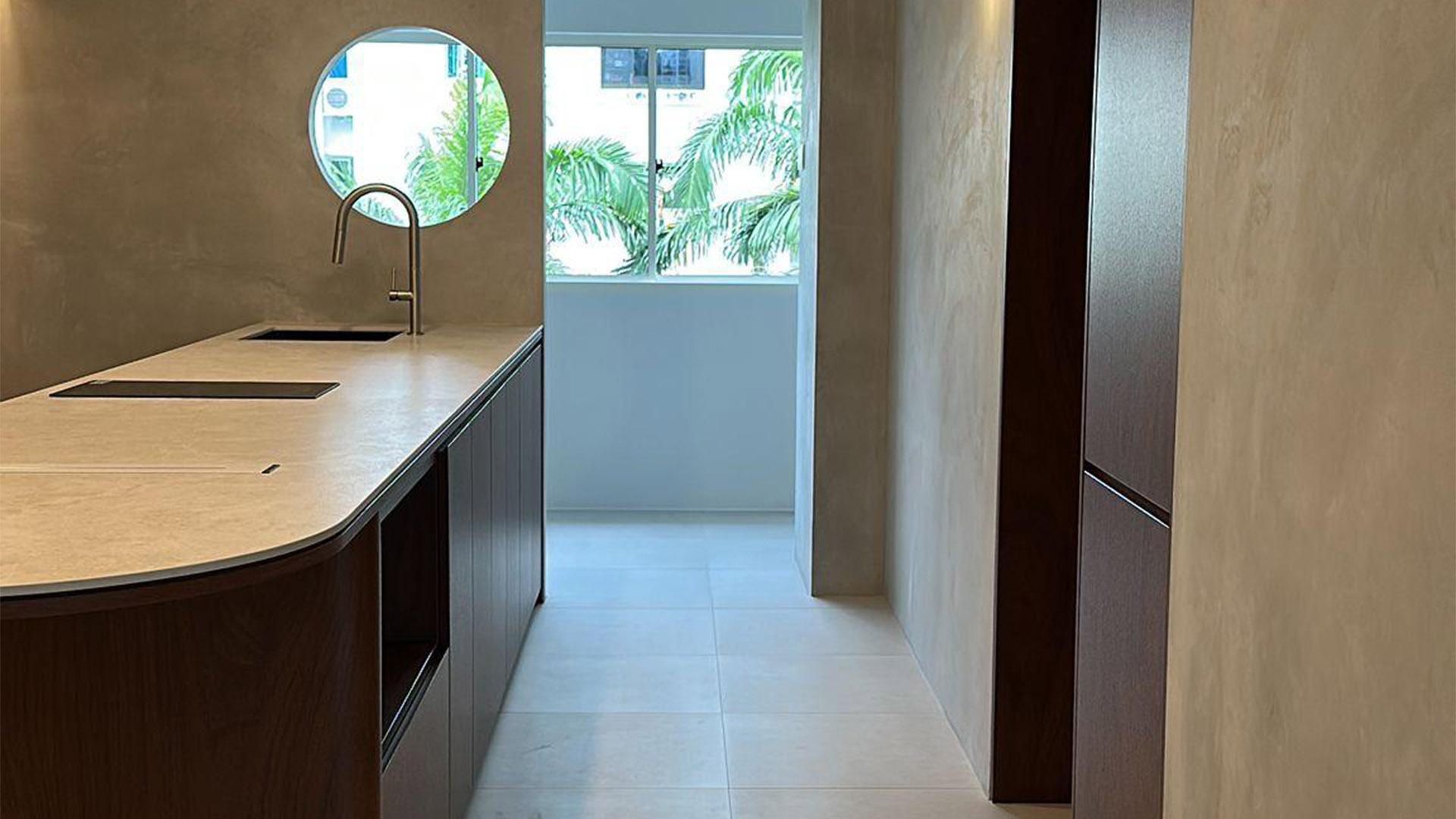
1. Compact galley or U-shaped layouts
Galley kitchens are where this approach earns its keep. When both walls are visible at once, running the same stone across the kitchen countertops in Singapore galley runs and straight up both sides stops the room from reading as two separate walls. You are already working with limited width. Every material change you add makes that narrowness feel more pronounced.
In an L-shaped or open-plan kitchen, the argument is weaker. Apply the continuous treatment to the hob wall only. That is where it counts.
2. Open-plan kitchens with an island
If your kitchen opens into a dining or living area, the island is usually the first thing guests see. A waterfall island, where the worktop stone falls to the floor on one or both sides, turns the island into the focal point of the whole open plan. Not just the kitchen.
Stone choice matters more here than anywhere else. A soft, low-movement tone carries it well. A bold, heavily veined slab tends to overwhelm the space it was supposed to anchor. The stone that looked striking as a single panel in the showroom can feel relentless on three surfaces in a real room.
3. Kitchens with integrated sinks
This is one of the most practical cases for going continuous. An integrated sink carved from the same slab as the worktop removes every join where water and residue collect. No rim. No gap at the edge. Nothing to scrub around. In Singapore’s humidity, that matters.
Our guide to integrated sink options covers which materials fabricate best as integrated basins and what to ask your supplier before committing.
4. Renovations committing to one material throughout
Continuous kitchen surfaces perform best when you choose one material and stay with it. Countertop, kitchen backsplash, island side panel: all from the same slab family. The reason is simple: even slabs sold as the same colour can read slightly differently under the specific lighting of a finished kitchen. In the showroom, you would not notice. Installed, it can look like a mistake.
If you are sourcing the worktop and backsplash panel separately, ask for slabs from the same production batch. Better still, have both templated at the same visit so the fabricator can plan veining alignment from the beginning.
“Retrofitting a slab backsplash after the worktop is in is harder than it sounds. Getting it done in one go, during the same templating visit, is how the vein alignment actually works.”
Which Materials Handle This Well?
Not everything works across both horizontal and vertical surfaces at once. Here is where the main options actually stand.
Sintered stone is the strongest choice for continuous kitchen surfaces in Singapore. Slabs go up to 3,200mm by 1,440mm, large enough to cover a galley worktop in a single run. The same material in a 12mm panel handles the kitchen backsplash. It is non-porous, does not need sealing, and tolerates sustained heat behind a gas hob without discolouring. For active cooking kitchens, it is hard to argue with.
Quartz is the more accessible option and consistent across batches, which helps with colour matching. The catch: quartz contains resin, and resin does not like direct sustained heat. Keep the quartz panel away from directly above the burners. Worth having a frank conversation with your fabricator before committing.
Stone-look surfaces in engineered porcelain cover the gap between budget and look. Modern stone-look surfaces print convincingly. A good concrete or marble effect holds up at scale. The limitation is the cut edge. Engineered porcelain does not carry its pattern through the body. Do a waterfall edge or mitre joint and the section face will show the base material. Fine for a flat backsplash. Less ideal for a showpiece island.
See how these materials compare across full kitchen applications in our guide to stone-look surfaces for Singapore interiors.
When to Stop at the Worktop
The one-stone look has limits. Knowing them saves an expensive mistake.
Large kitchens with ceiling height above 2.7 metres can make a full stone backsplash feel cold and austere rather than considered. Too much of one material at that volume can drain the warmth out of the room. A tile or a lighter panel above standard backsplash height gives the eye somewhere to rest.
Two-tone cabinetry is another case where stopping makes sense. If your upper and lower cabinets are in contrasting colours, that contrast is the design statement. Extending the same stone across kitchen countertops in Singapore homes with bold two-tone cabinetry ends up fighting the room rather than working with it. A quieter backsplash material lets the cabinetry lead.
Heavily veined countertops are a third reason to stop. A marble or granite surface with strong movement works beautifully flat on a worktop. Take that same pattern up the vertical wall behind it, and the room can tip from striking to busy fast. A plain or minimal stone-look backsplash in a complementary tone is often the more composed call.
Frequently Asked Questions

1. What is the difference between a continuous surface and a matching backsplash?
A matching kitchen backsplash uses the same or similar material but is sourced separately. A continuous surface is cut from the same slab, so veining and colour carry through the join without restarting. The difference shows in the finish. Matching materials can read as close but not quite right under kitchen lighting. A continuous surface reads as one piece.
2. Can continuous kitchen surfaces work in an HDB kitchen?
Yes, and small HDB galley kitchens are often where these surfaces perform best. The fabricator handles seam placement around the hob and sink cutouts, which is standard for sintered stone in HDB renovations.
3. Does the one-stone look need more upkeep than tiles?
Less, with sintered stone or non-porous quartz. No grout means no lines for residue to settle into. A wipe covers the whole surface. Some natural stones need periodic resealing. Sintered stone and engineered quartz do not.
Whether continuous kitchen surfaces make sense comes down to three things: your kitchen layout, the material, and getting the fabrication sequenced before templating rather than after it. If you want to see how the materials actually look running from worktop to wall, visit TSD’s showroom. Full slabs across quartz, sintered stone, and Cosentino are available to view, and the team can walk through what works for your specific layout.