Key Takeaways
- Dekton is a sintered surface material produced by Cosentino. It is engineered through ultra-compaction of raw minerals at an extreme heat and pressure. The result of that experiment is a near-zero porosity surface.
- Unlike quartz or granite, Dekton is completely unaffected by direct heat. Whether it is a lit cigarette, a hot pan, it won’t get damaged or discoloured.
- Dekton Singapore availability has grown considerably, with multiple specialist importers and fabricators now offering the full collection alongside custom sizing and installation.
- Dekton price Singapore ranges widely depending on series, thickness, and finish, understanding the tier system helps homeowners budget accurately without sacrificing material quality.
- UV stability makes Dekton, one of the few kitchen surface materials genuinely suitable for both indoor and outdoor installations in Singapore’s tropical conditions.
Introduction
In Singapore, the kitchen works hard. In this culture food runs from quick weekday stir-fries to elaborate weekend feasts, the surfaces in that kitchen absorb heat every single day. Most materials even premium ones accumulate the evidence of that use.
The question is not simply which material looks best on the day of installation. It is which material still looks and performs like itself five, ten, or fifteen years later. That is the question Dekton was built to answer.
According to Cosentino’s published technical data, Dekton has a water absorption rate of less than 0.1% making it one of the densest and least porous surface materials available for residential and commercial use.
This blog explains why Dekton has become Singapore’s preferred choice for high‑durability and heat‑resistant kitchen surfaces, showcasing how its advanced sintered‑stone technology delivers exceptional strength, thermal stability, and timeless design appeal for modern homes.
What is Dekton?
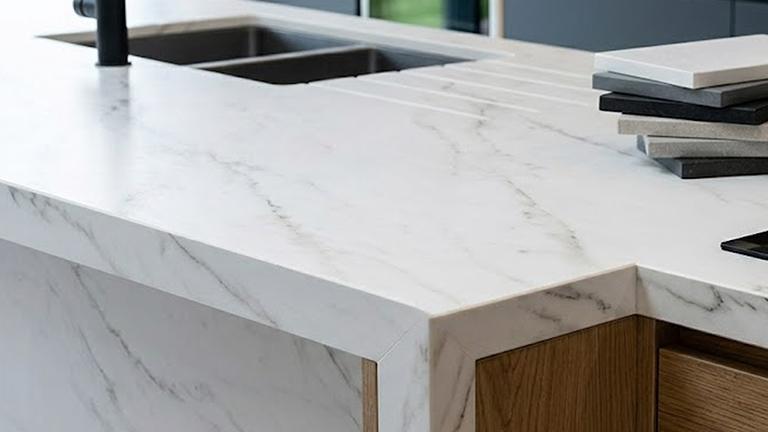
Dekton is a sintered surface a category that is distinct from both natural stone and engineered quartz. It is produced by Cosentino, the Spanish stone manufacturer, through a process called Particle Sintering Technology (PST).
Raw materials glass, porcelain, and natural quartz are combined and subjected to ultra-high temperature and pressure in a process that accelerates and replicates the geological formation of natural stone, but does so in a controlled manufacturing environment over hours rather than millennia.
The result is a surface with near-zero porosity, no resin binder content, and a material consistency that runs through the full thickness of the slab not just a surface coating. This matters for one straightforward reason: every physical property of Dekton applies uniformly.
There is no subsurface layer that behaves differently. There is no resin that softens under heat or degrades under UV. The material that faces your kitchen is the same material all the way through.
How Dekton Differs From Quartz?
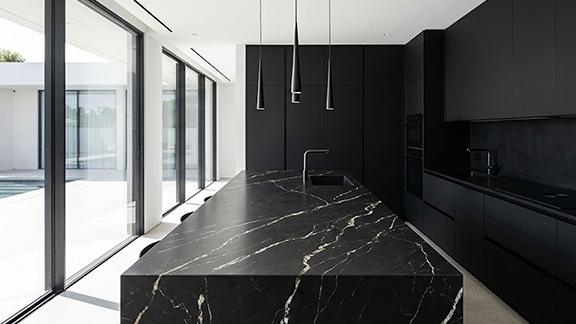
Many homeowners encounter Dekton through quartz comparisons, and the materials are often bundled into the same “engineered stone” category by retailers. They are not the same thing.
Quartz contains 10–15% polymer resin binder, which gives it flexibility and colour consistency but creates two vulnerabilities: heat sensitivity (resins can discolour above 150°C) and UV degradation (fading over time in outdoor or high-light-exposure environments).
Dekton contains no resin. It is fired and compressed until the raw particles fuse at a molecular level which is why it is heat-proof rather than merely heat-resistant, and why it holds its colour outdoors without any UV coating or protective treatment.
Learn More : Quartz Stone Table Top Trends: Elevate Your Dining Space With Durable & Stylish Custom Designs
Why Dekton Singapore Makes Particular Sense?
Singapore’s interior conditions create a specific set of demands that Dekton is unusually well-equipped to meet.
-
The Heat Factor
Singapore homes do not get a winter break from cooking. There is high-heat cooking day and night, whether it is wok hei stir-frying, steaming, deep frying or more.
Gas and induction hobs generate intense heat, and pots and pans are frequently rested directly on counter while cooking. Dekton’s heat resistance is not a selling point that wears thin with use it is a structural property that does not diminish.
-
Humidity and Outdoor Applications
Singapore’s year-round humidity makes most porous or resin-containing surfaces problematic in outdoor or semi-outdoor settings. Dekton Singapore installations are increasingly specified for outdoor kitchen platforms.
For covered balcony cooking areas, and pool terrace surfaces Dekton surface would be perfect as they don’t deteriorate within a few seasons. It absorbs moisture nor contains UV-degradable binders, it holds up in these environments without special treatment.
-
Hygiene in a Food-Focused Culture
The food culture in Singapore shows both rich diversity and deep connection to everyday life. The kitchen surface remains in constant contact with strong-smelling ingredients, acidic sauces, and oily residue.
No substances can penetrate Dekton because its material exhibits near-zero porosity. The space provides no opportunity for bacteria or mould or odour to establish themselves.
Dekton Collection for Singapore Homes
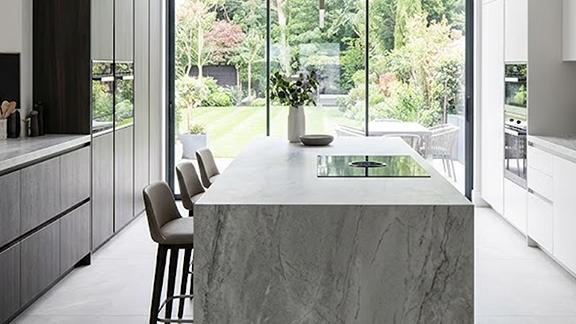
Cosentino produces Dekton in several series, each targeting a different aesthetic and application range. Here is how the main collections map to Singapore interior contexts:
- The Stonika Series
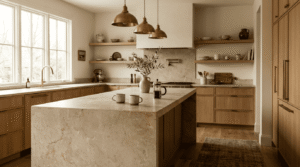
Inspired by natural quartzite, this series features deep mineral veining and textural variation the closest Dekton comes to the character of natural stone.
Popular in Singapore high-end landed home kitchens where the material is specified alongside natural stone feature walls. Colours include Entzo, Rem, and Som all tonal, complex, and distinctly non-synthetic in appearance.
- The Wild Series
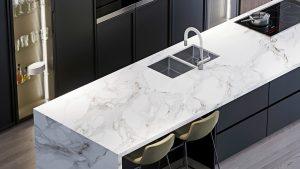
Bold, graphic, and high-contrast the Wild series mimics dramatic marble formations with sweeping white and dark veining. These are statement surfaces. In Singapore, they are most often specified for kitchen islands where the countertop is meant to be seen as the room’s dominant visual element.
- The Industrial Series
Matte concrete and stone-effect finishes suited to the Japandi and industrial-contemporary aesthetic that has shaped Singapore condominium renovations in recent years. Low visual noise, high tactile quality. These finishes are also specified frequently for bathroom surfaces in the same renovation projects.
- The Solid Series
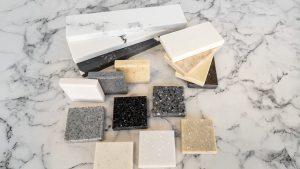
Uniform, non-veined colours across a wide palette from pure whites and blacks to warm greys and deep forest tones. These offer the design freedom to match specific cabinetry colour systems without the visual competition of veining. Popular in HDB renovations where the kitchen is compact and visual simplicity is an asset.
What to Expect from Dekton Price in Singapore?
Dekton price in Singapore varies by series, slab thickness, finish type, and fabrication scope. The table below reflects market ranges for supply and fabrication, based on commonly available series and standard installation scope.
| Dekton Series / Tier | Finish Options | Thickness | Approx. SGD/sqft (Supply Only) | Approx. SGD/sqft (Installed) | Best For |
|---|---|---|---|---|---|
| Entry / Solid Series | Polished, Matte | 12mm, 20mm | SGD 90–130 | SGD 160–220 | HDB kitchens, compact spaces, budget-conscious renovations |
| Mid / Industrial Series | Matte, Satin, Leathered | 20mm | SGD 130–180 | SGD 210–290 | Condominium kitchens, Japandi / industrial aesthetic |
| Premium / Wild Series | Polished, Satin | 20mm, 30mm | SGD 180–260 | SGD 280–380 | High-end condominiums, feature islands, luxury kitchens |
| Top / Stonika Series | Polished, Honed, Leathered | 20mm, 30mm | SGD 240–320+ | SGD 340–460+ | Landed homes, bespoke projects, full kitchen premium fit-outs |
| Ultra-Slim (4mm) | Polished, Matte | 4mm | SGD 110–160 | SGD 190–260 | Wall cladding, furniture fronts, overlay applications |
| Outdoor-rated Finishes | Grip / Anti-slip Texture | 20mm | SGD 150–220 | SGD 230–320 | Outdoor kitchens, pool terraces, covered balconies |
Common Misconceptions About Dekton
Even with Dekton’s growing popularity in Singapore’s renovation market, a few misconceptions still linger, especially around durability, aesthetics, and cost. Let’s clear up what homeowners often get wrong about this advanced sintered surface.
- “Dekton chips easily at the edges.”
Early-generation sintered surfaces were more brittle at thin slab edges. With correct installation including proper substrate support and professional templating edge chipping is rare. The 4mm ultra-slim format requires more careful handling, but that is a fabrication consideration, not a design flaw.
- “Dekton is too industrial-looking for residential kitchens.”
This stems from familiarity with only the Solid and Industrial series. The Stonika and Wild collections produce surfaces that are visually indistinguishable from natural quartzite or marble at a casual glance and rather more consistent across a full installation.
- “The Dekton price Singapore is out of reach for most homeowners.”
At entry-level series pricing, Dekton is positioned comparably with premium quartz not dramatically above it. The gap between the two products expands at the highest collection tier because Stonika and Wild series pricing shows both material complexity and large-format slab production costs.
- “Dekton cannot be repaired if damaged.”
Full repair of a crack through a sintered slab is not straightforward this is true. However, the probability of damage under normal kitchen conditions is very low. Dekton is rated to withstand temperatures up to 300°C+ without surface damage and resists impact that would chip granite.
Conclusion
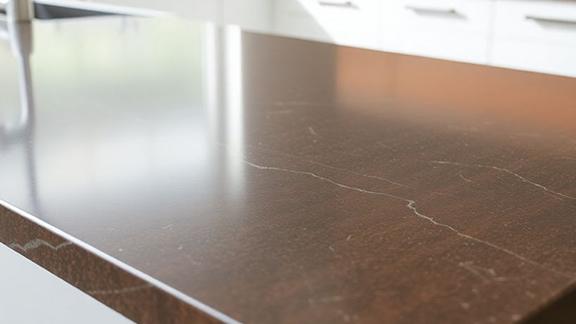
Dekton is the combination: heat-proof to temperatures which most kitchen surfaces will never reach. This is UV-stable, so can be used outdoors, dense enough to need no sealing, and available in designs that comes in a variety.
For Singapore homeowners renovating a kitchen they intend to live with for a decade or more. Dekton in Singapore installations represent a surface investment that does not compound maintenance costs or aesthetic regret over time. And is you are exploring the category for the first time, the range of Dekton price is more accessible.
TSD gives you access to the Cosentino Dekton collection, but also more than that. There’s in‑house help for consultation, fabrication, profiling, and installation, all managed by a seasoned stonework crew in Singapore.
You can head down to their showroom at 16 Joo Koon Circle, Singapore 629047, but note it’s appointment‑based, so it’s better to book first. There you can see full slabs, check live finishes, touch edge profile samples, and confirm custom sizing options in person. The range covers contemporary matte surfaces, marble‑inspired veining, industrial textures, and ultra‑slim profiles that fit modern interior designs.
With decades of residential and commercial stonework experience, TSD also handles quartz, granite, ML sintered stone, and other custom countertop setups for kitchens, bathrooms, dining tables, and feature walls.
If you want to ask about Dekton price in Singapore, fabrication lead times, or installation requirements, reach our team at +65 6908 5147 or tsd.enquiry@gmail.com and get started on a surface built for long‑term everyday use.
Find Out More : Silestone Singapore: Explore Premium Quartz Surfaces That Combine Style With Easy Maintenance
FAQs
1. Is Dekton the same as porcelain?
They are related but not identical. Both are sintered ceramic-based materials, and both share same properties. But, Dekton is specifically Cosentino’s proprietary formulation (raw glass and quartz) alongside porcelain components, and the Particle Sintering Technology used to produce it operates at specifications that differ from standard porcelain tile manufacturing.
2. Can Dekton be used for bathroom surfaces and not just kitchens?
Absolutely, and this is increasingly common in Singapore renovation projects. Dekton’s hygiene properties, moisture resistance, and wide colour range make it well suited to bathroom wall cladding, vanity tops, and shower surrounds.
3. How does Dekton Singapore hold up against Singapore’s hard water?
Hard water leaves limescale deposits on most surfaces over time, requiring chemical descalers that can damage some stone finishes. But it won’t happen with Dekton, it has a near-zero porosity means limescale does not bond into the surface.
4. What is the lead time for Dekton supply and installation in Singapore?
From confirmed order, most Dekton Singapore suppliers quote 14–28 working days to supply, template, fabricate, and install. Uncommon sizes or finishes may require importation from Cosentino’s regional distribution centres, which adds lead time.
5. Is Dekton worth the premium over quartz for a Singapore kitchen?
For homeowners who cook regularly, they value long-term surface integrity. The heat-proofing alone removes a significant constraint from how kitchens are used. For very light-use kitchens or spaces where budget is the primary constraint, premium quartz remains a strong alternative.