Key Takeaways
- The sink is integrated from the same stone slab as the surrounding countertop. This eliminates the rim, turning caulk line and all surface joints. So this trap dirt and moisture in conventional sink installations.
- Especially in a high-humidity environment like Singapore, the lack of a sink-to-countertop joint is an important hygiene benefit. As there is no seam where bacteria and mould can colonise.
- Based on the maintenance profiles and aesthetic characters, quartz, dekton or granite is the most common material selected in integrated sink Singapore installations.
- Fabrication quality determines everything when it comes to sinks. Cracked sink corners will ruin the whole experience, if fabricated well, an integrated sink cut and finished by a seasoned stone pro is structurally sound for decades
- Cost for integrated sink Singapore projects varies by material, basin size, and bowl depth understanding the full cost structure upfront prevents mid-project surprises.
Introduction
Look at almost any conventional kitchen sink installation and you will find a thin line of stainless steel rim. On the day of installation, it is clean and barely visible. Six months later especially in Singapore’s humidity that line has darkened. A year in, it is a breeding ground for mould, residual food particles, and moisture that no amount of surface wiping can fully address.
This is not a cleaning failure. It is a design flaw built into the conventional approach. The integrated sink exists specifically to remove it.
Integrated sink installations has grown considerably across Singapore over the past three years. According to the 2025 UK Houzz Kitchen Trends Study, 92% of homeowners upgraded their countertops during kitchen renovations, with durability, appearance, and ease of cleaning ranking among the top priorities influencing material selection.
This blog is about how homeowners in Singapore can achieve a seamless, hygienic, and design‑forward kitchen countertop using integrated stone sinks, covering fabrication methods, material choices, and installation practices that make the sink‑to‑countertop transition truly invisible.
also read: What Your Countertop Colour Says About Your Kitchen Style?
What is an Integrated Sink and How is it Made?
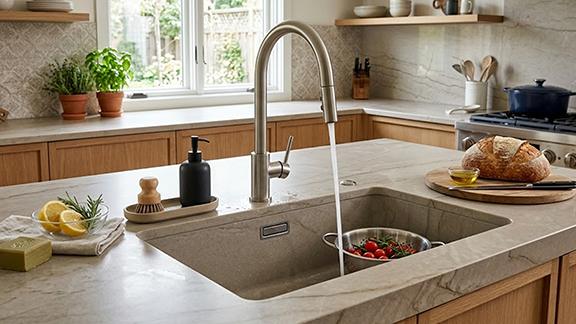
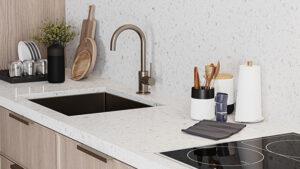
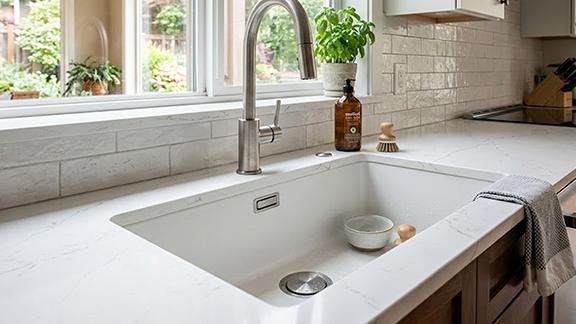
An integrated sink sometimes called a seamless sink, monolithic sink, or countertop sink is a wash basin that is carved, routed, and finished from the same stone slab as the surrounding countertop. There is no separate basin unit, no rim, or no silicone joint. The countertop and sink basin are one continuous piece of material.
The fabrication process begins after the countertop slab has been cut to its final dimensions. The basin cavity is carved from below the slab that defines the bowl depth, the internal radius at each corner, and the slope toward the drain point using a CNC routing machine.
The basin is then smoothed out and polished. This creates a surface on which water travels seamlessly from counter to basin to drain without ever crossing a joint in materials.
The Engineering Behind the Seamless Finish
The structural challenge in integrated sink fabrication is corner radius. Stone base of sharp internal corners has the concentration points of stresses this means, that under influence temperature changes or other loadings (impact or local pressure of a column from water) cracks on such corners arise more often.
For stone basins, more experienced fabricators will create an internal corner radius of 20–25mm and a bonded fibreglass mesh or resin backing on the underside of the slab at the basin perimeter to evenly transfer load/distribute weight.
This is why fabricator experience matters more for integrated sinks than for any other stone countertop application. The margin for error is narrower, the structural demands are higher, and the cost of a crack which means replacing the entire countertop is considerably greater than a standard countertop repair.
Why Integrated Sink Singapore Installations Are Growing?
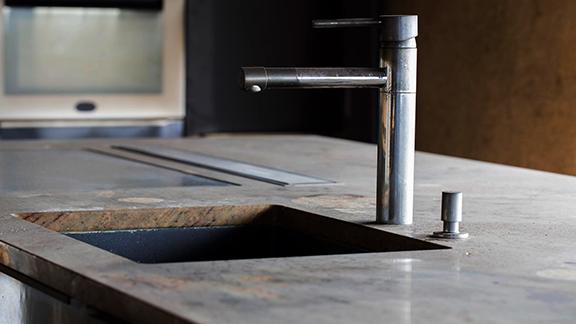
Several factors converge in Singapore that make the integrated sink a particularly rational choice:
Mould is a Constant Battle in Tropical Kitchens
Singapore’s humidity averages between 70% and 90% year-round. So in kitchens where water is in daily contact with the countertop, the silicone bead around a conventional sink rim show mould growth.
It is difficult to clean thoroughly, degrades over time, and must be periodically stripped and reapplied a maintenance cycle that integrated sink installations remove entirely.
Kitchen Sizes Reward Spatial Efficiency
Singapore’s HDB and condominium kitchens are frequently compact. A conventional undermount or topmount occupies both visual and physical space. Whereas an integrated sink, by contrast, reads as part of the countertop surface.
Design Coherence in Open-Plan Homes
This makes the kitchen visible from living and dining areas, despite open-plan layouts being standard in Singapore new launches and renovation work. Distance across the room could not have inspired such cohesion were it a conventional drop-in or undermount sink, however well chosen.
Absence of visual seams, which a monolithic countertop and integrated sink provide.
Which Stone Materials Work Best for Integrated Sinks?
Not every stone material is equally suited to integrated sink fabrication. Here is how the main materials available from Singapore stone suppliers compare:
-
Quartz
The most popular choice for integrated sink Singapore projects. Non-porous by manufacture, quartz requires no sealing and resists the soap scum, mineral deposits, and food residue that accumulate in a working kitchen sink. The resin content that makes quartz slightly heat-sensitive as a countertop material is less relevant in a sink context.
The basin surfaces rarely encounter the direct high heat that concerns designers on the main cooking zone. Quartz also polishes to a very consistent finish that is easy to maintain and ages without visible patina.
-
Dekton
The premium specification for integrated sink Singapore installations where maximum durability is the priority. Dekton’s near-zero porosity and resin-free composition mean it is completely impervious to water absorption, mineral staining, and soap etching. Its hardness makes it more resistant to impact from dropped utensils than quartz.
The trade-off is fabrication complexity. Dekton’s brittleness at thin sections requires skilled handling, and the basin corners must be routed with particular precision. Expect a price premium of 30–50% over quartz for an equivalent integrated sink in dekton.
-
Granite
A time-tested option that retains a following among homeowners. It is preferred for natural stone’s character over engineered consistency. Mostly granite is integrated in sinks; the stone gives each basin a genuinely individual appearance.
The maintenance requirement is periodic resealing every 12–18 months for a basin that is in daily water contact to prevent mineral absorption and surface staining. Without consistent sealing, granite basins can darken and develop watermarks that are difficult to reverse.
-
Sintered Porcelain/Ceramic
An alternative to dekton at a different price point, sintered porcelain can be fabricated into integrated basins with good results. It is non-porous, UV-stable, and available in a wide range of finishes.
The limitation is slab size standard porcelain slab formats are smaller than quartz or Dekton, which can restrict design options for larger countertop configurations. It is worth discussing slab availability with your stone supplier early in the design process.
The basin interior is exposed to standing water, soap, temperature change, and physical contact with cookware in ways that a dry countertop surface is not.
Material Comparison for Integrated Sink Fabrication
The table below compares the four main material options for integrated sink Singapore fabrication across the criteria that matter most for a basin application.
| Criteria | Quartz | Dekton | Granite | Sintered Porcelain |
|---|---|---|---|---|
| Porosity | Near-zero (engineered) | Near-zero (sintered) | Low–moderate (natural) | Near-zero (sintered) |
| Sealing Required | No | No | Yes — every 12–18 months | No |
| Stain Resistance (basin) | Excellent | Excellent | Good when sealed | Excellent |
| Impact Resistance | Very good | Excellent | Very good | Good |
| Heat Resistance (basin) | Moderate | Excellent | Very good | Very good |
| Fabrication Complexity | Moderate | High | Moderate | Moderate–high |
| Mould Risk at Drain | Very low (no joints) | Very low (no joints) | Very low (no joints) | Very low (no joints) |
| Natural Variation in Look | No (consistent) | No (consistent) | Yes (each slab unique) | No (consistent) |
| Approx. SGD Premium Over Standard Sink | SGD 800–1,800+ | SGD 1,400–2,800+ | SGD 700–1,600+ | SGD 900–1,900+ |
| Lifespan (with correct care) | 15–25 years | 25+ years | 20+ years (if sealed) | 20+ years |
How the Fabrication Process Works?
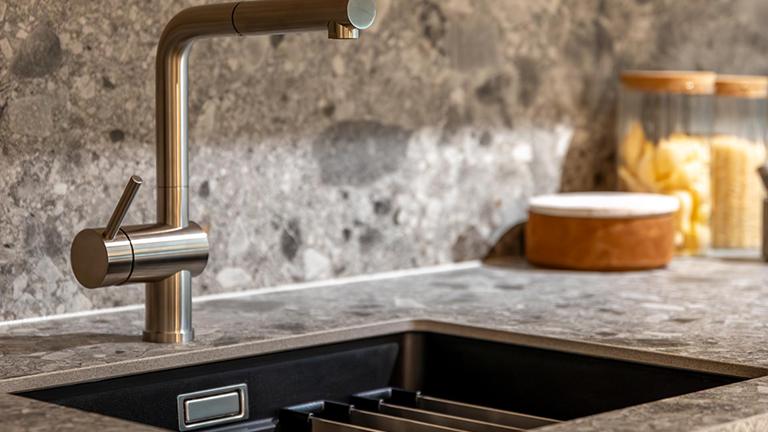
Understanding what happens between your first conversation with a stone supplier and the day your integrated sink is installed helps set realistic expectations and helps you ask the right questions at each stage.
Stage 1: Design and Specification
Your fabricator requires a detailed brief before ordering any material: dimensions and location of the countertop, location of basin (usually in the central point under the window or on the hob zone), size, depth, and drain location for bowls among others.
Common basin sizes for Singapore kitchens range from 45cm x 35cm for single-bowl compact layout to larger double-bowls at around 70cm x 42cm. Bowl depth 18–22cm deep enough to catch splash but shallow enough to prevent stretching for most people.
- Consult your plumber on drain rough-in position before stone is cut which cannot be moved after fabrication.
- Tap hole placement at this step one, two or three holes depending on your tap and soap dispenser position.
- Specify the basin interior finish: polished (easiest to clean), honed (less reflective, more tactile), or leathered (textural less common for basins but available).
Stage 2: Slab Selection
Choose your slab in person at the supplier’s yard. For integrated sinks, pay particular attention to the veining position. This is important across the countertop a dramatic vein that runs through the basin interior.
With this visual, you can get a striking or busy depending on the stone. Ask your fabricator to mark out the basin footprint on the slab so you can visualise how the stone pattern will read at the finished scale.
Stage 3: Templating
Once cabinets are installed in your kitchen, the fabricator visits to create a precise template of the countertop space. For integrated sinks, this includes confirming the drain rough-in position, the hob cut-out and more.
Remember, precision at this stage is what prevents gaps, overhangs, and misaligned drain connections on installation day.
Stage 4: CNC Fabrication
The slab is cut, the basin is routed, internal corners are radiused, the basin interior is polished, and the drain aperture is finished. The underside of the slab at the basin perimeter is reinforced with a structural backing. The full piece is inspected for surface consistency and structural integrity before delivery.
Stage 5: Installation and Plumbing Connection
The countertop is set in position on the cabinet carcasses and secured. The plumber connects to the drain waste, installs the tap through the pre-drilled holes, and confirms water-tightness at all connections.
No silicone is applied between sink and countertop because they are the same piece. The only sealant lines are at the wall junction and at cabinet edges, both of which are dry surfaces away from the water zone.
Conclusion
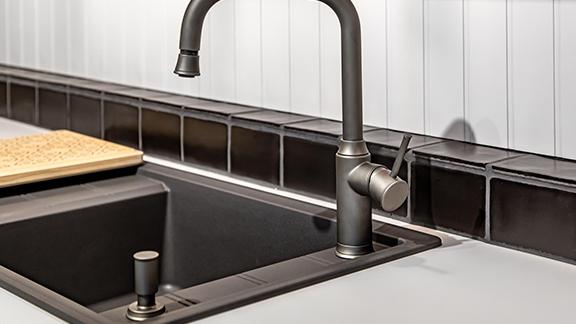
A sink inset is conveniently not just a seamlessly an aesthetic design choice, but a functional upgrade for Singapore kitchens in the twenty-first century. It eliminates joints and uncovered seams to create a countertop surface that is exceptionally clean, hygienic, and easy to maintain in environments with high humidity.
Regardless of whether you opt for quartz, Dekton, granite or sintered porcelain, quality fabrication is what delivers the longevity and performance that you can rely on over time.
TSD works with quartz, Dekton, granite, and ML sintered stone, so your countertops plus integrated sink look truly smooth with our in‑house help for consultation, fabrication, profiling, and installation.
You can visit our showroom at 16 Joo Koon Circle, Singapore to see full slabs, sink layouts, edge finishes, and countertop samples directly. Popular collections include River Blanc, Calacatta Aurum, Mystic Black, Bianco Evian, and Ivory White, suitable for both minimalist kitchens and bold statement designs.
With decades of residential and commercial stonework experience, TSD fabricates countertops built for long‑term everyday use in Singapore homes.
For details on integrated sink sizing, fabrication timelines, material options, or installation, contact us, speak to our specialists at +65 6908 5147 or tsd.enquiry@gmail.com and start mapping out a kitchen surface that fits your space perfectly.
also read :Sintered Stone Explained: Advantages, Disadvantages & More
FAQs
1. Can an integrated sink be retrofitted into an existing stone countertop?
In almost all cases, no. Creating an integrated basin requires routing from a full-thickness slab with access to the underside for reinforcement work. If you want an integrated sink in an existing kitchen, the countertop will need to be replaced.
2. What drain fitting works best with a stone integrated sink?
A slotted waste or click-clack drain in brushed stainless steel or brushed brass is the most common specification. Avoid chrome-plated fittings the plating can corrode at the stone interface over. The drain fitting should sit flush with or fractionally below the basin floor; a raised fitting creates a water retention point that promotes mineral build-up.
3. How do I maintain a quartz integrated sink over the long term?
Rinse the basin after use and wipe with a soft cloth. For mineral deposits and soap scum, a spray of diluted white vinegar left for two minutes before rinsing is sufficient. Avoid bleach-based cleaners, which can affect the resin and surface colour of quartz.
4. Is a single-bowl or double-bowl integrated sink better for Singapore kitchens?
For HDB and compact condominium kitchens, a single large bowl typically 60cm x 40cm is enough. Double-bowl configurations suit larger kitchens where the second basin can serve a dedicated function.
5. Which integrated sink Singapore suppliers offer fabrication for landed homes with extra-large countertops?
Specialist stone fabricators with in-house CNC routing capability rather than outsourced cutting are better. It is equipped for large-format integrated sink projects. When evaluating suppliers, ask specifically whether they fabricate in-house and request to see examples.