Key Takeaways
- A two-tone kitchen works when the countertop colour acts as a connector between the two cabinet tones, not as a third competing element.
- The most reliable countertop approach for a two-tone kitchen is to pick up one undertone from the darker cabinet colour and one from the lighter, then find a stone that carries both.
- Veined quartz and sintered stone with natural movement give the countertop visual interest without adding a third colour to manage.
- In Singapore’s compact open-plan kitchens, the countertop is one of the most visually prominent surfaces in the space, so colour decisions here carry more weight than they would in a larger kitchen.
- Getting a physical slab sample into the kitchen and viewing it under your actual lighting conditions is the only reliable way to confirm a colour decision before ordering.
Introduction
There is no lack of suggestions in regards to the selection of colours of countertops in two-toned kitchen design but there is not much information about which material distinguishes an organized colour palette from a random one.
According to the Houzz Kitchen Trends Study of 2025 in the United States, kitchen remodeling is concerned both with aesthetic considerations and practical issues, as 35% of homeowners expand their kitchens while renovating. 67% of homeowners favor full coverage of the kitchen back splashes, reaching the level of cabinets or range hood, while over 1 out of 10 of homeowners (12%) cover their back splashes all the way to the ceiling.
The survey showed that more than 3/4 of homeowners choose tile as an updated material for kitchen back splashes, and rectangular tiles are used the most often (68%). The countertop exists in the location where the two different tones of the cabinet exist. The lower cabinet will have one tone and the higher cabinet above will have a different tone.
In the case of the contemporary open plan kitchen in Singapore, the countertop can be visible in the living area, dining area, and even the entry point of the kitchen. It is the very basic foundation for all the discussions on this blog. It is not about selecting the right countertop colours, but it is all about the way the countertop can be used to blend the two colours together.
What is a Two-Tone Kitchen?
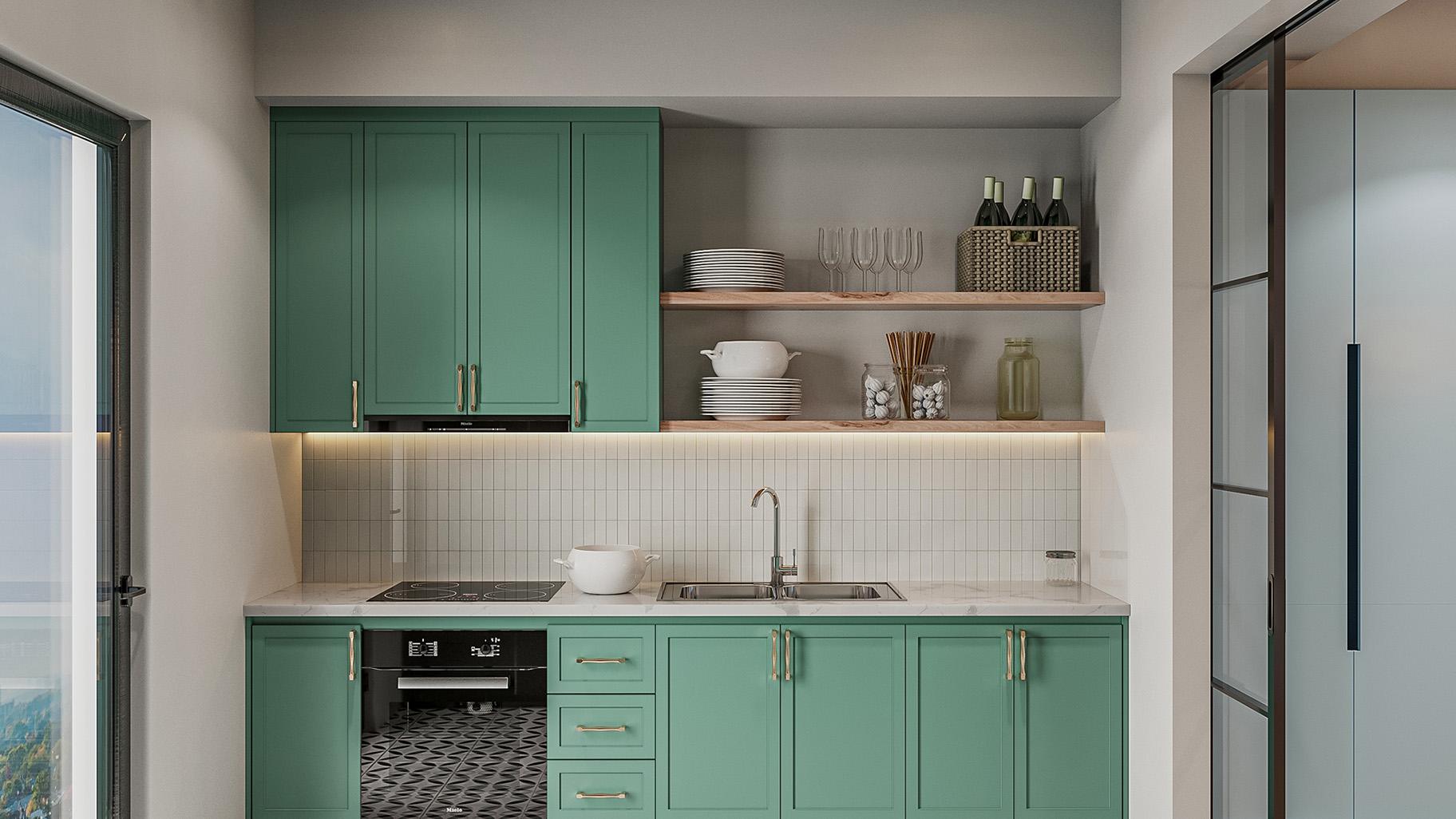
A two-toned kitchen will feature the application of two different shades of colour, texture, or material in the cabinets, which are the upper and lower cabinets. Two-toned kitchens can have a subtle combination of colours,
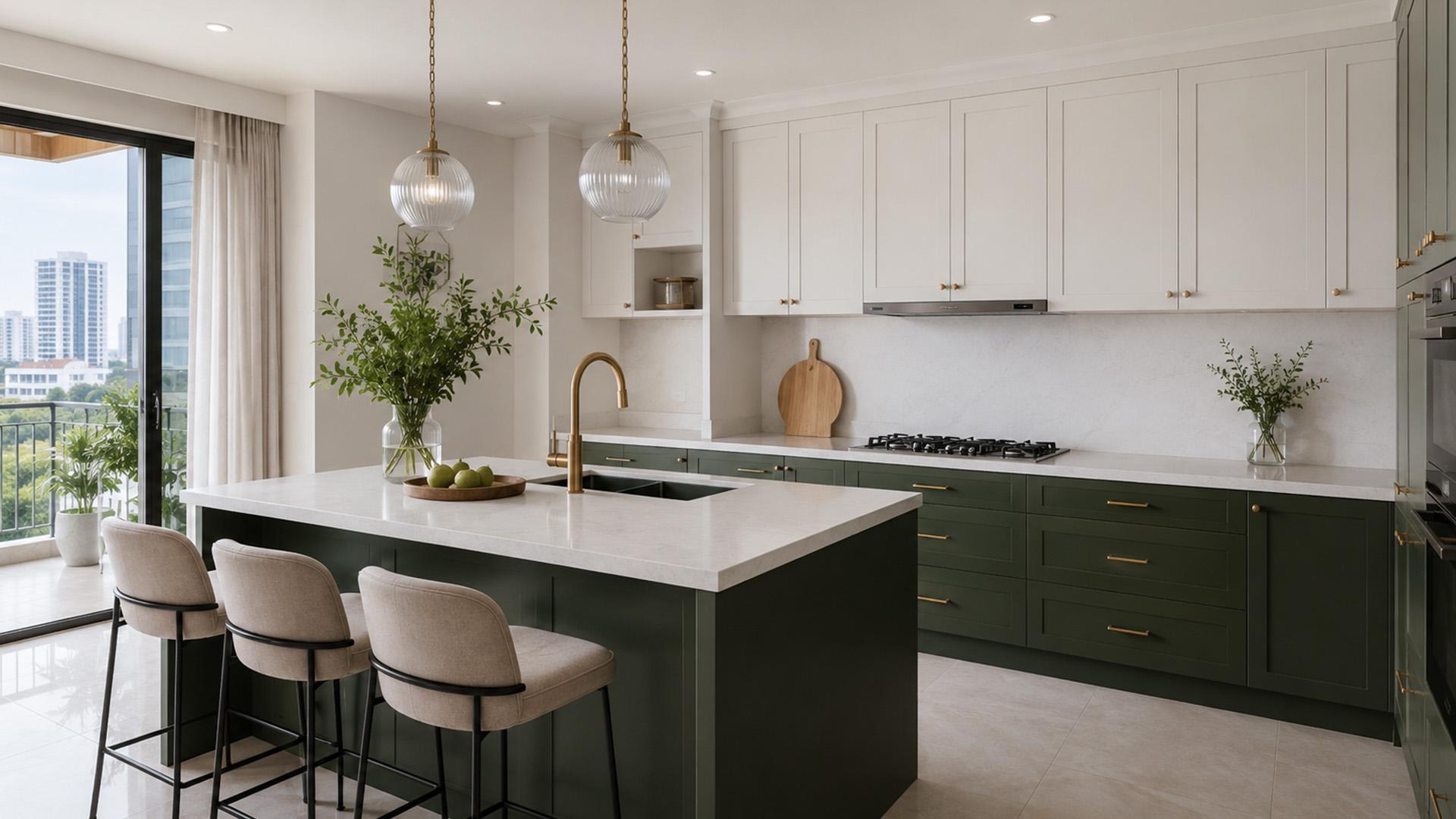
For example, white for the upper cabinets and warm gray for the lower cabinet or a bold combination of colours, for example, dark green for the base cabinet and cream for the upper cabinet. As per the Ideal Home guide to two-tone kitchen cabinets, the colours should have a common undertone.
Why the Countertop is the Most Important Decision in a Two-Tone Kitchen?
The job of the countertop in a monochromatic kitchen is simple. It has to function effectively, have great aesthetics, and match one colour of the cabinets. The task of the countertop in a dual tone kitchen is slightly more difficult, because it has to bridge two cabinet tones.
The lower cabinets are usually the dominant tone, and the countertop sits directly above them.
- A countertop that matches the lower cabinets too closely removes the contrast that gives a two-tone kitchen its character.
- A countertop that contrasts too sharply with both cabinet colours creates visual noise instead of cohesion.
- The goal is a surface that picks up characteristics from both tones and visually ties them together.
This makes countertop selection more specific than most homeowners expect.
- Many people choose stone based on how it looks on its own.
- A slab viewed in a showroom under white lighting can look very different once installed beside dark lowers, lighter uppers, and warm Singapore LED lighting.
- The countertop must be evaluated within the actual kitchen environment, not in isolation.
As Harvey Jones Creative Director told Ideal Home:
“When your head is saying ‘choose white’ but your heart is crying out for something with more character, adding an accent colour through the countertop is the way to go.”
How to Read Undertones When Choosing Countertop Colours?
Undertone is what makes two different colours feel harmonious or disconnected. A warm grey lower cabinet and a cream upper may appear contrasting, but both carry a warm yellow undertone.
A warm beige countertop works between them because it shares that undertone, while a cool blue-grey stone would clash and make the kitchen feel disconnected. The approach is to identify the dominant undertone in both cabinet colours.
- In most successful two-tone kitchens, the cabinet colours share at least one undertone.
- White uppers with a warm cream bias and sage green lowers with a yellow-green cast both lean warm.
- A countertop with warm veining, such as quartz with gold or honey movement, helps connect both zones.
The process becomes more nuanced when warm and cool tones are paired together.
- Navy lower cabinets carry a cool blue undertone.
- White uppers may lean warm or cool depending on the shade.
- In this combination, a white or light grey countertop with soft blue-grey veining acts as a bridge between the two tones without overpowering the upper cabinets.
As Houzz Singapore explains, a countertop colour that bridges both cabinet tones creates a more harmonious result than matching the countertop too closely to either cabinet colour alone.
The Best Countertop Surfaces for a Two-Tone Kitchen in Singapore
| Surface | Strengths | Best For | Considerations |
| Quartz | Consistent colour, veining, and pattern range. Predictable fabricated result. Resists heat, staining, and daily wear without sealing. White quartz with warm grey veining bridges dark lowers and light uppers effectively. | Two-tone kitchens needing reliable undertone matching and visual cohesion. | Engineered appearance offers less natural variation than stone. Bold veining works best when it connects both cabinet tones. |
| Sintered Stone | Strong surface character with finishes resembling concrete, marble, limestone, or basalt. Adds texture without introducing a third colour. Most heat-resistant option for high-use kitchens. | Kitchens where the countertop is intended as a design feature rather than a quiet connector. | Works best with restrained cabinet palettes. Matte and stone finishes carry most of the visual interest. |
| Granite | Natural movement and multi-tone variation create a natural bridge between warm cabinet tones. Every slab is unique. | Two-tone kitchens with warm, earthy, mineral-inspired cabinetry. | Full slab viewing is necessary because small samples cannot accurately show colour movement or undertones. |
Three Common Countertop Mistakes in Two-Tone Kitchens
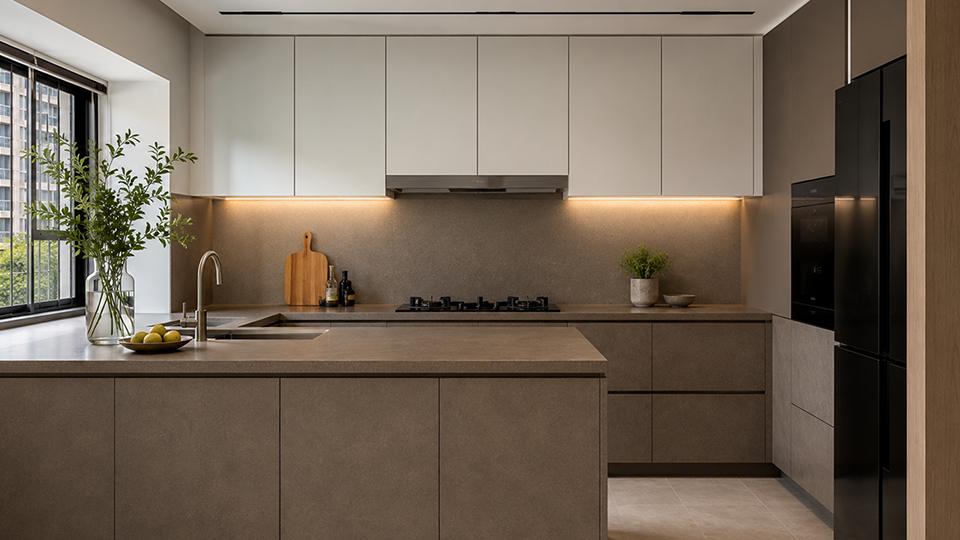
Matching the countertop too closely to one cabinet colour
- A countertop that blends into the lower cabinets removes the visual separation between the base cabinets and work surface.
- The countertop disappears within the composition.
- Upper cabinets can appear visually disconnected or unsupported.
- The countertop should relate to the lower cabinets without fully matching them.
Choosing a countertop with the wrong undertone
- A countertop with a conflicting undertone disrupts the entire kitchen palette.
- This commonly happens when stone is selected in isolation under showroom lighting.
- A cool blue-grey quartz paired with warm-toned cabinetry will feel visually incorrect, even if the reason is not immediately obvious.
- Undertone conflict is something the eye detects very quickly.
Using veining that is too dramatic for the kitchen size
- Bold large-format veining creates a strong visual statement.
- In compact Singapore kitchens, heavy movement competes with cabinet contrast instead of supporting it.
- Smaller kitchens usually work better with subtle veining or quiet concrete-style finishes rather than highly dramatic slabs.
As Mereway Head of Marketing explained to Ideal Home:
“The colour wheel is your friend when choosing two-tone combinations. Complementary colours create bold contrast, while analogous colours offer a harmonious flow. Both approaches can work, but the countertop must be chosen to support one or the other, not contradict it.”
How Countertop Finish Affects the Two-Tone Balance?
Countertop finish, polished, honed, or leathered, affects how the surface reads in a two-tone kitchen just as much as colour does.
-
Polished finish
- Reflects light and makes the countertop more visually prominent.
- Adds another layer of visual activity in kitchens with strong cabinet contrast.
- Works best when the overall palette is calm enough to balance the reflectivity.
-
Honed or matte finish
- Absorbs light and allows the countertop to recede slightly within the composition.
- Lets the cabinet contrast remain the primary design focus.
- Often works better in two-tone kitchens because the surface does not visually compete with the cabinetry.
-
Leathered and sintered stone finishes
- Most sintered stone surfaces are matte or leathered.
- These finishes integrate well into two-tone kitchens because they require less management of light reflection and glare.
For kitchen design in Singapore where the kitchen is visible from the living area, a honed finish also reduces the glare produced by polished countertops under direct LED downlights, offering both practical and visual advantages.
Is a Two-Tone Kitchen Right for Your Singapore Home?
A two-tone kitchen works particularly well in Singapore condo and HDB layouts where the kitchen is open to the living area and visible from multiple angles.
- The contrast between two cabinet tones adds visual interest that a single-colour kitchen cannot provide.
- In compact kitchens with limited design elements, that contrast becomes more important.
The design process is also important.
- The two cabinet colours should be selected first.
- Their undertone relationship should be considered before choosing the countertop.
- The countertop should act as the connecting surface between both tones.
- Choosing the countertop first often leads to a less cohesive result because the cabinets end up matching the stone instead of being visually bridged by it.
If you are planning a two-tone kitchen, viewing full-format slab samples inside your actual kitchen is one of the most important steps.
- Place the slab against your chosen cabinet colours.
- View it under your installed lighting conditions.
This is often the difference between a kitchen that feels cohesive and one that feels almost right.
FAQS

- Which colour is better for a countertop in a two-tone kitchen?
It is impossible to say which one is better since each combination of cabinet colours should have its specific countertop colour. The basic rule here is to find out the undertone in both colours of the cabinets and pick the countertop that will have this undertone. If you have a warm two-tone kitchen like cream coloured upper and warm sage lower cabinets, then it is recommended to use a countertop with warm veins instead of cold gray stones.
- Should the countertop match the colour of upper or lower cabinets?
This is not mandatory. The countertop is meant to tie together the top and bottom cabinets through colour, and when the countertop is in the colour of either of the cabinets, it ceases to fulfill its purpose as a connector. Most times, the veined quartz that incorporates both the lighter and darker colours of your cabinets is the best option.
- Is it possible to have a quartz table top in a high-contrast kitchen design?
It certainly is; in fact, quartz works well here thanks to its uniform colouration. For example, if one wishes to create contrast through black lower cabinets and white upper ones, a white quartz with fine dark grey veining would be suitable as the former would relate to the dark cabinets and the latter to the white upper cabinets.
- Do different countertop colours influence the size of a Singapore kitchen?
This is for sure because countertops that are light-coloured reflect light and make the small kitchen look larger in comparison to those that are dark and make the small kitchen look smaller. When it comes to small kitchens, it would be better to have countertops of medium tones or light stones and fine veins.
- How do I prevent myself from selecting the wrong colour for my two-colour kitchen countertops?
Ask for a full slab sample and not just a single tile; then, place it into your kitchen along with your selected door sample for the cabinets. Look at it at various times of the day, and also take note how it looks when you install your lighting. Some countertop colours look perfect in a showroom because of the white fluorescent light there, but when you install LED lights, they change dramatically.
Conclusion
Countertop selection for two-tone kitchens differs from that for single-colour kitchens. The countertop must still meet the functional criteria; however, it is tasked with the added challenge of blending both colours of cabinets.
A good combination of colours means the countertop integrates the whole kitchen. If there is no compatibility between colours, even a good design won’t be able to unify the kitchen visually.
TSD assists Singaporeans with evaluating the countertop colour, undertone, slab movement, and finishes in relation to the selected cabinets and lighting conditions. Our proprietary system includes templating, fabrication, edge profiling, and installation of countertops made out of quartz, granite, marble, terrazzo, and sintered stone.
The products we carry are quartz slabs, granite slabs, terrazzo finishes, and sintered stones that are ideal for small kitchens in condos as well as spacious kitchens with an open concept design. We operate cutting and profiling facilities that enable our staff to work on countertops and other surface requirements such as edge profiles and vanity tops.
We also offer complete slab viewing and consultation by appointment for homeowners who are looking to have a two-toned kitchen. For those who wish to view samples and determine which types of stones will complement the colour of their cabinets, please visit us at 16 Joo Koon Circle Singapore 629047, dial +65 6908 5147, or send us an email at tsd.enquiry@gmail.com to make an appointment.