Key Takeaways
- Kitchen countertop lighting, specifically LED colour temperature, changes how a stone surface looks in ways that sample tiles in a showroom cannot predict.
- Warm LEDs at 2700K to 3000K shift every surface toward yellow and amber. A cool-grey quartz specified under warm showroom lighting can look beige once installed under 2700K home LEDs.
- Cool white LEDs at 4000K to 4500K are the standard recommendation for kitchen task lighting. They render stone tones more accurately and prevent the yellow-cast problem that warm LEDs introduce on light-toned surfaces.
- Polished stone finishes amplify light source effects. A polished surface under direct LED downlights produces a strong reflection that competes with the stone’s pattern. Honed and matte finishes distribute light more evenly and read more consistently across changing light conditions.
- Viewing a full slab sample in your kitchen under your installed LEDs before finalising a countertop choice is the most reliable way to confirm the surface will look as intended after installation.
Introduction
A homeowner orders a countertop sample, views it in the showroom, and makes a decision. The slab is installed. The kitchen lights go on. The surface looks different. Not dramatically wrong, but not quite what was expected. The tone is slightly warmer. The veining is less defined. The grey reads as something closer to beige.
This is one of the most common post-installation surprises in kitchen renovations, and the cause is almost always kitchen countertop lighting. The showroom where the slab was viewed used a different LED colour temperature from the home kitchen. The stone surface responded to that difference in a way the homeowner didn’t anticipate.
Understanding how LEDs interact with specific stone finishes and tones converts this from a mystery into something predictable and manageable. The relationship between light and stone surface is not complicated once the relevant variables are named.
What Is Kitchen Countertop Lighting?
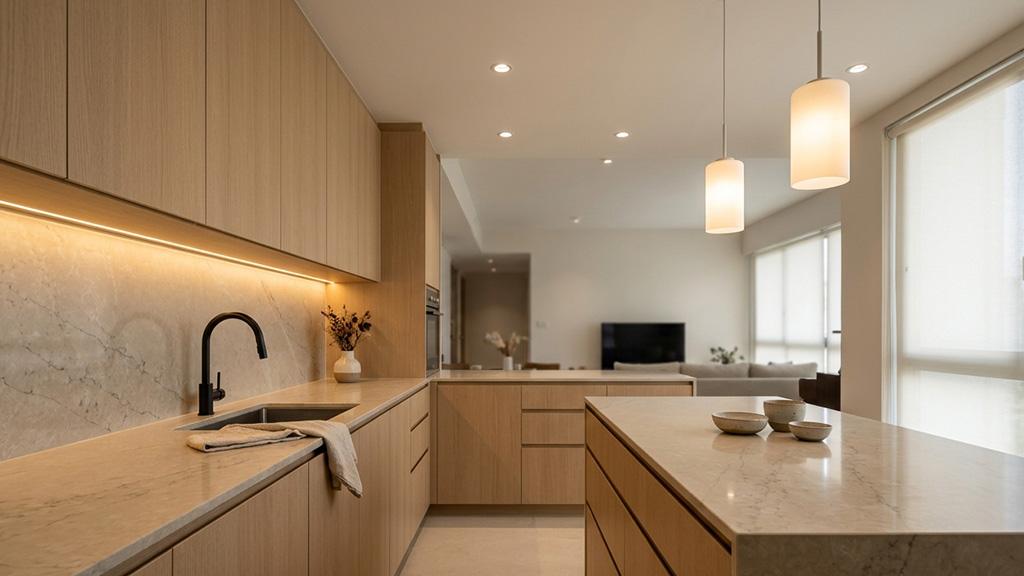
Kitchen countertop lighting refers to the light sources that illuminate the countertop surface, including ceiling downlights, under-cabinet LED strips, pendant lights over an island, and any combination of these. In Singapore residential kitchens, the dominant light source for countertop surfaces is recessed LED downlights positioned in the ceiling above the work zone, supplemented by under-cabinet LED strips in better-specified renovations. The colour temperature of these LEDs, measured in Kelvin, determines how the stone surface reads in practice. Different colour temperatures shift the apparent tone, depth, and veining character of every stone surface in ways that a showroom sample viewed under different conditions cannot reveal.
How LED Colour Temperature Affects Stone Surfaces
LED colour temperature is measured in Kelvin. Lower numbers produce warmer, more amber light. Higher numbers produce cooler, more blue-white light. As Houzz Singapore’s guide to LED colour temperature explains, warm light is generally anything at 3000K or below, while cool light is 4000K or above, with 3500K sitting in a middle ground that can read as either warm or cool depending on the surfaces and furnishings it encounters.
The way this Kelvin range affects stone surfaces is specific and predictable.
Warm LEDs (2700K to 3000K) add a yellow and amber cast to everything they illuminate. On a warm cream or ivory countertop, this effect is usually flattering: the warmth of the light matches the warmth of the surface, and the surface reads as intended. On a cool grey quartz, 2700K LEDs shift the grey toward a warmer beige or taupe. On a pure white countertop with a polished finish, warm LEDs can make the surface appear yellow, which is visually at odds with the crisp, clean kitchen aesthetic many Singapore homeowners are trying to achieve.
As Ideal Home’s guide to light bulb warmth notes, if you install a modern white high-gloss kitchen and use low Kelvin lighting, this makes the kitchen appear yellow and uninviting. The same principle applies to light stone countertops under warm LEDs: the surface reads as more yellow than it is, which is often not the effect intended when the stone was selected in a neutral showroom.
Cool white LEDs (4000K to 4500K) are the standard kitchen specification. At this temperature, LEDs produce a clean, bright white light that renders stone surface tones more accurately. They are recommended for kitchens specifically because they support task visibility and prevent the yellow-cast problem of lower Kelvin sources. A cool white LED makes a grey quartz read as grey, a cream surface read as cream, and a white sintered stone read as white.
Neutral LEDs (3500K) sit between the two and can read as warm or cool depending on the surrounding surfaces. In Singapore condo kitchens where the kitchen is open to the living area, 3500K can work well if the combined space benefits from a mid-temperature that feels warm enough for social use but clear enough for cooking conditions. The risk is that 3500K produces an inconsistent result across different stone surface tones, making it harder to predict how a specific slab will read without testing under the actual installed bulbs.
“Warmer tones enhance warm colours like reds and yellows, while cooler tones make blues and greens more pronounced. The light bulb warmth must complement the colours and overall colour scheme of the kitchen.” (Ideal Home, How to Choose the Right Light Bulb Warmth)
How Different Countertop Finishes Respond to LED Lighting
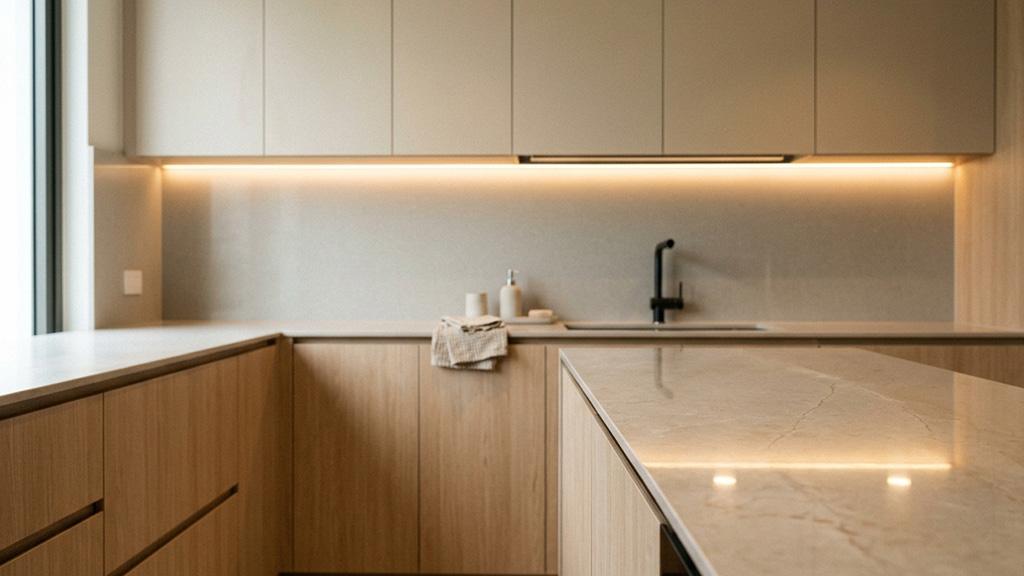
Kitchen countertop lighting does not affect all finishes equally. The finish type determines how the light source interacts with the surface and how the effect reads in the kitchen.
Polished Finishes
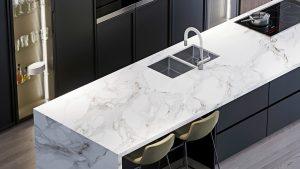
Polished stone surfaces have a high-gloss, mirror-like face that reflects light directly. Under LED downlights, a polished countertop acts as a secondary reflector, bouncing the light source back toward the viewer and toward the ceiling. This has a positive effect on kitchen brightness: a polished white or cream stone countertop under good LED downlights makes a Singapore condo kitchen significantly brighter and more open-feeling.
The trade-off is that polished finishes under direct LED downlights also produce intense highlight spots, the bright reflections of the light source on the surface, that can interfere with how the stone’s pattern and veining read. A polished Calacatta quartz that displays beautiful grey veining in diffuse natural light can look flatter under direct LED downlights because the highlight spots dominate the pattern. Veining that should create visual interest becomes secondary to the light reflection.
Polished finishes are also the most sensitive to LED colour temperature. The high-reflectivity surface transmits whatever colour the LED produces with high fidelity, which means a yellow cast from warm LEDs is most visible on polished stone.
Honed Finishes
Honed stone has a smooth, satin surface that diffuses light rather than reflecting it directly. Under LED downlights, a honed countertop distributes the light across the full surface area rather than producing localised highlight spots. The pattern and veining of the stone remain consistently readable from any viewing angle, and the surface reads the same way whether the kitchen is lit by task LEDs, ambient light, or natural daylight.
Honed finishes are also more forgiving of LED colour temperature variation. The diffuse surface dampens the colour-shift effect of warm LEDs compared to a polished surface. A honed grey quartz under 2700K LEDs will still show some warming effect, but the shift is less dramatic than the same stone in a polished finish.
For most Singapore kitchen designs, honed or matte countertop finishes produce a more consistent and predictable result across the range of LED conditions that a home kitchen encounters across different times of day, different levels of ambient light, and different ceiling LED positions. It’s why kitchen design in Singapore renovations increasingly favours honed finishes for exactly this reason.
Matte Finishes
Matte sintered stone and matte engineered surfaces absorb the most light of the three finish types. They produce no reflective highlights and distribute ambient and task light evenly across the surface. Under Singapore kitchen LEDs, matte surfaces read consistently and predictably: the tone and pattern visible in the showroom under neutral light will look very similar under 4000K kitchen LEDs installed at home.
The practical consideration for matte finishes under kitchen countertop lighting is fingerprint and residue visibility. Matte stone absorbs light rather than reflecting it, which means surface marks, including cooking oil splashes and moisture rings, are more visible on matte than on polished finishes because there is no sheen to obscure them. In Singapore’s high-use cooking environment, this is worth knowing before specifying a matte finish for the primary cooking zone.
How Light Position Changes What Stone Surfaces Look Like
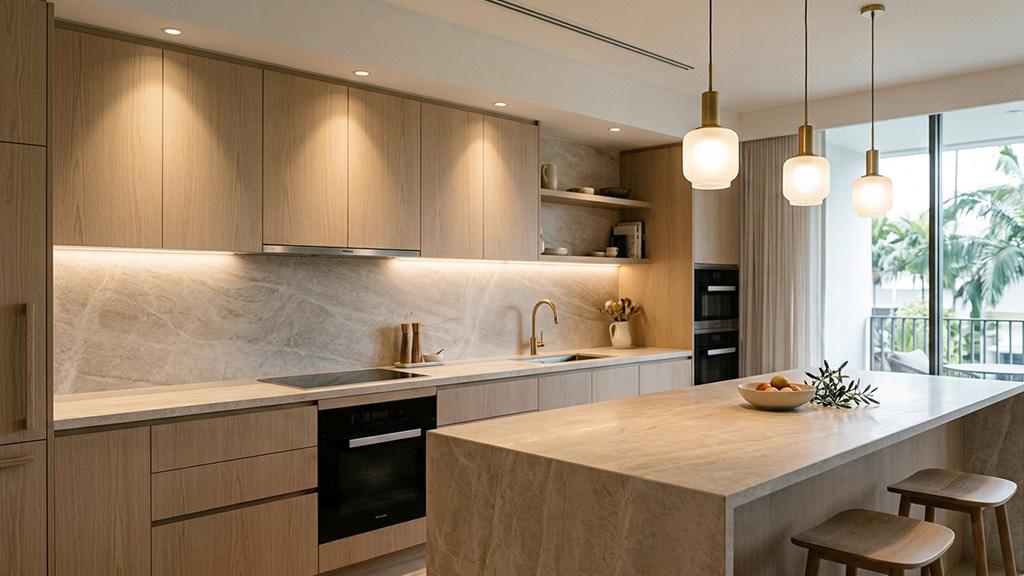
The angle and position of the LED source relative to the countertop affect the stone’s appearance as much as the colour temperature does.
Downlights positioned directly above the countertop cast light vertically onto the surface. This position emphasises the surface’s finish reflectivity, produces strong highlight spots on polished stone, and reads the tone of the stone accurately, but can flatten the depth of veined patterns.
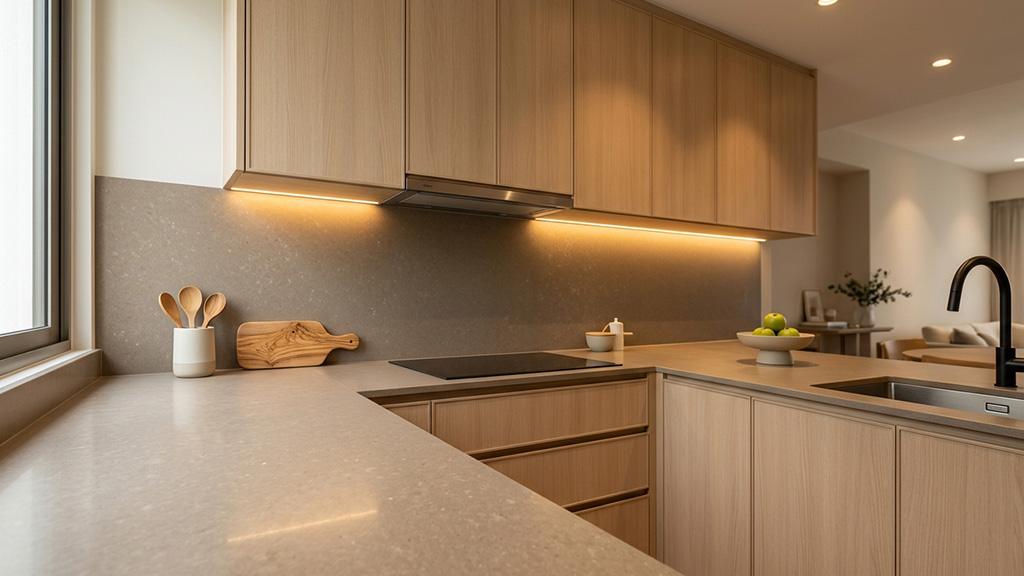
Under-cabinet LED strips cast light horizontally across the countertop from a low angle, grazing the surface at close range. This position is the most effective for revealing the texture and depth of honed and matte stone surfaces because the grazing light angle picks up subtle surface variation that downlights compress. Under-cabinet strips at 4000K beside a honed quartz or sintered stone surface make the material read with much more character and depth than the same surface under ceiling downlights alone.
Pendant lights over a kitchen island provide ambient light from a lower height and wider angle than ceiling downlights. Pendants at 2700K over an island with a light stone countertop will add warmth to the island surface that the rest of the kitchen, under 4000K ceiling LEDs, will not share. This mixed-temperature approach is common in open-plan Singapore kitchens where the island functions as a social and dining zone and the warm pendant light creates a different mood from the task-lit perimeter. The consequence for stone surfaces is that the island countertop will appear slightly warmer and softer under the pendants than the perimeter countertop appears under the ceiling downlights, even if both surfaces are the same material.
“Place lights in front of work areas, not behind you. For example, if lighting is behind you while you work on the counter, your body will cast shadows, making it harder to see.” (Ideal Home, 10 Kitchen Lighting Rules)
Which Stone Surfaces Handle LED Variation Best
For Singapore condo kitchens where the LED setup cannot be tested before the countertop is selected, some stone surfaces are more robust across varying LED conditions than others.
Warm neutral tones in honed or matte finishes are the most LED-forgiving specifications. A taupe, sandy beige, or warm grey sintered stone in a honed finish reads consistently under both warm (2700K) and cool (4000K) LEDs because the warm undertone of the stone absorbs some of the LED colour shift without registering a dramatic change. This tone and finish combination is one reason why countertop colour interacts with kitchen lighting conditions; homeowners choose it for its warm neutral options, which hold their appearance across the widest range of kitchen lighting conditions.
Cool grey quartz in a polished finish is the most LED-sensitive specification. The cool surface tone records the yellow shift of warm LEDs immediately, and the polished finish amplifies that shift by producing high-fidelity reflections of the LED colour. This combination requires 4000K or cooler LEDs to read as intended, which is perfectly manageable but must be planned for rather than assumed.
White or light cream stone sits between the two. In polished finish, white and cream surfaces are sensitive to warm LED colour shift. In honed finish, the same tones are more forgiving. The practical recommendation for Singapore kitchens specifying white or cream stone is to install 4000K task LEDs above the countertop zone regardless of the ambient LED temperature elsewhere in the open-plan space.
Dark-toned stone is relatively LED-insensitive compared to light surfaces, because the depth of the tone absorbs LED colour variation without registering a significant apparent shift. A charcoal or dark grey countertop reads as essentially the same surface under 2700K and 4000K because the base tone is deep enough to absorb the colour cast without reflecting it to the viewer.
Practical Steps Before Finalising a Countertop Selection
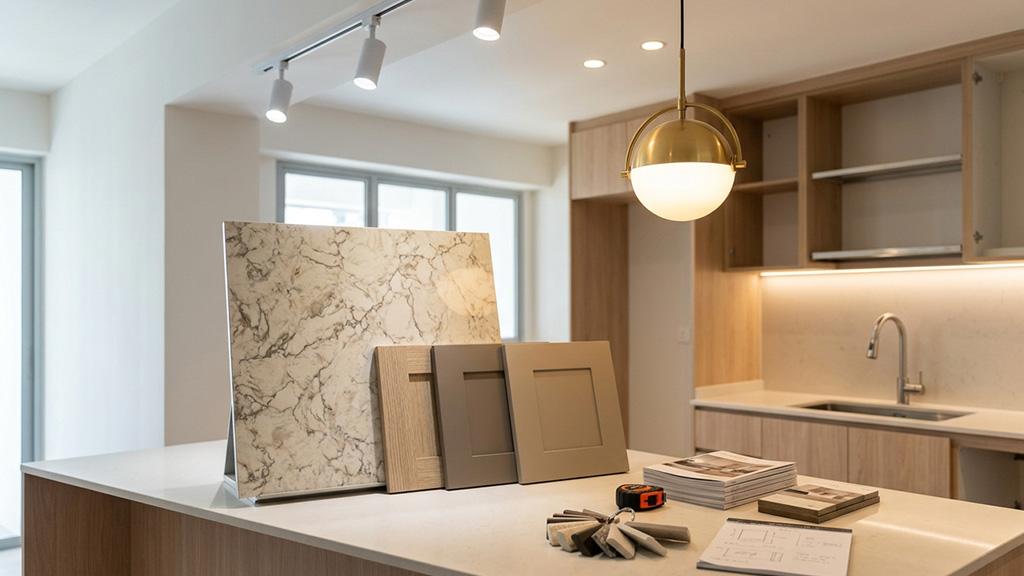
Borrow or purchase LED bulbs in 4000K and 2700K before viewing full slab samples. Hold the slab against your cabinet sample and illuminate it with each bulb in turn. The difference in how the surface reads under each temperature is the range of appearances the surface will cycle through in daily kitchen life, as you move between task lighting, ambient lighting, and evening mood lighting.
If your kitchen lighting plan includes both ceiling downlights at 4000K and warmer pendant lights at 2700K or 3000K over the island, view the slab sample under each temperature separately and confirm the surface reads acceptably under both. A surface that looks slightly different under the island pendants compared to the perimeter lighting is not necessarily a problem, but it should be a known outcome rather than a surprise.
Confirm with your LED installer what colour temperature will be used in each position before the countertop is ordered. In Singapore kitchen renovations where the electrician and the stone supplier are working on different timelines, a mismatch between planned and installed LED temperature is a common source of post-installation disappointment.
FAQS
1. What LED colour temperature is best for kitchen countertops in Singapore?
4000K to 4500K cool white LEDs are the standard recommendation for kitchen task lighting and the best specification for kitchen countertop illumination in Singapore. This temperature renders stone surface tones accurately without the yellow-cast effect of warmer LEDs, and it provides the task visibility needed for food preparation. If the kitchen is open-plan with warmer ambient LEDs in the living zone, keeping the countertop zone at 4000K ensures the stone reads correctly in the task area.
2. Why does my countertop look different from the showroom sample?
Showrooms use a range of LED colour temperatures, and many showrooms use warm ambient lighting at 2700K to 3000K to create an inviting environment. This warm light shifts the apparent tone of every stone surface away from how it reads under neutral or cool white task lighting. A grey quartz under 2700K showroom lighting appears warmer and more taupe-toned than the same slab under the 4000K kitchen LEDs most Singapore homes install. Viewing a full slab sample in your own kitchen under your installed LEDs before ordering is the most reliable prevention for this mismatch.
3. Do polished or honed stone surfaces perform better under kitchen LEDs?
Honed surfaces perform more consistently across a range of LED colour temperatures because they diffuse rather than reflect light, which reduces the fidelity of colour-temperature shift transmission. Polished surfaces amplify LED colour temperature effects by reflecting the light source with high fidelity. For Singapore kitchens where LED colour temperature varies across the space, honed finishes produce a more predictable and consistent result.
4. Can under-cabinet LED strips change how my stone countertop looks?
Yes, significantly. Under-cabinet LED strips at 4000K graze the countertop at a low angle, which reveals texture and depth in honed and matte stone that ceiling downlights compress. This is an enhancement rather than a problem for most stone surfaces. It is worth knowing so that the surface can be evaluated with under-cabinet lighting in mind if the kitchen design includes this specification.
5. Does LED colour temperature affect dark countertops as much as light ones?
No. Dark-toned stone surfaces absorb more light and reflect less of it, which makes them less sensitive to LED colour temperature variation. A dark charcoal or deep grey countertop reads similarly under 2700K and 4000K LEDs because the base tone’s depth absorbs the colour cast. Light-toned surfaces, particularly cool grey and white in polished finish, are most sensitive to LED colour temperature variation and most likely to look different from showroom samples installed under warmer home lighting.
Conclusion
The mismatch between a showroom countertop sample and the installed result in a Singapore kitchen is almost always a kitchen countertop lighting problem rather than a material problem. Understanding how LED colour temperature interacts with specific stone finishes and surface tones makes the selection process more reliable and the outcome more predictable. Viewing slabs under the actual LED conditions of the installation space, at the temperature specified for the kitchen, is the one step that closes the gap between expectation and outcome.
TSD supplies and fabricates stone and sintered stone countertops across the full range of finishes relevant to Singapore kitchen conditions. If you want to view full slab samples under LED conditions representative of your kitchen specification, visit the showroom at 16 Joo Koon Circle, call +65 6908 5147, or email tsd.enquiry@gmail.com.