Key Takeaways
- Good clearance around the island means lounge chairs can be shifted around and pathways kept clear, enhancing day-to-day usability in compact Singapore flats and reducing the feeling of a cramped family meal.
- The right width creates enough space for cooking and serving without dominating the kitchen. Good sizing means the island can work well as a prep area and social space.
- Use a metal bracket underneath every countertop overhang. High-quality support brackets allow weight to be distributed evenly and prevent sagging and future support problems. This is especially important if the island will be used for dining, entertaining or to hold heavy cookware.
- Use eased edge profiles for safety and less maintenance. Eased edge profiles are safer and easier to clean than detailed profiles, and match the clean-lined look of most Singapore condos.
- Use separate zones for prep work, serving and cleanup. Creating separate zones on the island for different cooking activities keeps things neat and tidy during busy meal prep and eases the cleaning of a humid Singapore kitchen.
Introduction
Planning a kitchen island in Singapore honestly needs more focus on small surface details than most people think. These decisions affect everything from food preparation and storage to seating comfort and daily movement through the kitchen.
Kitchen islands still stay one of the most asked-for renovation features worldwide, especially in open-concept layouts where the island basically becomes a prep station, a casual dining spot, and a social center. That said, renovation specialists keep coming back to the same issues: sizing that’s slightly off, not enough walkway clearance, and seating arrangements that just dont “fit” the way people actually live. Those are usually the regrets after installation, not during planning.
Designers often suggest planning with extra care around slab dimensions, circulation space, support structures, and edge profiles, otherwise overcrowding shows up, and maintenance becomes a headache sooner than you want.
This blog looks at key kitchen island considerations that are easy to miss: seating clearance, slab sizing, structural support, edge profiles, and easy-clean surface zoning. When you treat the surface plan as a whole system, Singapore homeowners can build islands that make day-to-day workflow smoother and keep the setup usable for the long run.
Seating Clearance: Room to Pull Up a Chair
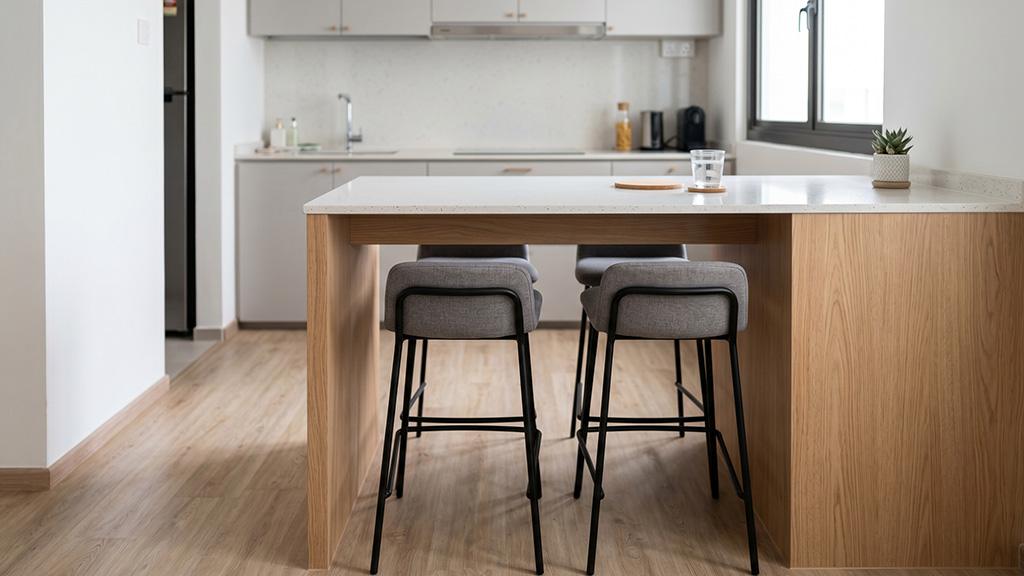
Seats around an island demand precise clearance. Homeowners often measure countertop height alone, missing legroom needs.
Aim for 24-30 inches (61-76 cm) between the island edge and any obstacle. This allows chairs to slide in without bumping cabinets or walls. In Singapore HDB kitchens, tight footprints make this vital test with actual chairs during kitchen island planning.
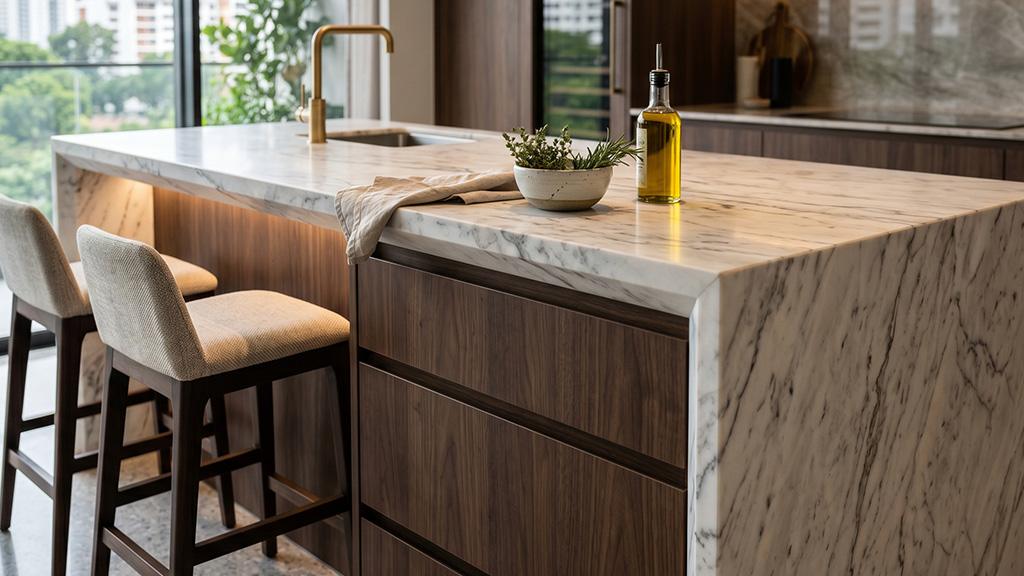
Consider stool depth too. Bar stools need 12-15 inches (30-38 cm) of countertop overhang for knees. Without it, diners hunch uncomfortably.
- Standard counter height: 36 inches (91 cm).
- Knee space under overhang: At least 12 inches deep.
- Pull out distance: 24 inches minimum for seated adults.
If you skip this, your island will feel cramped after install. You should mock it up with tape on the floor.
Matching Prep to Lifestyle with Slab Size
Slab dimensions set the island’s work zone. Many people pick based on looks, not function. For a kitchen island table setup, aim for 36-48 inches (91-122 cm) wide. This supports chopping veggies or rolling dough without edges crowding elbows. Narrower slabs suit solo cooks; wider ones handle group meals.
Length depends on room size. In typical Singapore condos, 6-8 feet (183-244 cm) works without dominating the flow.
- Single user prep: 30 inches wide minimum.
- Multi-task: 42 inches or more.
- Family dining: Add 24 inches per seat.
Overlook slab size in kitchen island planning, and mornings turn chaotic. A too small top forces spill off the edge.
Measure your habits first. Track weekly cooking to gauge space for platters and appliances. With size dialed in, support keeps it stable.
Hidden Strength for Heavy Use
Islands bear weight from pots, blenders, and leaning bodies. Surface support prevents sagging over time, thus, use sturdy legs or cabinets underneath. Steel framed bases hold 300-500 kg easily. In kitchen renovation Singapore humidity, wood alone warps pair it with metal bracing.
For overhangs, add corbels or brackets every 24 inches. These lift countertop overhang sections without visible posts.
- Leg spacing: 36 inches apart max.
- Bracket depth: Match overhang (12-15 inches).
- Load test: Simulate with weights pre install.
Weak support shows in cracks after a year. Plan for marble’s heft (20-25 kg per sq ft) or quartz’s density. Strong foundations lead naturally to edge choices.
Grip, Style, and Spill Control
Edges frame the surface and influence usability. Flat tops look sleek but slippery for wet hands. Popular profiles include eased (light bevel), bullnose (rounded), or ogee (curved). Eased edges suit busy Singapore kitchens safe for kids, easy to wipe.
- Eased: 1/4 inch bevel; modern, grippy.
- Bullnose: Full round; softens corners.
- Laminate: Square with metal trim for budget fits.
Thicker edges (1.5bb 2 inches) hide seams better. In kitchen island planning, match with the slab thickness for seamless flow.
Edges also guide spills with a slight bevel channels that water away from cabinets. Profile picked? Cleaning zones come next.
Cleaning Zones: Divide for Efficiency
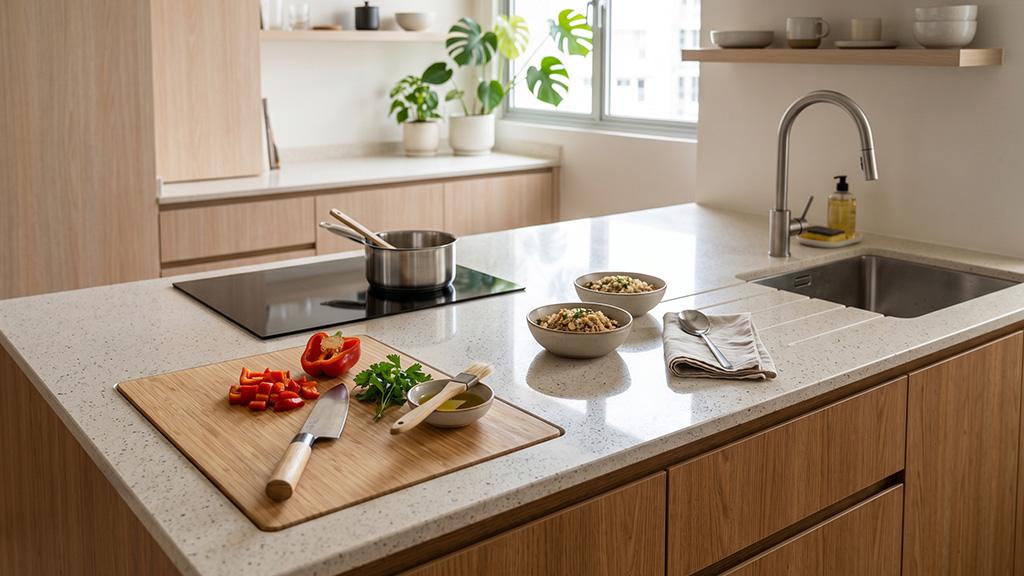
Smart surfaces split into zones: prep, cooking, serving, and cleanup. This cuts mess spread.
Dedicate one end for dirty dishes near the sink, use heat resistant mats here, and opposite side stays for plating.
- Prep zone: 24×36 inches; wood or bamboo inset.
- Cleanup: Sloped edge or built in drain groove.
- Appliance bay: Indent for mixer, avoiding clutter.
In tropical Singapore, humidity breeds stains. Quartz or granite offer top resistance; granite needs yearly sealing. Zones simplify routines and prevent full-surface cleanup. Mastering these details elevates your island from fixture to focal point.
Conclusion
The process of creating a kitchen island requires extensive planning work. The seating clearance and island slab dimensions together with the support system, edge design and functional areas of the island determine its ability to provide comfortable use and long-lasting durability and operational efficiency.
A properly designed kitchen island helps Singapore kitchens function better while providing users with daily convenience because of their small size and need for multiple functions.
Bring your kitchen island planning ideas to life with TSD’s custom stone surfaces, precision fabrication, and detailed countertop workmanship made for modern Singapore homes. From countertop overhang support and island sizing, to edge profiling and installation, TSD manages every stage “end to end” under one roof for a smoother renovation experience that feels more settled in the mind.
Take a look at premium quartz, granite, sintered stone, and terrazzo collections, with options like River Blanc, Mystic Black, and Calacatta-inspired finishes that fit both HDB and condo kitchens.
You can visit TSD’s showroom at 16 Joo Koon Circle, or speak with the team at +65 6908 5147 to begin planning a kitchen island that suits how you cook, the layout you prefer, and your everyday rhythm.
FAQs

1. What should I consider first in kitchen island planning for a small HDB kitchen?
You need to measure your space correctly because it will determine how much space you need for people to walk freely around the kitchen island. Your kitchen needs a minimum walkway width of 42 inches which requires you to design enough countertop overhang space.
2. What is the required countertop overhang length which needs to be installed for island seating?
The minimum countertop overhang distance of 12 to 15 inches provides sufficient space for legroom. The combination of an island and adjustable stools in Singapore condominiums creates a dining area that offers flexible dining options which enhance usability for all residents.
3. Can a kitchen island support both a sink and cooktop in Singapore renovations?
The design needs to implement HDB renovation requirements together with condo design restrictions. The placement of plumbing fixtures and utility lines should remain close to existing wall boundaries to minimize the need for structural modifications and construction duration.
4. Which slab material performs best in Singapore’s humid weather?
Quartz has become a popular choice because it resists both moisture and stains and humidity effects. The material does not require maintenance because its properties remain intact.