Key Takeaways
- A thick countertop edge is a design decision with specific conditions of success. It adds deliberate visual weight, and that weight needs to be earned by the room scale, material, and configuration around it
- As Ideal Home notes, thicker edges of around 50mm are having a resurgence, created by adding a strip of stone to the front face of a standard slab rather than using a single solid thick slab throughout.
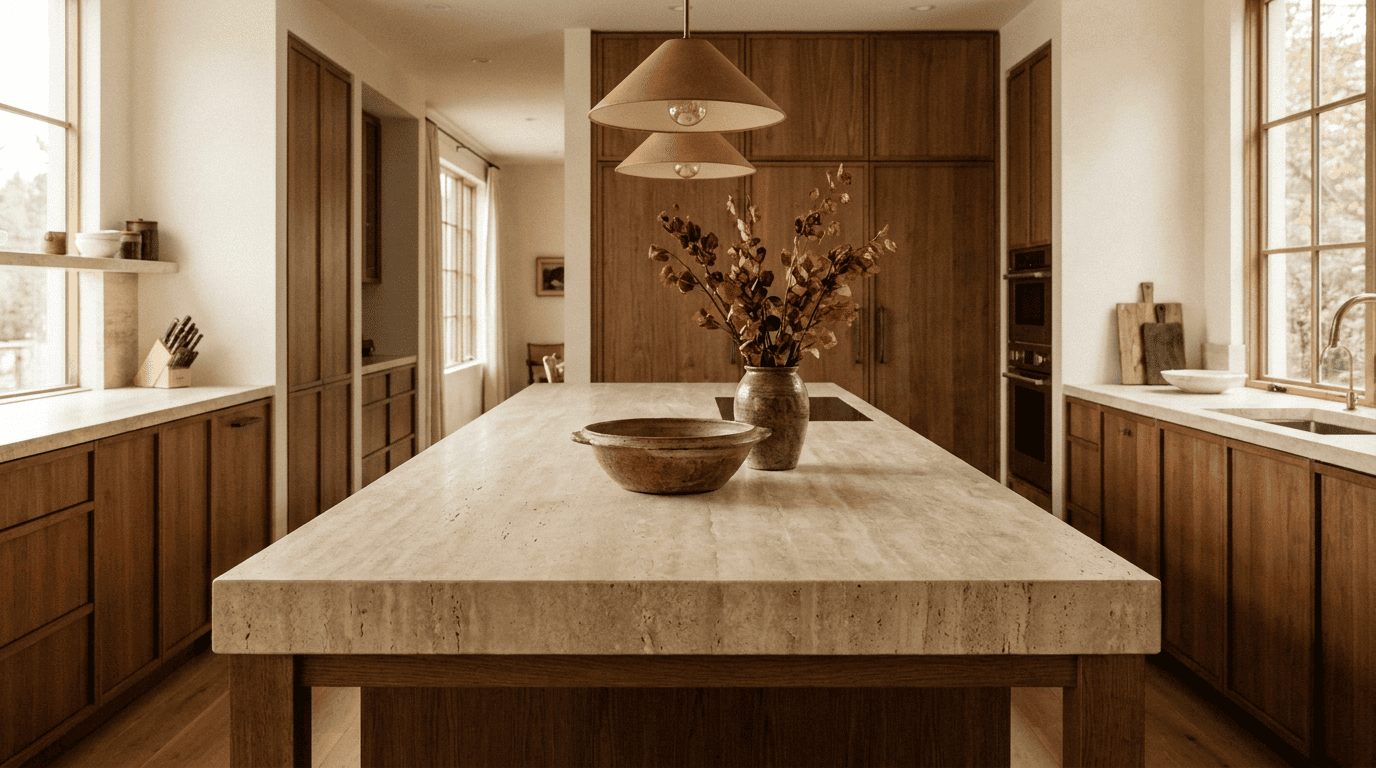
- The conditions where a thick edge works: a large island or long countertop run in a spacious kitchen, a material with enough visual character to carry the depth, and a configuration where the front face is permanently in view.
- In a compact Singapore HDB or condo kitchen, a thick edge typically reads as heavy rather than bold. A 20mm profile or a clean eased edge suits the scale better.
- Precision in stone surface fabrication is what determines whether the laminated joint or waterfall mitre reads as solid or assembled. This is not the stage to cut costs.
Introduction
The slim profile countertop dominated kitchen design for a decade. A 20mm slab with a pencil-round edge remains the right choice for most compact Singapore layouts.
A thick countertop edge has returned as a deliberate choice in kitchens where the countertop is meant to anchor the room. The question is when the conditions actually support it and when a chunky profile simply makes a kitchen feel heavy.
This piece maps those conditions: room scale, material choices, configuration, and the fabrication decisions that determine the outcome.
What Is a Thick Countertop Edge?
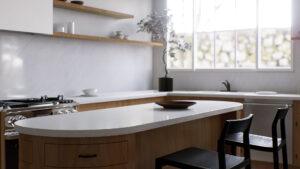
This type of profile describes a countertop where the visible front face is significantly deeper than the standard slab thickness. Standard kitchen countertops in Singapore typically sit at 20mm. A thick edge reads at 40mm, 50mm, or 60mm.
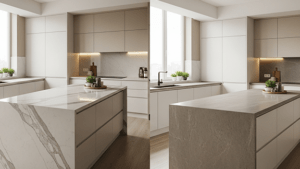
This extra depth is achieved in one of two ways. A laminated edge bonds a strip of the same stone to the underside of the slab’s front face. A waterfall configuration continues the countertop material vertically down the island side in a mitred joint, creating the impression of a solid slab to the floor.
Ideal Home notes that thicker edges of around 50mm are having a resurgence while thinner profiles remain popular for restrained schemes.
Why Edge Thickness Is a Design Decision, Not Just a Detail
Most homeowners choose material, colour, and finish, then decide on edge profile in the final minutes of a fabrication consultation. That sequence often produces results that feel slightly off: a thick edge on a countertop that was never designed to carry it, or a slim profile where more visual weight was needed.
The edge profile determines how much visual mass the countertop brings to the room and whether that mass feels deliberate or incidental.
The right thickness for a countertop depends on the room it sits in as much as the material it’s made from. The edge profile is a spatial decision as much as an aesthetic one.
Our full guide to countertop edge profiles covers how profile choice affects the look, upkeep, and fabrication requirements of different stone surfaces, from pencil-round through to waterfall mitre edges.
When a Thicker Edge Works: Room Scale, Material, and Configuration
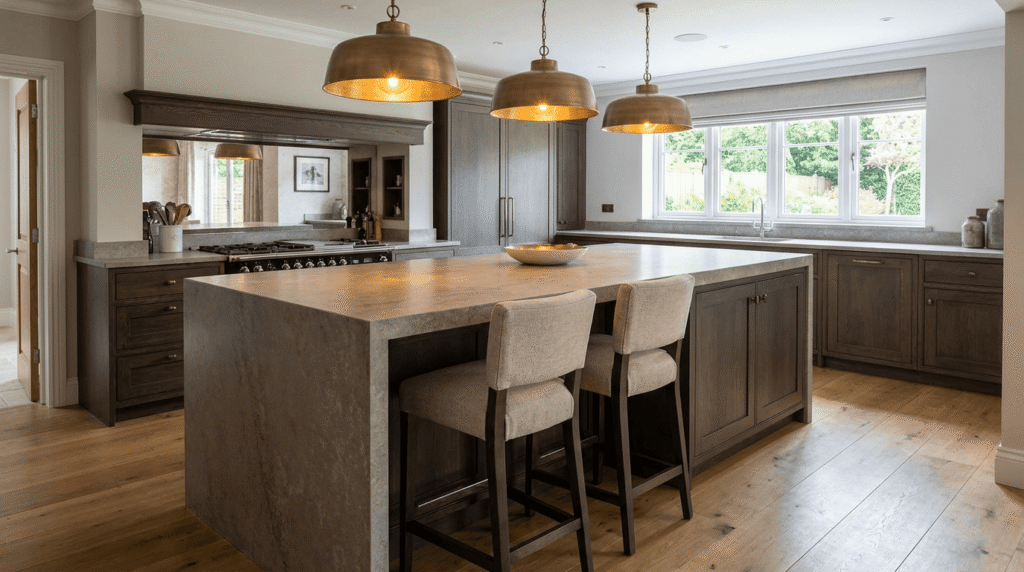
Three conditions need to align for a thick profile to read as intentional rather than heavy.
Room scale
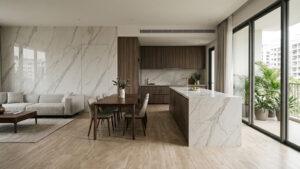
A thick edge adds visual mass at eye level. In a kitchen where the island anchors a large open-plan space, that mass grounds the room. In a compact HDB kitchen or narrow galley, the same thick edge closes in the space. If the island reads as furniture rather than a counter in a work zone, a thick edge fits the scale.
Material
A thick profile amplifies whatever material it carries. Stone with strong veining, warm tonal variation, or concrete-effect character reads well at a deeper front face because the added depth gives more surface area for the material’s character to register. A flat, uniform surface at 50mm depth tends to read as simply heavy.
Configuration
The front face needs to be in view across the room for a thick edge to justify its depth. A kitchen island table in an open-plan space satisfies this. A perimeter countertop tucked against a wall rarely benefits because the edge face is only visible when standing directly at it.
Which Materials Handle a Thick Edge Well
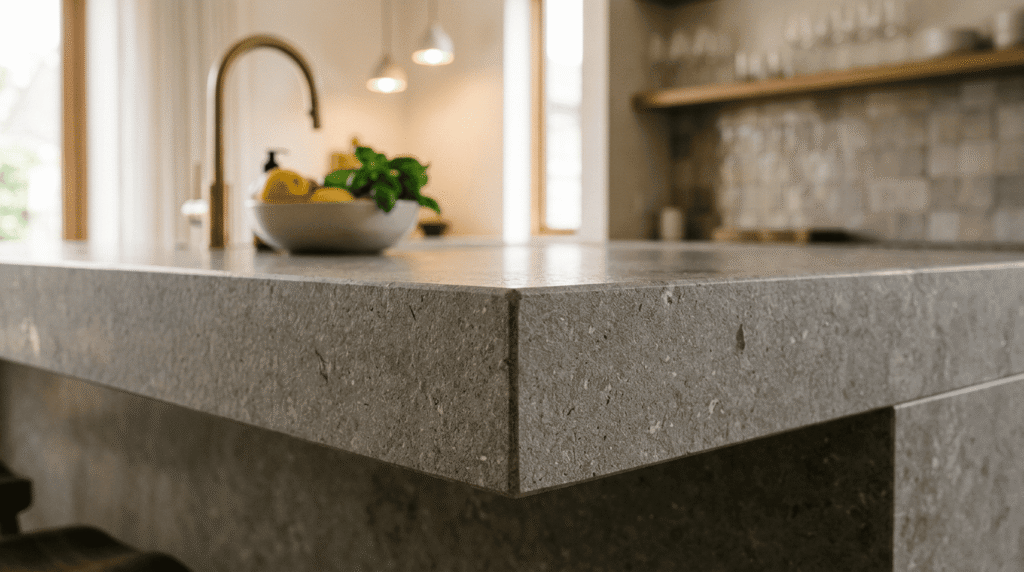
Sintered stone handles thick edge fabrication precisely because of its density and colour consistency. Waterjet and CNC cutting produce clean mitred joins without the micro-chipping that affects more brittle natural stone. Its colour runs consistently through the full slab, which matters when a laminated strip needs to match the countertop face at the join. Our guide to sintered stone kitchen countertops covers how the material performs across different slab thicknesses and edge configurations.
Quartz is a practical alternative with consistent colouring that keeps the laminated strip join from showing. The practical note is heat resistance: quartz should not be exposed to direct high heat at the island edge.
Granite brings natural variation that engineered surfaces approach but don’t fully replicate. The mineral depth reads differently at 50mm than at 20mm, and pattern alignment at the laminated joint requires more slab selection care.
Edge Profile Options Within a Thicker Format
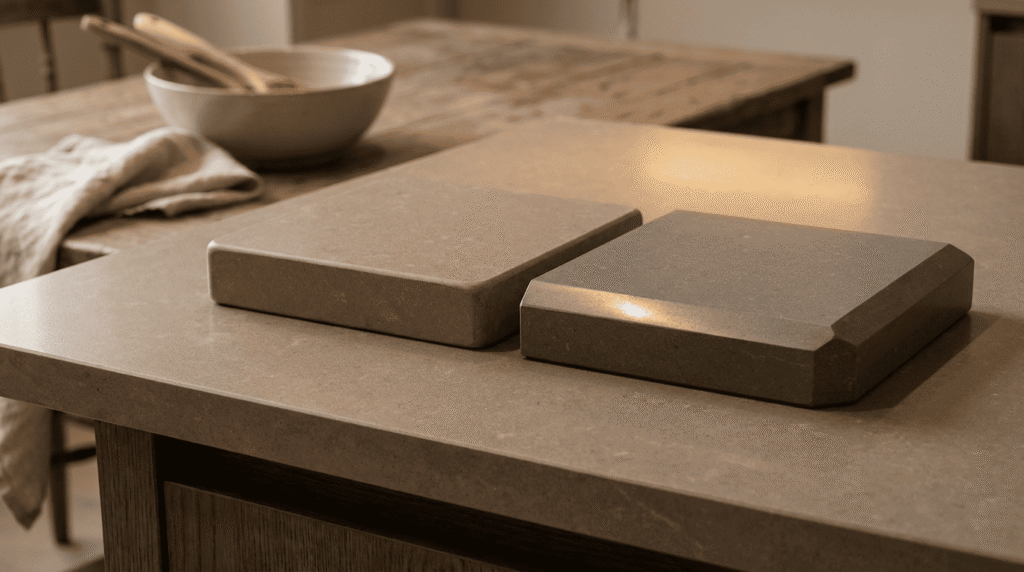
A thick edge is not a single profile. It’s a depth that can carry several different shapes.
Square or eased: A flat front face with a very slight softening at the corners. The cleanest expression of a thick edge. The thickness itself is the feature and suits contemporary and industrial kitchen schemes.
Chamfered: A 45-degree cut at the top corner of the face. The chamfer catches light differently from a flat face, adding interest without introducing a curved or traditional profile. Works well where the thick edge is meant to feel modern rather than decorative.
Waterfall: The countertop material continues over the island end in a mitred joint to the floor. The most dramatic and most fabrication-intensive option. Our guide to countertop joints and seam placement covers the structural requirements of mitred joints in stone surfaces.
Bullnose and ogee profiles are achievable at greater depths but move the kitchen toward a traditional register. In a contemporary Singapore kitchen, square and chamfered options within a thick format produce the most current result.
How to Get the Stone Surface Fabrication Right
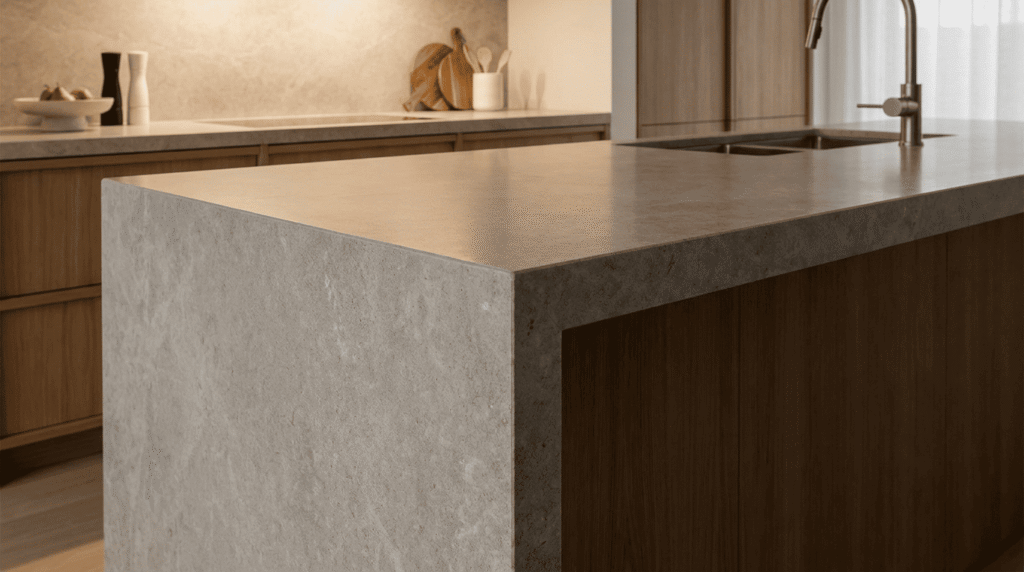
A thick edge is a fabrication challenge as much as a design choice. The most common failure point is the laminated joint, where a poorly aligned or mismatched strip shows as a visible line on the most prominent face of the countertop.
As Real Homes explains, a waterfall countertop requires the material to be wrapped over the edge with an angled mitre joint, and the technique demands both additional material and skilled fabrication to achieve a clean, seamless result. The same applies to a laminated edge: the strip must be cut from the same slab so colour, veining, and finish read continuously at the join.
A waterfall island mitre requires veining or pattern to continue across the vertical face in the correct orientation. This demands in-house waterjet cutting and profiling capability.
The laminated joint sits on the most visible face of the countertop. Getting it right means cutting the strip from the same slab, aligning the pattern, and bonding it so the join disappears at normal viewing distance.
We handle templating, edge profiling, and installation in-house at our Singapore workshop, so join quality is controlled at every stage.
FAQS
1. When does a thick countertop edge actually work in a kitchen?
This profile works when the kitchen has the scale to support it, the material has enough visual character to justify the added depth, and the configuration puts the edge face permanently in view. On a large island in an open-plan space, those conditions typically align. In compact HDB or condo kitchens, a 20mm profile or eased edge almost always reads better.
2. What are the most common countertop edge profiles for a thick format?
Square or eased (a flat face with softened corners), chamfered (a 45-degree cut that catches light), and waterfall (where the countertop continues vertically to the floor in a mitred joint). Square and chamfered profiles suit contemporary kitchens. Waterfall edges are the most dramatic and fabrication-intensive option. All three are achievable at 40 to 60mm depth.
3. Is thick edge fabrication harder than a standard slim profile?
Yes, specifically at the laminated joint and at mitred corners. A laminated thick edge requires the strip to be cut from the same slab for colour and veining to align continuously at the join. A waterfall mitre requires precise pattern-matching. Both demand in-house cutting and profiling capability.
4. Which stone material suits a thick edge on a kitchen island table?
Sintered stone is the most fabrication-reliable choice in Singapore. Its density allows clean mitred cuts, its colour consistency means laminated strips align well, and it handles Singapore’s conditions without maintenance. Quartz is a practical alternative. Granite brings natural depth to a thick edge but requires more care at the pattern-matching stage.
5. How thick should a countertop edge be for it to read as chunky?
The visible shift from standard to noticeably thick begins at 40mm. At 50mm, the effect is clearly intentional. At 60mm and above, the countertop becomes a significant architectural element in the room. Most laminated thick edges sit in the 40 to 50mm range, adding visual weight without the structural depth of a solid slab at that thickness.
Conclusion
The right conditions produce a surface that adds weight and permanence that slim profiles cannot match. Getting there means the right profile, the right material, and a fabricator who can handle the joint or waterfall mitre without a visible seam. We handle the full process in-house at our Singapore showroom and fabrication workshop, from slab selection through to installation.